How Compound Interest Actually Builds Wealth Over Time
Compound interest is growth calculated on both the original amount and on the returns already earned, so the balance grows faster each year. The formula is A = P(1 + r)^t for annual compounding. At a 7% average annual return, $10,000 becomes about $19,700 after 10 years, $38,700 after 20 and $76,100 after 30; the last decade adds more than the first two combined. The rule of 72 estimates doubling time: 72 divided by the rate, about 10 years at 7%. Starting earlier matters: $200 a month at 7% for 40 years grows to about $525,000, versus about $244,000 over 30 years, even though the extra decade adds only $24,000 in contributions. The same math works against you with fees and debt. A 1% annual fee cuts that 30-year $10,000 result from about $76,000 to about $57,000, and an unpaid credit card balance at 24% APR compounded monthly grows about 27% in a year. Stock returns are not guaranteed and vary year to year; 7% is an illustration, not a promise.
Reading time
— 4 min
Updated
— Sep 27, 2026
Fact-reviewed
— Sep 27, 2026
Key Takeaways
Key Takeaways
1Compounding means your returns start earning returns, so each year's gain is bigger than the last.
2Time matters most: at 7% a year, $10,000 grows to about $76,000 in 30 years, and the last decade adds more than the first two combined.
3The same math works against you: a 1% yearly fee or a credit card balance compounds too.
The concept
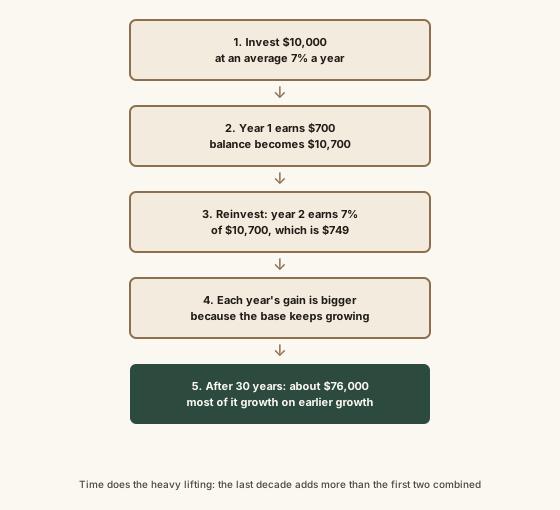
Put $10,000 in an investment that grows 7% a year and leave it alone. Year one earns $700. Year two earns 7% of $10,700, which is $749. Year three earns 7% of $11,449, about $801. The rate never changes, but the amount it applies to keeps growing, so the dollar gain keeps growing too. Early on it barely looks like anything is happening. After a few decades, most of your balance is growth on earlier growth. That's compounding, and the main ingredient is time. It works the same way on money you owe, which is why an unpaid credit card balance can snowball.
The calculator below uses annual compounding. Try changing only the years and watch how much more the last decade adds than the first.
Try it yourself
Project compound growth
Projected balance$76,123
Illustration only. Assumes a steady return with no fees, taxes or withdrawals; real returns vary.
Quick check
Why does year 2 earn more than year 1 at the same 7% rate?
Worked examples
Example 1: One lump sum left alone (baseline case)
$10,000 at 7% a year: after 10 years, 10,000 × 1.07^10 ≈ $19,672. After 20 years, ≈ $38,697. After 30 years, ≈ $76,123. The first decade adds about $9,700, the second about $19,000, and the third about $37,400. Nothing changed except time. With simple interest at the same rate, you'd have $31,000 after 30 years, so compounding more than doubles the result.
Example 2: The 1% fee (edge case)
Same $10,000, same 7% market return, but the fund charges a 1% expense ratio, so you net 6%. After 30 years: 10,000 × 1.06^30 ≈ $57,435, about $18,700 less than the $76,123 you'd have with no fee. A fee that sounds tiny takes roughly a quarter of the ending value, because it's charged on the whole balance every year and the money it removes never gets to compound. That's why the SEC and FINRA encourage investors to compare expense ratios before choosing a fund.
Example 3: Starting at 25 vs 35 (real-world use)
Two people invest $200 a month at an average 7% until 65. Alex starts at 25: 40 years, $96,000 contributed, ending near $525,000. Sam starts at 35: 30 years, $72,000 contributed, ending near $244,000. Alex put in only $24,000 more but ends with about $281,000 more, because the earliest dollars had the longest to compound. For Sam to catch up starting at 35, they'd need to invest about $430 a month instead of $200.
Quick check
Alex contributes $24,000 more than Sam but ends with about $281,000 more. Why?
How it works (visual)
How compound interest builds on itself
Common mistakes
Common Mistakes
✕
Waiting to invest until you can put in a 'real' amount.
→ Small amounts started early often beat larger amounts started later. Start with what you can and increase it over time.
✕
Ignoring fees because 1% sounds small.
→ Compare expense ratios with FINRA's Fund Analyzer. Over decades, fees compound just like returns.
✕
Cashing out and restarting, or withdrawing gains.
→ Compounding needs the returns to stay invested. Reinvest dividends and avoid early withdrawals.
Common misconception
“Compound interest makes you rich quickly.”
Compounding is slow at first and powerful only over long periods. In the first few years, the gains look like simple interest. The dramatic growth shows up in years 20 to 40. That's why it rewards patience and early starts, not quick trades, and why interrupting it with withdrawals is so costly.
What to do next
What to do next
Plug your own numbers into the calculator above, then try the same amount with 10 fewer years.
Look up the expense ratio on every fund you hold and compare it with low-cost alternatives.
Turn on automatic dividend reinvestment if your account offers it.
Pay off high-interest card balances first: compounding at 24% against you beats almost any investment return.
FAQ
FAQ
Related terms
Related terms
Compound interest
Interest or returns earned on both the original amount and on returns already added to it.
Simple interest
Interest calculated only on the original principal, so it grows by the same amount every period.
Rule of 72
A shortcut for doubling time: divide 72 by the annual percentage rate. At 8%, money doubles in about 9 years.
Compounding frequency
How often returns are added to the balance, such as yearly, monthly or daily. More frequent compounding grows slightly faster at the same stated rate.
Expense ratio
The yearly fee a fund charges, as a percentage of your balance. It compounds against you.
This entry was researched from public sources and drafted with AI-assisted tools, then edited — errors are still possible. Spot one, or want a topic covered? Read our disclaimer.
 KnowThis