 KnowThis
Key Takeaways
Key Takeaways
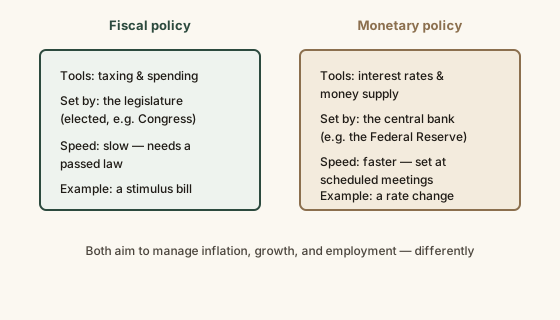
- 1Fiscal policy is government taxing and spending, decided by the legislature — think stimulus bills, tax law changes, infrastructure spending.
- 2Monetary policy is control of interest rates and money supply, decided by the central bank — think interest rate changes and bond-buying programs.
- 3Fiscal policy moves slowly because it requires passing a law; monetary policy can move faster because central banks make decisions at their own scheduled meetings.
The concept
Confusing the two matters practically: a news headline about "the government raising rates" is describing monetary policy incorrectly, since the central bank — not the elected government directly — controls that specific lever in most developed economies.
A news article says 'the government raised interest rates to fight inflation.' In the U.S. system, what's imprecise about this framing?
Worked examples
Example 1: A stimulus check program (baseline case)
Example 2: The two tools used together during a crisis (edge case / variation)
Example 3: A central bank raising rates to fight inflation (real-world / applied case)
During an inflationary period, the central bank raises interest rates while Congress separately debates a new spending bill. Are these two actions part of the same policy decision?
How it works (visual)
Common mistakes
Common Mistakes
Using 'the government' to refer to interest rate decisions specifically.
→ Attribute interest rate changes to the central bank specifically — it's a distinct institution from the elected government branches that control fiscal policy.
Assuming fiscal and monetary policy always move in the same direction at the same time.
→ Recognize they're set by separate institutions on separate timelines — they can align, conflict, or move independently of each other.
Treating monetary policy as something that requires a vote in the legislature.
→ Understand that monetary policy decisions are typically made by the central bank's own committee, not through the legislative process fiscal policy requires.
Common misconception
“Fiscal policy and monetary policy are basically two names for the same kind of government economic action.”
They're controlled by entirely different institutions using entirely different tools on entirely different timelines. Fiscal policy is the elected legislature's taxing and spending decisions; monetary policy is the central bank's control of interest rates and money supply, deliberately structured with independence from the elected government. Conflating the two — like attributing an interest rate change to "the government" — misidentifies who's actually making the decision.
What to do next
What to do next
- When reading economic news, check whether an action is attributed to the legislature/executive (fiscal) or the central bank (monetary) — they're not interchangeable.
- Understand that interest rate changes come from the central bank's own process, not a legislative vote.
- Recognize that fiscal and monetary policy can move independently, in the same direction, or even in tension with each other.
- For deeper analysis of how either policy might affect your personal finances, consult a qualified financial professional rather than relying on headline framing alone.