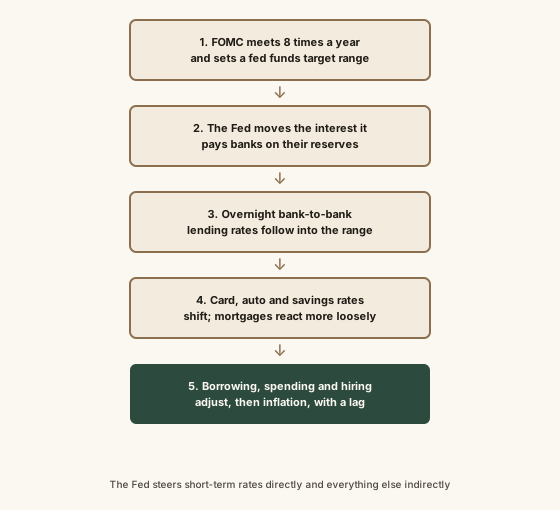
The Federal Reserve is the central bank of the United States, created by the Federal Reserve Act of 1913. It is made up of a seven-member Board of Governors in Washington, whose members serve 14-year terms, and 12 regional Reserve Banks. Its best-known job is monetary policy, set by the Federal Open Market Committee (FOMC): the seven governors, the president of the New York Fed and four other Reserve Bank presidents on a rotating basis. The FOMC meets eight times a year and sets a target range for the federal funds rate, the rate banks charge each other for overnight loans. It keeps rates in that range mainly by setting the interest it pays banks on their reserves. Congress gave the Fed the goals of maximum employment, stable prices and moderate long-term interest rates, and since 2012 the Fed has defined stable prices as 2% inflation measured by the PCE price index. The Fed also supervises and regulates banks, acts as a lender of last resort through its discount window, and runs payment systems including Fedwire and the FedNow instant payment service launched in 2023. It does not set mortgage rates directly, and the Bureau of Engraving and Printing, not the Fed, prints paper currency.
Reading time
— 5 min
Updated
— Sep 27, 2026
Fact-reviewed
— Sep 27, 2026
Key Takeaways
Key Takeaways
1The Federal Reserve is the U.S. central bank. Its main job is steering short-term interest rates to pursue maximum employment and 2% inflation.
2It sets a target for the federal funds rate eight times a year; that ripples out to credit cards, car loans and savings rates, and more loosely to mortgages.
3It also supervises banks, lends in emergencies and runs payment systems, but it doesn't print paper money or set mortgage rates directly.
The concept
Think of the Fed as the economy's thermostat for borrowing. When prices are rising too fast, it raises interest rates, which makes loans more expensive, so people and businesses borrow and spend less, and price increases slow down. When the economy is weak and jobs are disappearing, it lowers rates to encourage borrowing and spending. It doesn't control every rate directly. It sets one key rate for overnight loans between banks, and other rates tend to follow. The Fed also keeps an eye on banks to make sure they're safe and runs some of the plumbing that moves money between banks.
Quick check
Which rate does the Fed set a target for directly?
Worked examples
Example 1: A quarter-point hike on a credit card (baseline case)
The FOMC raises its target range by 0.25 percentage points. Banks raise the prime rate by the same amount within a day or two, and most credit card APRs are set as prime plus a fixed margin. A card at 22.00% becomes 22.25%. On a $5,000 balance, yearly interest rises by about 0.25% × $5,000 = $12.50. A single hike is small; a series of them adds up. In 2022–2023, the FOMC raised its target by a total of 5.25 percentage points, which added roughly $260 a year in interest to that same $5,000 balance.
Example 2: The Fed cuts, mortgages don't budge (edge case)
Homebuyers often expect mortgage rates to drop the day the Fed cuts. They often don't, and sometimes they rise. A 30-year mortgage is priced off long-term bond yields, like the 10-year Treasury, which reflect what investors expect for inflation and Fed policy over many years. If markets already expected the cut, it was priced in weeks earlier. If investors think the cut could fuel inflation later, long-term yields can even rise. The Fed steers the short end of the yield curve directly and the long end only through expectations. For how those moves ripple into bond prices, savings yields and stock valuations, see how interest rate changes affect investments.
Example 3: Reading a Fed announcement (real-world use)
On FOMC decision days, the Fed releases a short statement at 2:00 p.m. Eastern, and the chair holds a press conference at 2:30. Four times a year the release includes the Summary of Economic Projections, with each participant's rate forecast shown as a dot on the "dot plot." For your own finances, the useful questions are: did the target range change, what does the statement say about inflation and jobs, and do the projections suggest more moves ahead? If you're carrying variable-rate debt, that tells you whether your rate is likely to rise or fall. If you're saving, high-yield savings rates tend to follow within weeks.
Quick check
Why didn't mortgage rates fall in Example 2 when the Fed cut?
How it works (visual)
How a Fed rate decision reaches you
Common mistakes
Common Mistakes
✕
Assuming a Fed cut means mortgage rates will drop by the same amount.
→ Watch the 10-year Treasury yield and lender quotes; long rates move on expectations.
✕
Blaming or crediting the Fed for government spending or tax decisions.
→ Those are fiscal policy, decided by Congress and the President. The Fed runs monetary policy.
✕
Expecting a rate change to affect inflation within weeks.
→ Monetary policy works with long lags, often a year or more for its full effect.
Common misconception
“The Federal Reserve prints money and hands it to the government.”
Paper currency is printed by the Treasury's Bureau of Engraving and Printing; the Fed orders it and distributes it through banks to meet public demand. The Fed doesn't fund government spending directly. It buys Treasury securities in the open market, not from the Treasury at issue, and when it does quantitative easing it creates bank reserves, not cash handouts. The Fed also sends its net earnings to the Treasury after covering expenses.
What to do next
What to do next
Check whether any of your debts have variable rates tied to prime; those move with the Fed.
Look up the FOMC meeting calendar on federalreserve.gov and read one post-meeting statement.
When shopping for a mortgage, compare lender quotes rather than waiting on a Fed decision.
If you're saving, compare your savings rate with current high-yield accounts after rate changes.
FAQ
FAQ
Related terms
Related terms
Federal funds rate
The interest rate banks charge each other for overnight loans of reserves; the Fed sets a target range for it.
FOMC
The Federal Open Market Committee, the 12-member Fed body that sets monetary policy.
Dual mandate
Congress's goals for the Fed of maximum employment and stable prices (the law also names moderate long-term interest rates).
Interest on reserve balances (IORB)
The rate the Fed pays banks on money they keep at the Fed; its main tool for steering the federal funds rate.
Quantitative easing (QE)
Large-scale Fed purchases of Treasury and mortgage-backed securities to push down longer-term interest rates.
This entry was researched from public sources and drafted with AI-assisted tools, then edited — errors are still possible. Spot one, or want a topic covered? Read our disclaimer.
 KnowThis