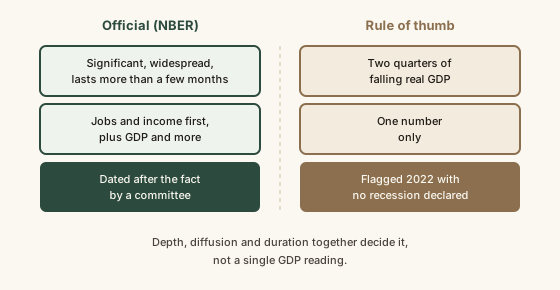
In the United States, recessions are officially dated by the Business Cycle Dating Committee of the National Bureau of Economic Research (NBER), a private, nonprofit research organization. Its definition is 'a significant decline in economic activity that is spread across the economy and lasts more than a few months,' judged on three criteria, depth, diffusion and duration, which the committee treats as somewhat interchangeable. It relies mainly on monthly data such as real personal income less government transfers and nonfarm payroll employment, alongside real consumer spending, household-survey employment, inflation-adjusted manufacturing and trade sales, industrial production, and quarterly GDP and GDI. The popular 'two consecutive quarters of falling real GDP' test is only a rule of thumb: in 2022, first estimates showed two quarters of GDP decline without a recession being declared, while the 2020 downturn lasted only two months and still counted because it was so deep and widespread. The committee dates peaks and troughs after the fact, often many months later, so real-time signals like the Sahm rule, based on rising unemployment, are used to spot recessions sooner.
Reading time
— 4 min
Updated
— Sep 26, 2026
Fact-reviewed
— Sep 26, 2026
Key Takeaways
Key Takeaways
1In the U.S., a committee of economists at the NBER decides when recessions start and end. There's no automatic formula.
2Its test is a significant, widespread decline lasting more than a few months, judged mainly by jobs and income, not just GDP.
3'Two quarters of falling GDP' is a rule of thumb. It has flagged recessions that didn't happen and would miss some that did.
The concept
Think of a doctor deciding whether someone has the flu. A single high temperature reading isn't enough. The doctor looks at how bad the symptoms are, whether they're affecting the whole body, and how long they've lasted. Recessions are called the same way. A group of economists looks at how much the economy shrank, whether the drop hit most industries and regions or just one, and how long it lasted. They mostly watch jobs and incomes, because those show whether ordinary people are feeling it. Because they want to be sure, they usually make the call months after the recession has already started.
GDP falls in two back-to-back quarters, but employment and incomes keep rising across most industries. What would the NBER most likely conclude?
Worked examples
Example 1: The 2007 to 2009 recession (baseline case)
Payroll employment, income, spending and production all turned down together, across nearly every industry and region, and kept falling for a long time. The NBER dated the peak to December 2007 and the trough to June 2009, an 18-month recession. Every criterion was clearly met. But the committee didn't announce the December 2007 peak until December 2008, a year after the recession had begun. By then, most people had already felt it.
Example 2: Two short, different cases (the edge cases)
In 2020, activity collapsed in March and April as the pandemic hit, then began recovering. The recession lasted two months, the shortest on the NBER's record, and still counted because the drop was so deep and so widespread. In 2022, first estimates showed real GDP shrinking in the first and second quarters, which met the two-quarter rule of thumb. But employers added jobs month after month and incomes held up, so the decline wasn't spread across the economy, and the NBER declared no recession. Together they show why the committee looks at depth, diffusion and duration rather than one number.
Example 3: Reading the headlines (real-world use)
A news report says "Economy shrank last quarter: are we in a recession?" You now know what to check. Did payrolls fall, or just GDP? Is the weakness in one sector (say, housing) or many? Has unemployment risen enough to trigger the Sahm rule? And remember that the official answer may not arrive for months. For personal decisions, the job market in your own field is usually a better signal than waiting for the official call.
Quick check
Why did the 2020 recession count despite lasting only two months?
How it works (visual)
Rule of thumb vs. the official NBER approach
Common mistakes
Common Mistakes
✕
Treating two quarters of negative GDP as an official declaration.
→ Check what jobs and incomes are doing too. In the U.S., the NBER makes the call on broader evidence.
✕
Assuming there's no recession because none has been announced.
→ Official dating lags by months. Watch real-time signals like unemployment and payrolls.
✕
Equating a stock market drop with a recession.
→ Markets can fall sharply without a recession and rise during one. Stock prices aren't one of the NBER's dating measures.
Common misconception
“A recession is officially defined as two consecutive quarters of falling GDP.”
In the U.S., that's a rule of thumb, not the definition. The NBER's committee looks for a significant decline spread across the economy that lasts more than a few months, and it relies mostly on monthly jobs and income data. The rule of thumb misfires both ways: it would have flagged 2022, when employment kept growing and no recession was declared, and a sharp downturn that starts and ends within the same quarter could slip past it.
What to do next
What to do next
When you see a recession headline, check payroll employment and the unemployment rate, not just GDP.
Look up the NBER's business cycle table to see the dates and lengths of past U.S. recessions.
Build or maintain an emergency fund, since recessions are usually confirmed only after they start.
Watch conditions in your own industry, which can matter more to you than the national call.
FAQ
FAQ
Related terms
Related terms
Recession
Per the NBER, a significant decline in economic activity that is spread across the economy and lasts more than a few months.
Business cycle
The repeating pattern of expansion (growth) and contraction (recession) in an economy, marked by peaks and troughs.
Peak and trough
The peak is the last month of an expansion; the trough is the last month of a recession. The recession is the period between them.
Two-quarter rule
A popular rule of thumb that two consecutive quarters of falling real GDP signal a recession. It isn't the official U.S. definition.
Sahm rule
A real-time recession signal that triggers when the three-month average unemployment rate rises at least 0.5 percentage points above its low of the previous 12 months.
This entry was researched from public sources and drafted with AI-assisted tools, then edited — errors are still possible. Spot one, or want a topic covered? Read our disclaimer.
 KnowThis