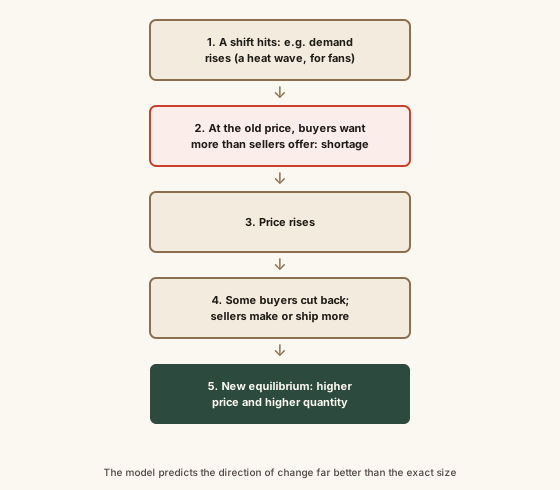
The supply and demand model, as taught in OpenStax's Principles of Economics, predicts how the price and quantity of a good change when conditions change: an increase in demand (from higher incomes, a change in tastes, or a heat wave for fans) creates a shortage at the old price, which pushes the price up until quantity demanded and quantity supplied meet at a new equilibrium, while an increase in supply pushes price down. The model distinguishes a movement along a curve, caused by the good's own price changing, from a shift of the whole curve, caused by other factors. It also predicts that a price ceiling set below equilibrium produces a persistent shortage and a price floor above it produces a surplus. Its strength is predicting the direction of change; the size depends on elasticity, which must be measured, and real markets add delays, market power, and regulation that the basic model leaves out.
Reading time
— 4 min
Updated
— Sep 25, 2026
Fact-reviewed
— Sep 25, 2026
Key Takeaways
Key Takeaways
1Supply and demand predicts which way price and quantity move when something changes: more demand means higher prices, more supply means lower prices.
2The model is strong on direction and weak on size. How much a price moves depends on elasticity, which has to be measured.
3It also predicts the side effects of fixing prices by rule: a cap below the market price creates lasting shortages, and a floor above it creates surpluses.
The concept
Every market has buyers who want more of something when it's cheap and sellers who offer more when it's expensive. Somewhere in the middle is a price where the amount people want matches the amount on offer. That's where prices tend to settle. The useful part is what happens when something changes. If a heat wave hits and everyone wants fans, stores run out at the old price, so prices go up, some people decide to wait, and suppliers ship more fans in. If a new factory floods the market with fans, the opposite happens. The model won't tell you that fans will cost exactly $43 next week. It tells you which way things will move and why.
Scale the same logic up to a whole economy and you get aggregate demand and supply, which is how economists think about GDP and the tools covered in fiscal vs. monetary policy.
Quick check
Coffee's price rises because of a poor harvest in Brazil. According to the model, what happens to tea?
Worked examples
Example 1: A heat wave and fans (baseline case)
At $40, a city's stores sell 1,000 fans a week, and that's an equilibrium. A heat wave raises demand so that at $40, people now want 1,800 fans. Stores sell out: a shortage of 800. Retailers raise prices; at $55, some shoppers decide to cope with open windows, and suppliers rush more stock in. A new balance forms at, say, $52 and 1,400 fans. The model got the direction of both moves right. The exact $52 and 1,400 came from assumed numbers, not from the model itself.
Example 2: A cheaper way to make TVs (supply shift)
A new manufacturing process cuts the cost of making large TVs. At the old price, makers now want to sell far more than buyers want: a surplus. Prices fall until buyers take the extra sets. The prediction is lower price and higher quantity, which matches the long-run pattern of electronics getting cheaper as production technology improves.
Example 3: A price cap on a scarce item (policy case)
After a storm, a local rule caps generator prices at the pre-storm $600, while the market price would have jumped to $900. At $600, many more people want generators than stores have, so shelves empty in hours and the shortage lasts. The model predicts this, and it predicts the side effects: long lines, resale at higher prices, and less incentive for sellers to bring more in from other regions. Whether a cap is worth those costs is a fairness judgment the model can't make, but it tells you clearly what the trade-off is.
Quick check
In Example 3, what does the model predict as the main result of the $600 cap?
How it works (visual)
From a demand shift to a new equilibrium
Common mistakes
Common Mistakes
✕
Saying 'the price rose, so demand fell' as if that were a shift in demand.
→ A price change causes a movement along the curve. Demand shifts only when something other than the good's own price changes.
✕
Expecting the model to give exact future prices.
→ Use it for direction and reasoning. Magnitude needs data on elasticity for that specific market.
✕
Assuming shortages always mean there isn't enough of something in total.
→ In economics, a shortage is a gap at a particular price. Often it's caused by a price being held below equilibrium.
Common misconception
“Supply and demand is just a classroom theory that doesn't predict anything in the real world.”
It's among the best-supported predictions in economics when used for what it does: the direction of change after a shift, and the effects of price controls. OpenStax documents examples from gasoline to rent control. What it doesn't do on its own is give exact numbers or capture every real-world friction, like market power or sticky prices. Those limits are why economists measure elasticities and build larger models on top of it, not a reason to discard it.
What to do next
What to do next
Next time a price jumps in the news, ask: did demand shift, supply shift, or both? Name the specific cause.
Practice separating 'movement along' from 'shift of' using a product you buy often.
Read OpenStax chapter 3 (free online) for the diagrams behind each case in this post.
Follow the same logic into our explainers on inflation and interest rates.
FAQ
FAQ
Related terms
Related terms
Demand
The relationship between a good's price and the quantity buyers are willing and able to buy. At lower prices people generally want more.
Supply
The relationship between a good's price and the quantity sellers are willing to offer. At higher prices sellers generally offer more.
Equilibrium
The price at which quantity demanded equals quantity supplied, so there's no shortage or surplus pushing the price to change.
Shortage
A situation where buyers want more than sellers offer at the current price. It tends to push the price up.
Surplus
A situation where sellers offer more than buyers want at the current price. It tends to push the price down.
Price elasticity
How strongly quantity demanded or supplied responds to a change in price. It determines how big a price change a shift causes.
This entry was researched from public sources and drafted with AI-assisted tools, then edited — errors are still possible. Spot one, or want a topic covered? Read our disclaimer.
 KnowThis