A tariff is a tax on imported goods, collected by the importing country's customs agency from the importer of record, which in the U.S. is usually a U.S. company. The foreign exporter doesn't write the check, though it can absorb some of the cost by cutting its price. How much of a tariff reaches consumers is called pass-through. Research on the 2018-2019 U.S. tariffs found pass-through to U.S. import prices was close to complete: Amiti, Redding and Weinstein (2019) estimated the tariffs cost U.S. consumers and importers about $3 billion a month in added taxes by the end of 2018, and Fajgelbaum and colleagues (2020) found the full cost fell on U.S. buyers. Retail prices rose by less than border prices in many categories because retailers absorbed part of the cost in their margins (Cavallo, Gopinath, Neiman and Tang, 2021). Tariffs also let domestic competitors raise prices: after 2018 washing-machine tariffs, Flaaen, Hortaçsu and Tintelnot found washer prices rose about 12%, and untariffed dryers rose by a similar dollar amount. How much a given tariff raises a given price depends on competition, substitutes, markups and exchange rates, and rates have changed repeatedly in 2025 and 2026.
Reading time
— 5 min
Updated
— Sep 30, 2026
Fact-reviewed
— Sep 30, 2026
Key Takeaways
Key Takeaways
1A tariff is a tax on imports. In the U.S., customs collects it from the importer, usually a U.S. company, not from the foreign country.
2Studies of the 2018 U.S. tariffs found nearly the full tariff showed up in U.S. import prices.
3Store prices can rise by less than the tariff (retailers absorb some) or by more (percentage markups and domestic rivals raising prices).
4How much a tariff raises a given price depends on competition, substitutes, markups and exchange rates.
The concept
A tariff works like a toll on goods crossing the border. When a U.S. company imports a $200 vacuum cleaner with a 25% tariff, it pays U.S. Customs $50 before the vacuum can leave the port. The company now has $250 in that vacuum, and it has three choices: raise its price, accept a smaller profit, or push the foreign supplier to cut its price. In practice it's usually a mix. The common idea that "the other country pays" skips a step: the other country only bears the cost if its exporters cut their prices, and research on recent U.S. tariffs found they mostly didn't.
Quick check
A U.S. retailer imports a $200 item with a 25% tariff. Who pays the $50 to U.S. Customs?
Worked examples
Example 1: The $200 vacuum (baseline case)
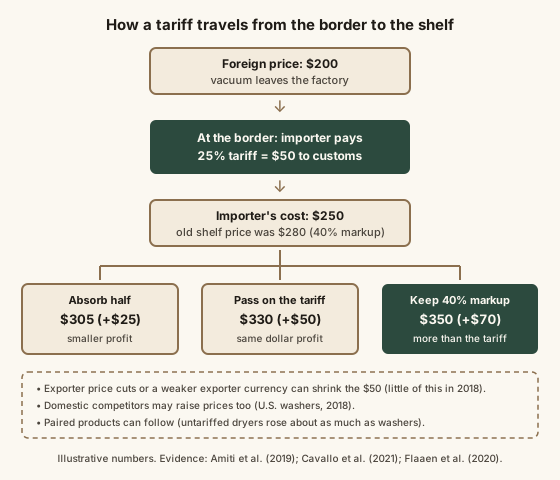
A retailer imports a vacuum for $200 and sells it with a 40% markup on cost: $280. A 25% tariff adds $50, so its cost becomes $250. If it keeps the same percentage markup, the shelf price becomes $350, a $70 increase on a $50 tariff. If it instead passes on exactly the tariff, the price is $330. If it absorbs half, the price is $305 and its profit per unit falls from $80 to $55. The same tariff can raise the shelf price by $25, $50 or $70 depending on how the seller prices, which is why "a 25% tariff means prices go up 25%" is too simple.
Example 2: When the exporter or the currency absorbs some (edge case)
Pass-through isn't always complete. If a foreign exporter has few other buyers, it may cut its price to keep the order: a $200 item might be re-quoted at $185, so a 25% tariff adds about $46 instead of $50. Exchange rates can do the same: if the exporter's currency weakens against the dollar, the item gets cheaper in dollars, offsetting part of the tariff. Cavallo and colleagues found something similar going the other way: when China put retaliatory tariffs on U.S. goods, U.S. exporters cut their prices somewhat to stay competitive. So incidence is shared when sellers have weaker bargaining power, but for the 2018 U.S. tariffs, the measured pass-through to U.S. import prices was close to full.
Example 3: Washing machines and the dryer surprise (applied case)
In early 2018 the U.S. put tariffs on imported washing machines. Flaaen, Hortaçsu and Tintelnot (2020) found washer prices rose about 12%, roughly $86 per unit. Domestic washer makers, facing less competition, raised their prices too. And dryers, which weren't tariffed, rose by a similar dollar amount, because people often buy them as a matched pair and sellers priced them together. They estimated the tariffs cost U.S. consumers about $1.5 billion a year and created around 1,800 jobs, or roughly $815,000 per job. The applied lesson: a tariff's price effect spreads beyond the tariffed import, to domestic substitutes and to complementary products.
Quick check
Why did U.S. dryer prices rise after the 2018 washing-machine tariffs?
How it works (visual)
How a tariff travels from the border to the shelf
The tariff enters at one point, the border, but the price effect depends on three later choices: how much the exporter absorbs, how the retailer marks up, and whether competitors follow prices up.
Common mistakes
Common Mistakes
✕
Saying the exporting country pays the tariff.
→ Customs collects it from the importer. The exporter bears part only if it cuts its price.
✕
Assuming a 25% tariff raises shelf prices exactly 25%.
→ Account for markups, retailer margins, exporter price cuts and how big a share of the final price the import is.
✕
Ignoring domestic products.
→ Domestic competitors often raise prices under the tariff's cover, as with U.S. washers in 2018.
✕
Counting tariff revenue as pure gain.
→ Revenue is a transfer from domestic buyers; economists net it against higher prices and lost trade.
✕
Expecting price effects to show up instantly.
→ Inventory, contracts and stockpiling mean effects can take months to reach stores.
Common misconception
“Tariffs are paid by foreign countries, so they don't affect domestic prices.”
Tariffs are paid by the importer, and the best evidence on the 2018-2019 U.S. tariffs found nearly all of the cost showed up in U.S. import prices. Whether it then reached consumers depended on retailers, but foreign exporters absorbed little of it.
What to do next
What to do next
When you hear a tariff rate, ask what share of the final price the imported part is.
Look up a product's current rate in the Harmonized Tariff Schedule (hts.usitc.gov).
Check whether domestic substitutes exist; their prices may rise too.
Compare a tariffed item's price over several months, not days, since pass-through takes time.
Read tariff headlines alongside the inflation data to see whether goods prices are moving.
FAQ
FAQ
Related terms
Related terms
Tariff
A tax on imported goods, collected by customs from the importer when the goods enter the country.
Ad valorem tariff
A tariff set as a percentage of the good's customs value, such as 25% of a $200 shipment.
Importer of record
The party legally responsible for bringing goods into a country and paying any duties owed, usually a domestic company.
Pass-through
The share of a tariff that shows up in the price paid by the buyer. Complete pass-through means the buyer's price rises by the full tariff.
Tariff incidence
Who ultimately bears the cost of a tariff: foreign exporters, importers, retailers or consumers, depending on how prices adjust.
This entry was researched from public sources and drafted with AI-assisted tools, then edited — errors are still possible. Spot one, or want a topic covered? Read our disclaimer.
 KnowThis