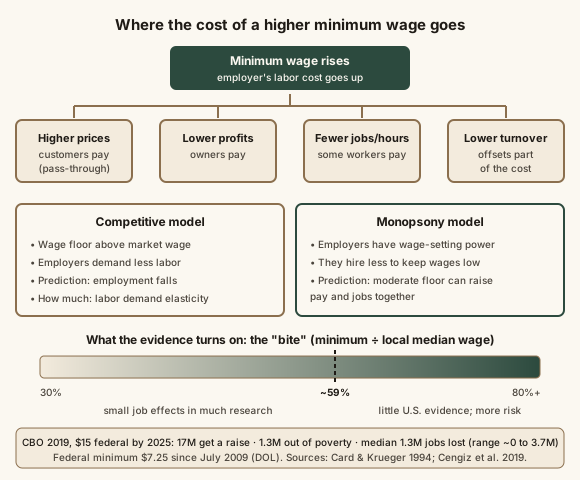
Minimum wage debates are less about whether low-wage workers deserve more and more about one empirical question: when a law raises the price of low-wage labor, how is the extra cost absorbed? The options are fewer jobs or hours, higher prices, lower profits, or gains from lower turnover and higher productivity. The simple competitive-market model predicts job losses; the monopsony model, where employers have wage-setting power, predicts a moderate minimum can raise pay without cutting jobs. Card and Krueger's 1994 study of fast-food restaurants in New Jersey and Pennsylvania found no employment drop after New Jersey's increase, which launched decades of dispute. Later work such as Cengiz, Dube, Lindner and Zipperer (2019) found little change in the number of low-wage jobs for increases up to about 59% of the local median wage, while studies of Seattle's rise toward $13 found reduced hours for some low-wage workers. CBO's 2019 analysis of a $15 federal minimum by 2025 estimated pay raises for 17 million workers, 1.3 million people lifted out of poverty, and a median 1.3 million jobs lost, with a wide range. The U.S. federal minimum has been $7.25 since July 2009, while more than 30 states plus D.C. set higher minimums (DOL, updated July 2026). The size of an increase relative to local wages, its 'bite', is what the evidence most turns on.
Reading time
— 6 min
Updated
— Oct 1, 2026
Fact-reviewed
— Oct 1, 2026
Key Takeaways
Key Takeaways
1The core question isn't whether workers deserve more. It's who absorbs the cost when pay is forced up: jobs and hours, prices, profits, or lower turnover.
2The textbook competitive model predicts job losses. The monopsony model, where employers set wages, predicts a moderate floor can raise pay without cutting jobs.
3Evidence since Card and Krueger (1994) finds small employment effects for moderate increases, with more disagreement as minimums rise relative to local wages.
4The U.S. federal minimum has been $7.25 since July 2009; more than 30 states plus D.C. set higher minimums (DOL, updated July 2026).
The concept
A minimum wage is a price floor for an hour of work. Raise it, and an employer's wage bill goes up. That money has to come from somewhere, and the whole debate is really an argument about where. One side says businesses will hire fewer people or cut hours, so some of the workers the law meant to help end up worse off. The other side says many employers have more room than that: they can raise prices a little, accept slightly lower profits, and save money because better-paid workers quit less often. Both stories are possible. Which one dominates depends mostly on how big the increase is compared with local wages. A raise from $7.25 to $9 in a city where most jobs already pay $20 barely registers. The same raise in a town where half the jobs pay $8 is a big shock.
Notice that the two sides often agree on more than they admit. Most economists accept that a very high minimum would cost jobs and that a very low one does almost nothing. The real disagreement is about where the threshold sits and how to weigh higher pay for many against lost hours or jobs for some. That's partly an empirical question and partly a values question, which is why evidence alone hasn't settled it. Job effects show up in employment counts and the unemployment rate, whose definition is narrower than most people assume.
Quick check
A city raises its minimum wage. Which of these is NOT one of the main ways employers absorb the higher cost?
Worked examples
Example 1: What $7.25 actually pays (baseline case)
Full-time work is about 2,080 hours a year (40 hours × 52 weeks). At the federal minimum of $7.25, that's $15,080 before tax, below HHS's 2025 poverty guideline of $21,150 for a two-person household. The federal rate hasn't changed since July 2009, while inflation has cut its purchasing power by roughly a third since then, judged by the BLS consumer price index. That erosion is one reason so many states set their own higher minimums. It's also why relatively few workers earn exactly $7.25: in recent BLS reports, workers at or below the federal minimum were only around 1% of hourly-paid workers.
Example 2: The same $15 in two different places (edge case)
Suppose the median hourly wage is $32 in a large coastal city and $20 in a rural county. A $15 minimum is 47% of the median in the city but 75% in the rural county. In the city, it lifts a modest slice of jobs and sits inside the range Cengiz and colleagues studied. In the rural county, it would reach well into the middle of the wage distribution, beyond the range where U.S. evidence is strong. That's why some economists who support raising minimums favour indexing them to local wages rather than setting one national number. The dollar figure is the same; the bite is not.
Example 3: A restaurant's arithmetic (applied case)
A restaurant with $1.2 million in annual revenue employs 12 workers at $12 an hour, each working 1,500 hours a year. A new $15 minimum raises its wage bill by $3 × 1,500 × 12 = $54,000 a year, before payroll taxes. That's 4.5% of revenue. If the owner passed all of it through to customers, menu prices would rise about 4.5%: a $12 meal becomes about $12.54. More realistically, the cost is split: prices go up a few percent, profit margins shrink a little, and some savings come back because fewer workers quit (replacing and training a worker costs money). If margins were already thin and customers are price-sensitive, cutting shifts becomes more likely. Each of these channels is real; the debate is about their relative sizes.
Quick check
A study finds a minimum wage increase raised pay for low-wage workers but reduced their weekly hours slightly. What does that illustrate?
How it works (visual)
Where the cost of a minimum wage increase goes
Common mistakes
Common Mistakes
✕
Treating 'raises cost jobs' or 'raises have no effect' as settled facts.
→ The evidence depends on the size of the increase relative to local wages. Moderate increases show small employment effects in much research; large ones are less studied.
✕
Counting only jobs.
→ Look at hours, prices, turnover and total earnings too. A study can find no job losses and still find fewer hours.
✕
Comparing dollar minimums across places without adjusting for local wages and prices.
→ Use the bite: the minimum as a share of the local median wage.
✕
Assuming most minimum wage earners are teenagers.
→ BLS data show minimum wage workers skew young, but many are adults; who is affected depends on how high the new minimum is set.
Common misconception
“Economics proves that any minimum wage increase destroys jobs.”
That's the prediction of one model, the fully competitive labor market. Card and Krueger (1994) found no relative employment drop after New Jersey's increase, and Cengiz and colleagues (2019) found little change in low-wage job counts for increases up to about 59% of the median wage. The monopsony model explains how that can happen. But the evidence doesn't say any increase is free either: CBO's central estimate for $15 nationally still included job losses, and some studies find reduced hours. The honest summary is that effects depend on size and local context.
What to do next
What to do next
When you see a minimum wage claim, ask: how big is the increase relative to local median wages?
Check which outcome a study measured: jobs, hours, earnings, prices or poverty. Different measures can point in different directions.
Look up your own state's current minimum on the Department of Labor's state minimum wage page; many states adjust theirs for inflation each year.
Read central estimates and ranges together. CBO's 1.3 million figure came with a range from near zero to 3.7 million.
For background on the price side of the trade-off, see our explainer on how tariffs affect prices, which uses the same pass-through idea.
FAQ
FAQ
Related terms
Related terms
Minimum wage
The lowest hourly pay an employer may legally pay covered workers. The U.S. federal minimum has been $7.25 since July 24, 2009; many states and cities set higher ones.
Monopsony
A labor market where employers have power to set wages below what a fully competitive market would pay, often because workers have few alternative employers or find switching costly.
Bite
How high a minimum wage is relative to local wages, often measured as the minimum divided by the median wage (the Kaitz index). A bigger bite affects more workers.
Elasticity of labor demand
How strongly employers cut the hours or jobs they offer when labor gets more expensive. Debates over minimum wages are largely debates about its size.
Pass-through
The share of a cost increase that a business passes on to customers through higher prices.
Tipped minimum wage
The lower cash wage ($2.13 an hour federally) employers may pay tipped workers, provided tips bring total pay up to at least the full minimum wage.
This entry was researched from public sources and drafted with AI-assisted tools, then edited — errors are still possible. Spot one, or want a topic covered? Read our disclaimer.
 KnowThis