 KnowThis
Key Takeaways
Key Takeaways
- 1Inflation means the same amount of money buys less over time — it's tracked in the U.S. mainly through the BLS Consumer Price Index, a basket of representative consumer goods and services.
- 2Inflation compounds year over year, the same mathematical way interest does — a modest annual rate adds up to a much larger erosion of purchasing power over a decade.
- 3If income doesn't rise at least as fast as inflation, real purchasing power falls even while the nominal dollar amount of income stays the same or grows slightly.
The concept
This compounding effect is exactly why financial guidance emphasizes that savings sitting in an account earning less than the inflation rate are quietly losing real value every year, even as the account balance itself grows or stays flat.
Someone's salary stays exactly the same dollar amount for three years in a row, during a period of steady 4% annual inflation. What actually happens to their purchasing power?
Worked examples
Example 1: Grocery prices over a year (baseline case)
Example 2: Cash savings during high inflation (edge case / variation)
Example 3: A fixed pension over 20 years (real-world / applied case)
Why do many pensions and Social Security benefits include cost-of-living adjustments (COLAs) tied to the CPI?
How it works (visual)
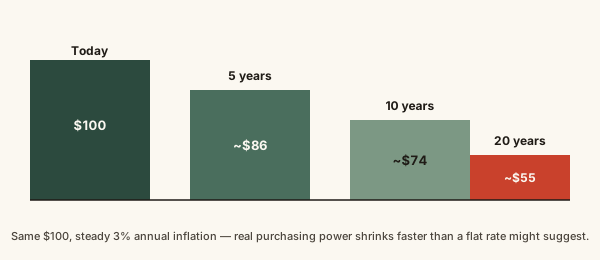
The shrinking isn't linear — because each year's erosion compounds on top of the previous years', purchasing power falls faster in later years than the annual rate alone might suggest.
Common mistakes
Common Mistakes
Judging financial progress by nominal dollar amounts alone, ignoring inflation.
→ Compare income and savings growth against the inflation rate over the same period to see real, not just nominal, change.
Assuming a fixed payment (pension, contract, rent-controlled lease) keeps the same real value indefinitely.
→ Check whether the payment includes a cost-of-living adjustment, and if not, account for its shrinking real value in long-term planning.
Treating a single high-inflation year as the whole story, ignoring compounding over many years.
→ Consider inflation's cumulative, compounding effect over the relevant time horizon, not just one year's rate in isolation.
Common misconception
“A modest inflation rate like 2-3% a year is basically negligible and not worth planning around.”
Because inflation compounds the same way interest does, even a "modest" 3% annual rate erodes roughly a quarter of a dollar's real purchasing power over about a decade — per BLS CPI data and standard compounding math, small annual rates add up to genuinely significant long-term effects, which is exactly why financial planning explicitly accounts for inflation over multi-year and multi-decade horizons rather than dismissing it as negligible.
What to do next
What to do next
- When evaluating a raise or a savings account's interest rate, compare it against the current inflation rate to see real, not just nominal, growth.
- Check whether any fixed payments you rely on (a pension, a long-term contract) include a cost-of-living adjustment.
- Use BLS.gov's published CPI data to check the actual current inflation rate rather than relying on a general impression.
- For long-term savings or retirement planning, account for inflation's compounding effect over the full time horizon, not just the near term.