 KnowThis
Key Takeaways
Key Takeaways
- 1Inflation reduces what a fixed amount of money can buy over time, even if the number in the account never changes — the real cost is to purchasing power, not to the nominal balance.
- 2Money earning a lower return than the inflation rate is quietly losing real value, even though the account balance itself may be growing.
- 3"Inflation-proofing" isn't about escaping inflation entirely — no individual can control the inflation rate — it's about choosing where money sits so its growth has a realistic chance of keeping up with rising prices.
The concept
Comparing what the same amount of money is actually worth after a period of inflation, at different growth rates, makes the difference between nominal and real value concrete.
If a savings account balance grows from $10,000 to $10,200 over a year (2% nominal growth), while inflation for that year was 4%, what happened to the real purchasing power of that money?
Worked examples
Example 1: Cash sitting idle for 10 years (baseline case)
Example 2: Same amount in a higher-yield account (edge case / variation)
Example 3: Comparing two inflation scenarios (real-world / applied case)
Why can the same nominal savings growth rate lead to very different real outcomes?
How it works (visual)
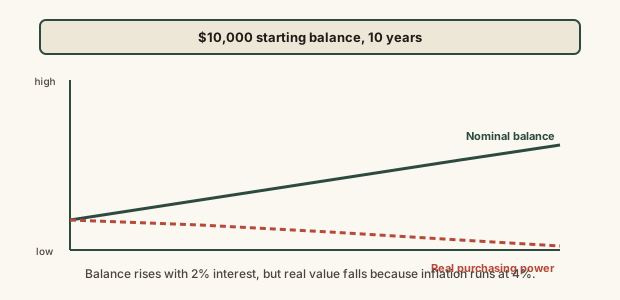
The nominal balance and the real purchasing power of that balance are two different numbers, and only tracking the first one can hide a real, ongoing loss.
Common mistakes
Common Mistakes
Judging savings progress purely by the account balance, without considering the inflation rate over the same period.
→ Compare the account's growth rate to the inflation rate for the same period to see the real (purchasing-power-adjusted) result, not just the nominal balance.
Leaving a large cash reserve in a zero- or near-zero-interest account for years at a time, assuming it's automatically "safe."
→ Recognize that low-yield cash is only nominally safe — it's still exposed to a real, ongoing erosion of purchasing power from inflation, even without any market risk.
Assuming any investment automatically "beats inflation" without checking its actual historical or expected return relative to inflation.
→ Compare a specific vehicle's expected or historical return to the inflation rate directly — no investment vehicle guarantees outpacing inflation in every period.
Common misconception
“If my savings account balance is going up, my money isn't losing value.”
A rising nominal balance can still represent a real loss in purchasing power if its growth rate is lower than the inflation rate during that period. What matters for "losing value" in the sense that matters — the ability to buy things — is the real return, not whether the number on the statement went up.
Try it yourself
Estimate the real purchasing power of a present-day amount after a number of years of inflation.
This is a simplified illustration of how inflation affects purchasing power over time, using a single assumed constant rate. Actual inflation varies year to year and cannot be predicted with certainty.
What to do next
What to do next
- Check the current interest rate on any large cash balance and compare it to the current inflation rate, not just to zero.
- Avoid holding large amounts of money for long periods in accounts earning meaningfully less than the inflation rate, beyond what's needed for near-term spending or an emergency fund.
- Learn about inflation-indexed instruments (like Series I savings bonds) as one option among several, understanding their specific mechanics before relying on them.
- Consult a qualified financial professional before making investment decisions aimed at outpacing inflation, since risk tolerance and time horizon vary by individual.