 KnowThis
Key Takeaways
Key Takeaways
- 1The exchange rate quoted on a news site or currency chart is the market rate — the rate an individual actually gets when converting money is usually that market rate minus a spread, and often a separate fee on top.
- 2Cards, ATMs, and exchange counters each apply their own spread and fee structure, which is why converting the same amount in different ways can produce noticeably different results.
- 3A currency's short-term movements don't need to be predicted to make good decisions — knowing where the spread and fees hide is more useful than trying to time a conversion.
The concept
Working through how the spread and fee combine on an actual conversion — and comparing that to a headline market rate — makes the gap between "the exchange rate" and "what you actually get" concrete.
If a currency chart shows an exchange rate of 1.10, why might converting $100 through a bank or exchange counter yield less than that rate would suggest?
Worked examples
Example 1: Converting cash with a fee (baseline case)
Example 2: Same amount, no explicit fee but a wider built-in spread (edge case / variation)
Example 3: Comparing two real conversion channels (real-world / applied case)
Why can a card with 'no foreign transaction fee' still cost more than expected on an international purchase?
How it works (visual)
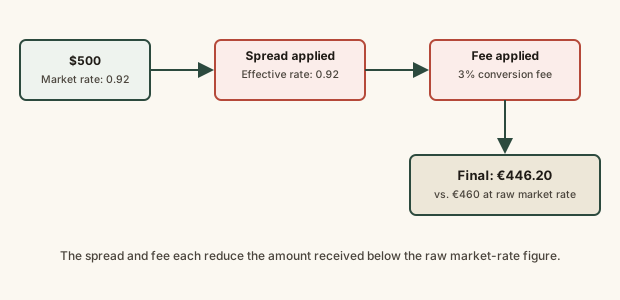
The market rate is only the starting point of a conversion — the spread and fee applied along the way determine the actual amount received, and both are worth checking before assuming the headline rate applies.
Common mistakes
Common Mistakes
Assuming the exchange rate seen on a news site or currency app is the rate you'll actually receive when converting money.
→ Treat published market rates as a reference point only, and check the specific rate (including any built-in spread) your bank, card, or exchange provider actually applies.
Choosing an option because it's labeled "no fee" without checking the exchange rate it uses.
→ Compare the effective rate received (final amount ÷ original amount), not just whether a fee line item is present, since spread alone can cost more than a stated fee.
Converting cash at an airport or hotel counter out of convenience without comparing costs.
→ These venues typically carry some of the widest spreads and highest fees; a bank, ATM withdrawal abroad on a low-fee card, or a dedicated currency service is usually cheaper.
Common misconception
“A card that advertises 'no foreign transaction fee' guarantees the best possible exchange rate.”
It guarantees the absence of one specific cost (an explicit percentage fee) — it says nothing about the exchange rate the card network applies, which can still include a spread relative to the true market rate. Comparing the final converted amount, not just the presence of a fee, is the more reliable check.
Try it yourself
Estimate the converted amount after applying an exchange rate and a conversion fee.
This is a simplified illustration of how spreads and fees affect currency conversion, not a live exchange-rate quote. Actual rates change constantly and vary by provider.
What to do next
What to do next
- Before converting a meaningful amount of money, check the actual rate offered, not just the market rate reported elsewhere.
- Compare the final converted amount across at least two providers (bank, card, dedicated exchange service) rather than assuming one is automatically cheapest.
- Avoid airport and hotel currency counters for large conversions when a lower-cost alternative is available in advance.
- Ask directly whether "no fee" language refers to an explicit fee only, or also reflects a competitive exchange rate.