 KnowThis
Key Takeaways
Key Takeaways
- 1Most common bank fees — monthly maintenance, out-of-network ATM, wire transfer — are structured around a specific, published condition, and meeting that condition typically waives the fee entirely.
- 2A monthly maintenance fee is usually waived by one of a few standard triggers: a minimum daily balance, a set number of direct deposits, or being a student or senior account.
- 3Fee schedules are legally required disclosures — every bank publishes the exact conditions and amounts, which makes 'avoidable' fees a matter of reading the disclosure, not luck.
The concept
Once the pattern is visible — most fees are default charges with a stated escape hatch — reviewing an account's fee schedule becomes a genuinely useful five-minute exercise rather than an intimidating wall of fine print.
A checking account charges a $12 monthly maintenance fee, waived by maintaining a $1,500 minimum daily balance. If the balance dips to $1,200 for one day mid-month, what happens?
Worked examples
Example 1: Waiving a monthly maintenance fee with direct deposit (baseline case)
Example 2: Stacked ATM fees from using an out-of-network machine (edge case / variation)
Example 3: Comparing total annual fee exposure across two account types (real-world / applied case)
Why might a 'no monthly fee' checking account still end up costing more per year than an account that does charge a monthly fee?
How it works (visual)
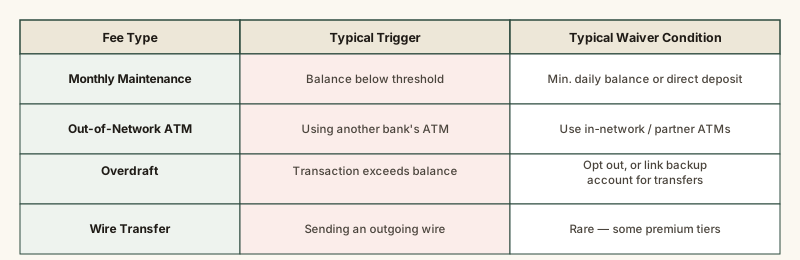
Reading this as a map rather than a list of penalties is the useful reframe: each fee has a specific trigger and, in most cases, a specific published condition that turns it off — the work is matching your own account behavior against that condition.
Common mistakes
Common Mistakes
Assuming a 'minimum balance' waiver condition only checks the balance once, at the end of the month.
→ Check the specific account's fee schedule — many minimum-balance conditions are checked daily, meaning any single low-balance day in the cycle can trigger the fee.
Using an out-of-network ATM without realizing two separate fees (your bank's, and the ATM owner's) can both apply to the same withdrawal.
→ Use your own bank's ATM locator or partner network before withdrawing cash away from home, since in-network use typically avoids both charges.
Comparing accounts only by whether they advertise 'no monthly fee,' without checking other fee categories against your own usage.
→ Pull up the full fee schedule (not just the headline) and compare it against your actual balance and withdrawal habits, not the account's marketing label.
Common misconception
“Bank fees are arbitrary or hidden, so there's no real way to avoid them without switching banks entirely.”
Banks are required to disclose their full fee schedule, typically in a Truth in Savings document, and the large majority of common fees (monthly maintenance, in particular) are structured with a specific, published waiver condition. Reviewing that one document for your actual account is usually enough to identify which fees genuinely apply to you and which are avoidable by a behavior you may already do, like receiving direct deposit.
What to do next
What to do next
- Pull up your account's fee schedule (often called a Truth in Savings disclosure) and list every fee alongside its exact waiver condition.
- Check whether your existing direct deposit or balance already satisfies the monthly maintenance fee waiver — many people qualify without realizing it.
- Use your bank's ATM locator app before withdrawing cash away from home to avoid stacking two separate ATM fees on one transaction.
- If a fee's waiver condition is genuinely out of reach for your situation, compare the account's total realistic annual cost against a different account type before assuming switching isn't worth it.