A capstone review of recurring personal finance misconceptions covered across this category — from budgeting and credit scores to emergency funds and scams — showing that most myths aren't outright false so much as an oversimplified rule applied outside the specific conditions where the underlying mechanism actually holds.
Reading time
— 4 min
Updated
— Aug 22, 2026
Fact-reviewed
— Aug 22, 2026
Key Takeaways
Key Takeaways
1Most personal finance myths aren't pure fabrications — they're a real rule of thumb or mechanism, stretched past the specific conditions where it actually holds true.
2Checking a credit score, budgeting, saving, and avoiding scams all have recurring misconceptions that trace back to skipping the underlying mechanism in favor of a memorized shortcut.
3Understanding why a rule works (not just that it exists) is what lets you correctly judge when it applies to your specific situation and when it doesn't.
The concept
Personal finance is full of rules of thumb — the 50/30/20 budget split, "pay off high-interest debt first," "keep three to six months of expenses in savings." These aren't wrong, but they're simplifications of an underlying mechanism, and treating them as universal laws rather than starting points is where most myths come from.
Reviewing the specific myths below, and the actual mechanism each one oversimplifies, ties together concepts covered throughout this category.
Quick check
What's the most common structural reason a personal finance 'myth' turns out to be misleading?
Myth by myth
Myth 1: "A good credit score means you're good with money overall."
A credit score measures a narrow set of credit-specific behaviors — payment history, amounts owed, length of credit history, credit mix, and new credit — not savings habits, income, net worth, or spending discipline. Someone with a high income and low savings can have an excellent credit score, and someone with substantial savings and no debt at all can have a thin, unremarkable credit file. The score measures credit risk to a lender, not overall financial health.
Myth 2: "The 50/30/20 rule is the correct way to budget."
It's a reasonable starting split (roughly 50% needs, 30% wants, 20% savings/debt repayment) for a specific range of incomes relative to cost of living — it breaks down for very low incomes, where needs can exceed 50% no matter how tightly a budget is run, and it's overly conservative for very high incomes, where a much larger share could reasonably go to savings. It's a starting template, not a formula that fits every household.
Myth 3: "You always need three to six months of expenses in an emergency fund."
This range is a reasonable general benchmark, but it's derived from assumptions about job-loss risk and income replacement time that vary by profession, household income sources, and dependents. A dual-income household with stable jobs may reasonably target the lower end or less; a single-income household with variable freelance income may reasonably need more than six months. The range is a starting point to adjust, not a fixed requirement.
Myth 4: "If an investment opportunity has documentation and other people vouching for it, it's legitimate."
Ponzi schemes and other financial scams routinely include convincing paperwork, other genuine investors (often unknowingly acting as references), and even real early "returns" paid from other investors' contributions rather than actual profit. Documentation and social proof reduce risk somewhat but don't eliminate it — verifying registration with actual regulators (like checking an investment adviser's registration through the SEC) is a separate, necessary step that documentation and word-of-mouth alone don't replace.
Myth 5: "Carrying a small credit card balance instead of paying it off in full improves your credit score."
This one is close to backward. Paying a statement balance in full each month avoids interest entirely and doesn't hurt a credit score — credit scoring models look at reported utilization and payment history, not whether interest was paid. Carrying a balance only costs money in interest; it isn't required to build credit.
Quick check
Why is 'carrying a small credit card balance improves your credit score' considered a myth?
How it works (visual)
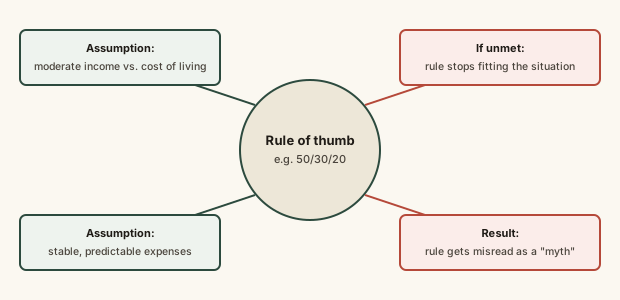
A rule of thumb versus the specific conditions it assumes
Every rule of thumb in personal finance rests on assumptions about income, risk, or circumstances that were true for the situation it was derived from — checking whether those assumptions match your own situation is what separates using a rule well from being misled by it.
Common mistakes
Common Mistakes
✕
Treating a widely repeated personal finance rule as a precise, universal formula rather than a starting point.
→ Look up the underlying mechanism or assumption behind the rule, then check whether your own income, risk, and circumstances actually match those assumptions.
✕
Assuming a credit score reflects overall financial health rather than a narrow measure of credit risk.
→ Track savings rate, net worth, and spending separately from a credit score — they measure different things and can move independently of each other.
✕
Trusting an investment opportunity because of documentation or other investors' involvement, without independently verifying registration with an actual regulator.
→ Check a specific investment or adviser's registration directly through official sources (like the SEC's investment adviser search) before relying on paperwork or word-of-mouth alone.
Common misconception
“Personal finance myths are outright false claims with no real basis.”
Most trace back to a real, generally useful rule of thumb or mechanism — the myth is in treating that starting point as a precise, universal formula rather than checking whether its underlying assumptions actually apply to your specific situation.
What to do next
What to do next
For any personal finance rule of thumb you rely on, identify the specific assumption behind it and check whether it matches your own income and circumstances.
Separate "credit score" from "overall financial health" when evaluating your own financial position — track them independently.
Independently verify any investment opportunity's registration through an actual regulator before relying on documentation or other people's involvement.
Revisit budgeting and emergency-fund targets periodically, adjusting the standard benchmarks to your actual income stability and household structure rather than following them rigidly.
FAQ
FAQ
Related terms
Related terms
Rule of thumb
A simplified, generally useful guideline (like the 50/30/20 budget split) that works well as a starting point but isn't a precise or universally applicable formula for every situation.
This entry was researched from public sources and drafted with AI-assisted tools, then edited — errors are still possible. Spot one, or want a topic covered? Read our disclaimer.
 KnowThis