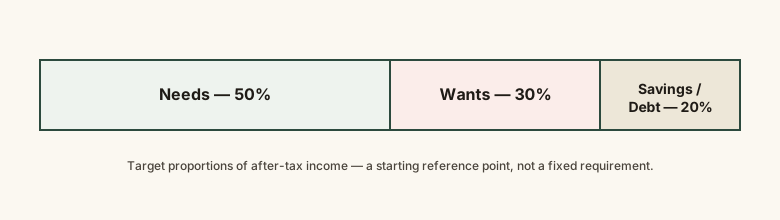
The 50/30/20 rule is a budgeting framework that allocates after-tax income into three categories: roughly 50% to needs, 30% to wants, and 20% to savings and debt repayment, popularized as a simple starting split rather than a precise formula every household must follow exactly.
Reading time
— 4 min
Updated
— Oct 10, 2026
Fact-reviewed
— Oct 10, 2026
This entry explains a general budgeting framework — it is financial literacy, not personalized advice. The right split for any individual depends on their cost of living, debt, and goals; a financial advisor can help apply a framework like this to a specific situation.
Key Takeaways
Key Takeaways
1The 50/30/20 rule splits after-tax income into three buckets: roughly 50% needs, 30% wants, and 20% savings/debt repayment.
2It's a starting framework, not a mandatory formula — someone with a high cost of living or significant debt may need a different split to reflect their real numbers.
3The rule's usefulness comes from forcing a distinction between needs and wants, which is often the actual gap in an unstructured budget.
The concept
The 50/30/20 rule takes after-tax income and splits it into three rough categories: about 50% for needs (rent, groceries, utilities, minimum debt payments), 30% for wants (dining out, entertainment, subscriptions), and 20% for savings and extra debt repayment. On $4,000 of monthly take-home pay, that's roughly $2,000 for needs, $1,200 for wants, and $800 for savings — a starting point to compare actual spending against, not a rule that has to be hit exactly.
Applying the rule starts with the hardest and most honest step: sorting every actual expense into needs or wants before comparing the totals to the 50/30 split.
Quick check
A household categorizes their $150/month streaming and dining subscriptions as 'needs' because they've become part of the routine. What's the issue with this classification under the 50/30/20 framework?
Worked examples
Example 1: Applying the split to a straightforward income (baseline case)
Take-home pay: $5,000/month. 50% needs = $2,500. 30% wants = $1,500. 20% savings/debt = $1,000. If actual needs (rent, groceries, utilities, minimum payments) total $2,300, that's comfortably under the 50% target, leaving room to potentially shift more toward the savings bucket if desired.
Example 2: When needs genuinely exceed 50% (edge case / variation)
Take-home pay: $3,000/month in a high-cost area. Rent alone is $1,400, plus $300 utilities, $400 groceries, and $200 minimum debt payments — needs total $2,300, which is about 77% of income, far above the 50% target. The framework doesn't change the household's real costs, but it does make the gap explicit: either wants and savings have to shrink well below 30/20, or the underlying needs (most likely housing) need to change for the ratio to become achievable.
Quick check
If a household's needs genuinely take up 70% of income instead of the target 50%, does that mean the 50/30/20 rule 'doesn't work' for them?
Example 3: Using the rule to set a savings target (real-world / applied case)
Take-home pay: $4,500/month. The 20% savings/debt bucket targets $900/month. If current savings are only $300/month, the framework surfaces a concrete $600/month gap — a specific number to investigate, whether by trimming the wants category, increasing income, or accepting a lower savings rate deliberately rather than by default.
How it works (visual)
The 50/30/20 split of after-tax income
The bar's proportions are a target, not a law — the diagnostic value comes from comparing a household's real, honestly-categorized spending against these three target widths.
Common mistakes
Common Mistakes
✕
Categorizing discretionary spending (subscriptions, dining out, entertainment) as 'needs' because it feels routine.
→ Apply a strict test: a need is required to maintain basic living and work obligations; everything else is a want, regardless of habit.
✕
Treating the 50/30/20 percentages as mandatory rather than a starting reference point.
→ Use the framework to quantify the gap between actual and target spending, and adjust expectations for genuinely high-cost situations rather than forcing an unrealistic ratio.
✕
Applying the rule to gross income instead of after-tax take-home pay.
→ Always base the split on take-home pay — using gross income overstates what's actually available and understates how tight the real budget is.
Common misconception
“The 50/30/20 rule is a strict formula that everyone's budget must match exactly to be considered financially healthy.”
The rule is a widely-cited rule of thumb, not a formal financial standard. It's most useful as a diagnostic starting point — someone whose needs genuinely exceed 50% due to cost of living or family size isn't failing at budgeting, they simply have a different starting ratio, and the framework still helps by quantifying exactly how different.
Try it yourself
Calculate a 50/30/20 category amount from take-home pay
Target amount for that category$2,000
What to do next
What to do next
Calculate the 50/30/20 target amounts for your own take-home pay using the calculator above.
Sort every real expense honestly into needs or wants before comparing totals to the targets.
If needs genuinely exceed 50%, use that gap as information rather than a sign of failure — it points to where the real constraint is (usually housing).
Revisit the split periodically, since income, debt, and cost of living all change over time.
FAQ
FAQ
Related terms
Related terms
50/30/20 rule
A budgeting framework allocating after-tax income as roughly 50% to needs, 30% to wants, and 20% to savings and debt repayment.
After-tax income
Income remaining after taxes and mandatory payroll deductions are removed — the actual amount available to allocate in a budget, also called take-home pay.
This entry was researched from public sources and drafted with AI-assisted tools, then edited — errors are still possible. Spot one, or want a topic covered? Read our disclaimer.
 KnowThis