A need is a cost required to maintain basic health, safety, employment, and shelter — the baseline a person cannot go without for long without real consequences. A want improves comfort, enjoyment, or convenience beyond that baseline. The distinction is functional, not about price, guilt, or how essential something feels in the moment, and most budgeting frameworks rely on making this call honestly rather than by rigid formula.
Reading time
— 4 min
Updated
— Aug 22, 2026
Fact-reviewed
— Aug 22, 2026
A note on this article: this content is for general education only and is not personalized financial advice. What counts as a need versus a want depends on individual circumstances (a car may be a need for a rural commute and a want in a city with transit); use the framework here as a starting point, not a rule to apply mechanically to someone else's situation.
Key Takeaways
Key Takeaways
1A need is a cost required to maintain basic health, safety, shelter, and the ability to work; a want improves comfort or enjoyment beyond that baseline.
2Price and how essential something feels are not reliable signals — an expensive item can be a need (a work laptop) and a cheap habitual purchase can be a want (daily coffee).
3The same category of spending can be a need for one person and a want for another depending on individual circumstances like job requirements, health conditions, or location.
The concept
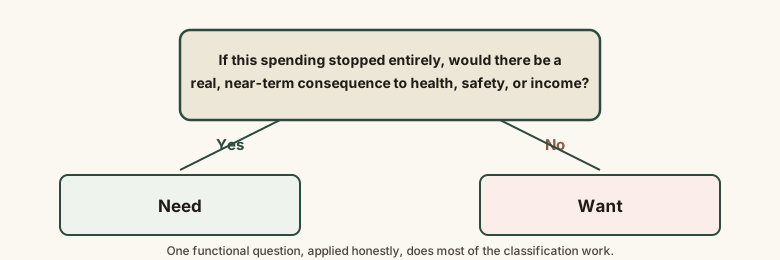
A need is something required to keep basic life running — food, shelter, utilities, transportation to work, minimum debt payments. A want makes life more comfortable or enjoyable but isn't required — dining out, streaming subscriptions, upgraded electronics. The test is simple to state and harder to apply honestly: if this spending stopped entirely, would there be a real, near-term consequence to health, safety, housing, or income?
The line matters most when a budget needs to be cut — a want can usually be reduced or eliminated without lasting harm, while cutting a true need has real costs that go beyond the dollar amount saved.
Quick check
A household needs to cut $150/month from the budget. Which is the more defensible first target under the needs vs. wants framework?
Worked examples
Example 1: Splitting a single spending category into its need and want portions (baseline case)
A household spends $500/month on groceries. Comparing prices, roughly $350 covers a basic, nutritionally adequate diet with generic brands and simple meals; the remaining $150 reflects name-brand preferences, pre-made convenience items, and occasional treats. The $350 is the need; the $150 on top of it is a want layered onto the same category — useful to know precisely because it identifies where the first $150 of potential savings sits without touching actual nutrition.
Example 2: The same expense category as a need for one person and a want for another (edge case / variation)
A car payment is a need for someone whose job requires a 40-minute commute with no public transit option — without the car, they cannot get to work and lose income. The identical car payment is more of a want for someone living in a city with reliable transit who chose a car for convenience and could get to work another way. Same expense, same dollar amount, different classification, because the functional test depends on individual circumstances, not the expense category itself.
Quick check
Why can the same expense (a car payment) be a need for one person and a want for another?
Example 3: Applying the test honestly under psychological pressure (real-world / applied case)
Someone reviewing their spending labels a $120/month premium gym membership a "need" because "I need it for my mental health." Applying the functional test honestly: is there a real, near-term consequence to health or safety if this specific membership stops? A basic gym membership or free home workouts would still support physical and mental health — so the $120 premium tier is more accurately a want, even though exercise itself supports genuine wellbeing. The honest reclassification doesn't mean the gym has no value; it means the budget should treat it as a want when deciding what to cut first.
How it works (visual)
The needs vs. wants functional test
One question does most of the work — whether stopping the spending creates a real, near-term consequence, not how the spending feels or what it costs.
Common mistakes
Common Mistakes
✕
Classifying an entire spending category as all-need or all-want instead of splitting it.
→ Break categories like groceries or transportation into a baseline need portion and an additional want portion layered on top.
✕
Using price as the deciding factor (assuming expensive = want, cheap = need).
→ Apply the functional test instead — ask what real consequence follows from stopping the spending, regardless of its price.
✕
Assuming the classification is universal rather than dependent on individual circumstances.
→ Reassess the classification when circumstances change (a new job with a commute, a health condition) rather than applying a fixed list learned once.
Common misconception
“Wants are frivolous or wasteful spending that a disciplined budget should eliminate entirely.”
The needs vs. wants split is a prioritization tool for when cuts are needed, not a moral judgment on wants themselves. Frameworks like the 50/30/20 rule deliberately allocate a real, planned percentage to wants — spending on things that improve quality of life is a legitimate part of a functioning budget, not a failure of discipline.
What to do next
What to do next
Go through last month's spending and label each line as a need, a want, or a mix of both.
For mixed categories (like groceries), estimate what portion covers the baseline need versus what's layered on top as a want.
Apply the functional test consistently: what real, near-term consequence follows if this specific spending stopped?
Revisit the classification when circumstances change — a new job, a move, a health condition can shift something from want to need or back.
FAQ
FAQ
Related terms
Related terms
Need
A cost required to maintain basic health, safety, shelter, and the ability to work or attend school — the baseline a person cannot go without for long without real consequences.
Want
A cost that improves comfort, enjoyment, or convenience beyond the baseline covered by needs.
This entry was researched from public sources and drafted with AI-assisted tools, then edited — errors are still possible. Spot one, or want a topic covered? Read our disclaimer.
 KnowThis