Zero-based budgeting is a method where every dollar of income is deliberately assigned a job — a spending category, a savings goal, or a debt payment — before the month begins, so that income minus all assignments equals zero. It doesn't mean spending everything; money assigned to savings is still assigned, just to a savings job rather than being left unassigned. The method's value is forcing an explicit decision about every dollar rather than discovering at month's end what's left over.
Reading time
— 4 min
Updated
— Aug 22, 2026
Fact-reviewed
— Aug 22, 2026
A note on this article: this content explains a budgeting method for general education and is not personalized financial advice. Whether zero-based budgeting fits a given situation depends on income stability, financial goals, and personal preference — a licensed financial advisor can help apply it to individual circumstances.
Key Takeaways
Key Takeaways
1Zero-based budgeting assigns every dollar of income a specific job before the month begins, so income minus all assignments equals zero.
2"Zero" refers to unassigned dollars, not spent dollars — money assigned to savings or debt repayment still counts toward reaching zero.
3The method requires a fresh assignment plan each period since income and priorities can change, which is more effort than a fixed-percentage rule but gives more precise control.
The concept
In a zero-based budget, every dollar earned gets a name before it's spent. Instead of spending throughout the month and seeing what's left for savings, this method starts by writing down income, then subtracting planned amounts for rent, groceries, savings, debt payments, and everything else — one at a time — until the number reaches exactly zero. Reaching zero means every dollar has a job, not that every dollar has been spent.
The main tradeoff is effort: a zero-based budget requires a new assignment plan every period since income, bills, and priorities can all shift, whereas a fixed-percentage rule can mostly run on autopilot once set up.
Quick check
In a zero-based budget, if $3,000 in income is assigned to $2,600 of expenses and $400 to a savings account, what should the remaining balance be?
Worked examples
Example 1: Building a basic zero-based budget from monthly income (baseline case)
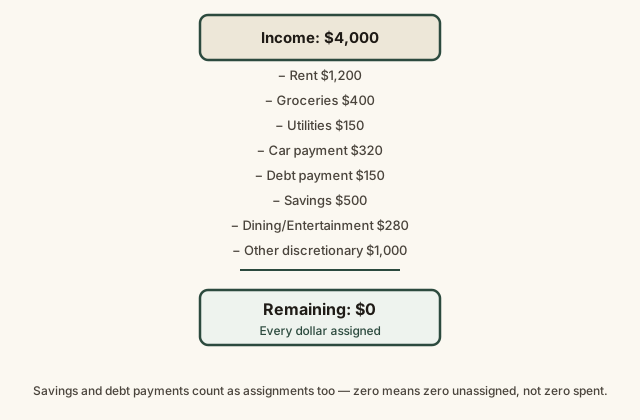
Monthly income: $4,000. Assignments: rent $1,200, groceries $400, utilities $150, car payment $320, minimum debt payment $150, savings $500, dining/entertainment $280, remaining discretionary categories totaling $1,000 (insurance, gas, subscriptions, miscellaneous). Running total: $4,000 − $1,200 − $400 − $150 − $320 − $150 − $500 − $280 − $1,000 = $0. Every dollar has an assigned job; the budget is balanced at zero.
Example 2: What happens when the running total doesn't reach zero cleanly (edge case / variation)
Using the same income ($4,000) and the same fixed obligations, but adding a larger emergency-fund savings goal of $800 instead of $500, the assignments now total $4,300 — $300 more than income. A zero-based budget makes this shortfall visible immediately, before the month starts, rather than being discovered as an overdraft at month's end. The fix is to either reduce a discretionary assignment (dining, entertainment) by $300, or reduce the savings goal for this period, choosing deliberately rather than by default.
Quick check
A zero-based budget shows assignments totaling more than income. What does this reveal that a simple after-the-fact spending log might not catch until later?
Example 3: Adjusting a zero-based budget mid-month when income changes (real-world / applied case)
A freelancer builds a zero-based budget assuming $3,500 in expected income, but only $2,900 actually arrives by mid-month. Because every dollar was already assigned a specific job, the shortfall is easy to trace to specific categories rather than being a vague sense of "running low" — the freelancer can see exactly which $600 of assignments (perhaps the discretionary and extra-savings portions) need to be delayed or reduced for this period, while the fixed obligations (rent, minimum debt payments) stay protected.
How it works (visual)
Zero-based budgeting: assigning income down to zero
Each subtraction represents a deliberate assignment, not a passive expense — the process ends only when the running total hits exactly zero.
Common mistakes
Common Mistakes
✕
Assuming zero-based budgeting means spending every dollar and leaving nothing for savings.
→ Remember that savings and debt repayment are valid assignments — 'zero' means zero unassigned dollars, not zero dollars saved.
✕
Building the budget once and never revisiting it as income or bills change.
→ Rebuild the assignment plan each period, since zero-based budgeting is designed around current, actual numbers rather than a fixed formula.
✕
Leaving a 'miscellaneous' catch-all category so large that it defeats the purpose of assigning every dollar deliberately.
→ Keep the miscellaneous category small and specific, or break it into named sub-categories, so most spending is genuinely planned rather than vaguely bucketed.
Common misconception
“Zero-based budgeting is the same as spending your entire paycheck.”
The "zero" refers to unassigned income, not unspent income. A household that assigns $4,000 of income to $2,800 in expenses and $1,200 to various savings and debt-payoff goals has run a correct zero-based budget — every dollar has a deliberate destination, even though a large share of it isn't being spent on goods or services.
What to do next
What to do next
List total expected income for the upcoming period.
Assign specific dollar amounts to each fixed obligation first, then variable needs, then savings goals, then wants.
Subtract each assignment from the running total and confirm it reaches exactly zero — adjust assignments if it goes negative or leaves unassigned money.
Rebuild the assignment plan each new period rather than reusing an old one automatically.
FAQ
FAQ
Related terms
Related terms
Zero-based budget
A budgeting method where every dollar of income is assigned a specific job (spending, saving, or debt repayment) before the month begins, so income minus assignments equals zero.
Assignment
In zero-based budgeting, the deliberate designation of a specific dollar amount to a specific category or goal.
This entry was researched from public sources and drafted with AI-assisted tools, then edited — errors are still possible. Spot one, or want a topic covered? Read our disclaimer.
 KnowThis