 KnowThis
Key Takeaways
Key Takeaways
- 1Unemployment insurance is run by individual states, not a single federal program — eligibility rules, benefit formulas, and maximum amounts all vary by state.
- 2Most states calculate the weekly benefit as a percentage of wages earned during a defined recent "base period," not a flat amount everyone receives equally.
- 3General eligibility usually requires losing a job through no fault of your own (layoffs generally qualify, most voluntary quits and terminations for misconduct generally don't) plus actively searching for new work.
The concept
This state-by-state structure is exactly why the same job loss can result in very different benefit amounts for two people in different states with similar recent earnings — the formula itself, not just the person's wage history, differs.
Two people with identical recent earnings history lose their jobs at the same time, but live in different states. Why might they receive different weekly unemployment benefit amounts?
Worked examples
Example 1: A standard layoff (baseline case)
Example 2: A voluntary quit (edge case / variation)
Example 3: Inconsistent recent earnings (real-world / applied case)
Why might someone's calculated weekly unemployment benefit not match a simple average of their recent pay across the whole base period?
How it works (visual)
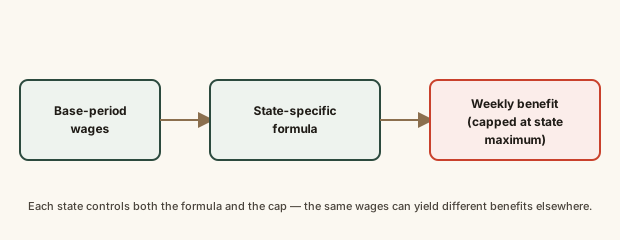
Each state controls both the formula in the middle of this process and the cap at the end, which is why the same starting wages can lead to different final benefit amounts depending on the state.
Common mistakes
Common Mistakes
Assuming unemployment benefits work the same way and pay the same amount nationwide.
→ Check your specific state's unemployment agency for its actual formula, base period definition, and maximum weekly amount.
Assuming any job separation automatically qualifies for benefits.
→ Confirm eligibility specifics with your state agency — reason for separation (layoff versus voluntary quit versus misconduct) generally affects eligibility.
Estimating your benefit with a simple average of recent pay instead of the state's actual formula.
→ Use your state's official benefit calculator or agency guidance, since formulas often weight specific quarters rather than averaging flatly.
Common misconception
“Unemployment benefits replace your full previous salary while you look for a new job.”
Per U.S. Department of Labor program structure, unemployment insurance is designed as partial, temporary wage replacement, not full income replacement — weekly benefit amounts are calculated as a percentage of past wages, capped at a state-specific maximum that is often well below what many claimants previously earned, which is why it's described as a bridge rather than a replacement income.
What to do next
What to do next
- Find your specific state's unemployment agency through CareerOneStop or DOL.gov and review its actual eligibility rules and formula.
- Gather recent pay records covering your likely base period before applying, since the formula depends on that specific window.
- Apply promptly after job loss, since most states have specific filing timelines that affect when benefits start.
- If your claim is denied and you believe it was in error, ask your state agency directly about the specific appeals process — don't assume the initial decision is final without checking.