A public holiday is a legally mandated non-working day, typically set by national or regional government statute and enforced through labor and banking law, while an observance is simply an officially designated day of recognition with no legal requirement to close anything.
Reading time
— 4 min
Updated
— Aug 21, 2026
Fact-reviewed
— Aug 21, 2026
Key Takeaways
Key Takeaways
1A public holiday has a specific legal effect — it closes government offices and typically triggers labor-law provisions like paid leave or holiday pay — while an observance carries no such legal requirement.
2Whether a given day is a 'public holiday' often varies by jurisdiction even within one country, since many public holidays are set at the state, provincial, or local level rather than nationally.
3Most UN international days are observances, not public holidays — they're designed to draw attention to an issue, not to close businesses or government offices.
The concept
A public holiday is a day that's legally recognized as a non-working day — government offices close, and depending on the country, employees are often entitled to paid time off or extra holiday pay if they do work. An observance, on the other hand, is just a designated day meant to draw attention to something — it doesn't close anything or change anyone's work schedule. World Water Day is an observance; Independence Day (in most countries that celebrate one) is typically a public holiday.
This distinction matters practically: knowing whether a date is a legally binding public holiday or just a recognized observance tells you whether to expect government offices and banks to actually be closed, or whether it's simply a day when an issue gets extra media attention.
Quick check
World Water Day (March 22) is a UN-designated day. Does it legally close government offices or banks?
Worked examples
Example 1: A clear public holiday (baseline case)
In the United States, Thanksgiving (the fourth Thursday of November) is a federal public holiday established by an act of Congress in 1941 — federal offices close, and most private employers voluntarily follow suit even though they aren't legally required to for non-federal employees, since it's become a near-universal cultural norm layered on top of the legal designation.
Example 2: A widely-known observance that is NOT a public holiday (edge case / variation)
Earth Day (April 22) is one of the most widely recognized environmental observances in the world, marked by events, media coverage, and school programs in dozens of countries — but it is not a public holiday anywhere; it has no legal closure effect, no mandated paid leave, and government offices operate normally. Its wide recognition comes from decades of grassroots and educational adoption, not from any statute requiring closures.
Example 3: An observance day that later became a legal public holiday (real-world / applied case)
Juneteenth (June 19) was observed informally and at the state level in the US for well over a century — Texas made it a state holiday in 1980 — before Congress passed the Juneteenth National Independence Day Act in 2021, converting it into an official federal public holiday. This shows the two categories aren't permanently fixed: an observance can transition into a legally binding public holiday, but only through a separate, specific legislative act, not through informal popularity alone.
Quick check
Juneteenth was widely observed for decades before becoming a US federal public holiday in 2021. What actually changed its legal status?
How it works (visual)
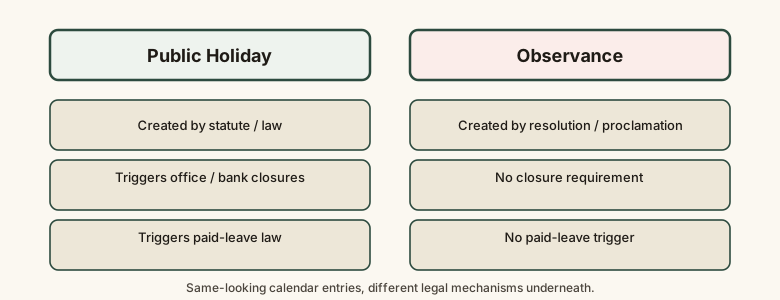
Public holiday vs observance: what each legally triggers
The visual difference is really a legal-mechanism difference: a public holiday is defined by what it forces institutions to do, while an observance is defined only by what it asks people to pay attention to.
Common mistakes
Common Mistakes
✕
Assuming a widely-recognized observance (like Earth Day) must also be a public holiday somewhere.
→ Check whether a specific statute grants the day legal closure or paid-leave status — wide recognition and legal holiday status are separate things.
✕
Assuming a country's public holidays are uniform nationwide.
→ In federal systems especially, check whether a holiday is set at the national, state/provincial, or local level, since coverage can vary.
✕
Assuming UN-designated international days automatically function as public holidays anywhere in the world.
→ Remember UN days are almost always observances by default — a country would need to pass its own separate law to also make that date a public holiday.
Common misconception
“If a day is well-known and widely marked with events and media coverage, it must legally be a public holiday somewhere.”
Public visibility and legal holiday status are entirely separate. Earth Day, World Water Day, and many other globally recognized observances have no legal closure effect anywhere — their prominence comes from sustained cultural, educational, and media attention, not from any statute mandating institutional closures.
Quick check
Why might a day be closed for government offices in one US state but not another, even though it's widely called a 'national' observance?
What to do next
What to do next
Before assuming an office or bank will be closed on a given date, check whether it's actually a legally designated public holiday in your specific jurisdiction.
When you encounter an 'international day,' check whether it's a UN observance (no legal closure effect) or has separately been adopted as a public holiday somewhere.
Notice which level of government (national, state/provincial, local) actually sets a given holiday in your country.
Look up the specific statute behind a public holiday you observe, to understand when and why it was legally established.
FAQ
FAQ
Related terms
Related terms
Public holiday
A day designated by government statute on which government offices, and often banks and many private businesses, are legally closed or operate under special rules (e.g. mandatory paid leave).
Observance
A day officially designated to recognize an issue, group, or event, carrying no legal requirement that any institution close or alter its operations.
Bank holiday
A term (especially common in the UK and Commonwealth countries) for a public holiday specifically defined by its effect on banking and financial institution operating hours.
This entry was researched from public sources and drafted with AI-assisted tools, then edited — errors are still possible. Spot one, or want a topic covered? Read our disclaimer.
 KnowThis