National Symbols Explained (Flag, Anthem, Emblem — General Framework)
National symbols — the flag, anthem, and state emblem — are formally adopted, legally protected representations of a country's identity, each carrying deliberately chosen colors, imagery, or lyrics that encode a specific national narrative.
Reading time
— 4 min
Updated
— Aug 21, 2026
Fact-reviewed
— Aug 21, 2026
Key Takeaways
Key Takeaways
1A flag, anthem, and emblem are each independently and formally adopted — usually by a specific law or constitutional provision — not just customs that emerged informally over time.
2Every element of a well-designed national flag (each color, each shape, each number of stripes or stars) is typically traceable to a specific, documented reason, even when that reason has been reinterpreted over generations.
3National symbols carry real legal weight: most countries have statutes governing how the flag may be displayed, folded, disposed of, or reproduced, and violating them can carry actual penalties.
The concept
A country typically has three separate official symbols: a flag (a specific pattern of colors and shapes), a national anthem (an official song with legally designated lyrics and music), and a state emblem (a symbol distinct from the flag, often used on passports, currency, or government buildings). Each one is adopted through its own formal process — usually a law passed by the national legislature — and each one is designed to encode a specific piece of the country's identity or history.
Because each symbol is independently codified, a country can change one without touching the others — a national anthem's lyrics can be revised by a legislature while the flag stays completely unchanged, and vice versa.
Quick check
A country updates its national anthem's lyrics through a new law. Does this automatically change the country's flag design as well?
Worked examples
Example 1: Reading a flag's encoded meaning (baseline case)
South Africa's flag, adopted in 1994, uses six colors arranged in a Y-shaped design explicitly intended to represent the convergence of the country's diverse population groups into one nation after apartheid — the design brief itself, published by the government, states the Y symbolizes "the convergence of divergent elements within South African society, taking the road ahead in unity." This is typical of modern flag design: the shapes and colors are not arbitrary decoration but a deliberately chosen visual argument about national identity, documented in the official adoption record.
Example 2: A country with a flag that is legally distinct from its emblem (edge case / variation)
Switzerland's national flag is a simple white cross on a red square — no coat of arms, no text, no additional imagery. But Switzerland's official state emblem (used on some government documents and by Swiss embassies) is a more heraldic version of the same cross set within a shield shape, following formal coat-of-arms conventions. The two are legally distinct symbols defined by separate federal ordinances, even though they visually share the same core cross-on-red motif — illustrating that "flag" and "emblem" are not always just two names for the same image.
Example 3: Legal penalties for flag misuse (real-world / applied case)
The United States Flag Code (Title 4 of the U.S. Code) specifies detailed rules for display, folding, and retirement of a worn flag (by burning, in a dignified ceremony) — while the Flag Code itself is largely advisory with no federal criminal penalty attached to most violations, individual states have separately enacted flag-desecration statutes with real (though constitutionally contested) penalties, and the U.S. Supreme Court has ruled on the free-speech limits of such laws multiple times (notably Texas v. Johnson, 1989). This shows that "symbolic" national symbols can carry genuine, litigated legal consequences, not just etiquette expectations.
Quick check
Switzerland's flag (a plain white cross on red) and its official state emblem look visually similar but are legally two different symbols. What does this illustrate?
How it works (visual)
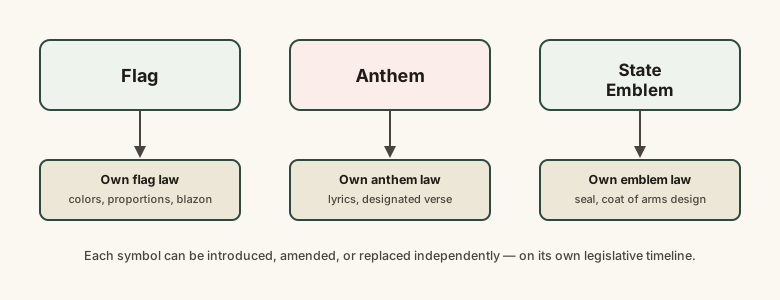
Three separate national symbols, three separate adoption processes
Each symbol sits in its own legal track — a flag law, an anthem law, and an emblem law can each be introduced, debated, and amended on entirely separate legislative timelines, which is why countries sometimes update one symbol decades before touching another.
Common mistakes
Common Mistakes
✕
Assuming a country's flag and its state emblem (or coat of arms) are just two names for the same image.
→ Check whether the country has separately published a flag law and an emblem/coat-of-arms law — most do, and the two symbols are often visually different.
✕
Treating a flag's colors and shapes as purely decorative rather than deliberately symbolic.
→ Look for the country's official design brief or adoption legislation, which almost always documents a specific intended meaning for each color and shape.
✕
Assuming national anthem lyrics are fixed and universal, when many anthems have multiple verses and only an officially designated subset is used ceremonially.
→ Check the anthem's official adopting law for which verse(s) are designated as the ceremonial standard.
Common misconception
“A country's flag design is just a matter of aesthetic taste or historical accident, without any formal legal status.”
National flags are almost always defined by a specific law or constitutional clause, including an official written blazon that precisely specifies proportions and colors — reproducing a flag incorrectly (wrong color shade, wrong proportions) can technically violate that legal definition, even if the visual difference looks minor to a casual observer.
Quick check
Why do many countries publish an official written 'blazon' (a precise textual description) of their flag, rather than just an image file?
What to do next
What to do next
Next time you see a national flag, try to identify what each color or shape is documented to represent — most governments publish this explanation officially.
Check whether a country you're curious about has a separate state emblem from its flag, and compare the two designs.
Look up your own country's flag code or flag law to see what display and disposal rules actually apply.
When encountering a national anthem, notice whether only a specific verse is used ceremonially, and look up why.
FAQ
FAQ
Related terms
Related terms
Vexillology
The formal study of the history, symbolism, and design of flags.
State emblem
An officially adopted graphic symbol (distinct from the flag) used to represent a government or state on documents, buildings, and official seals.
Blazon
The precise, standardized written description of a flag's or coat of arms's design, used to define it legally regardless of how any individual artist renders it.
This entry was researched from public sources and drafted with AI-assisted tools, then edited — errors are still possible. Spot one, or want a topic covered? Read our disclaimer.
 KnowThis