International Days & Their Origins (UN-Designated Days)
A UN-designated international day is a specific date formally adopted by resolution — typically of the UN General Assembly or a specialized agency — created to focus sustained global attention and reporting on one particular issue, not just a symbolic calendar entry.
Reading time
— 4 min
Updated
— Sep 25, 2026
Fact-reviewed
— Aug 21, 2026
Key Takeaways
Key Takeaways
1Every official UN international day traces back to a specific resolution, adopted by a specific UN body, on a specific date — it isn't simply a tradition that accumulated informally.
2The UN currently recognizes well over 100 international days, and the list keeps growing as member states propose and pass new resolutions.
3Most international days are designed around a campaign structure — a yearly theme, coordinated reporting, and often a flagship UN report timed to release alongside the day — rather than existing purely as a symbolic date.
The concept
An international day like World Water Day (March 22) or International Women's Day (March 8) exists because the United Nations formally created it through an official vote — usually by the UN General Assembly resolution process. The goal of most international days is to focus worldwide attention, media coverage, and often government reporting on one specific issue for at least one day a year, rather than just marking an anniversary.
Because the designation process is formal and documented, it's possible to trace any genuine UN international day back to the exact resolution, year, and adopting body that created it — which is a useful way to separate an actual UN observance from an informally popularized one.
Quick check
Someone claims a certain date is an 'official international day' but can't point to any UN resolution or agency designation behind it. What does that suggest?
Worked examples
Example 1: Tracing World Water Day to its origin (baseline case)
World Water Day (March 22) was established by UN General Assembly resolution A/RES/47/193 in 1992, following a recommendation from the UN Conference on Environment and Development held that same year in Rio de Janeiro. Each year since, UN-Water (the inter-agency coordination mechanism) selects a specific theme and releases the UN World Water Development Report timed to the day — the 2023 theme, for example, focused on accelerating change for water and sanitation. This shows the typical structure: a founding resolution, an ongoing coordinating body, and a recurring annual campaign built around it.
Example 2: A day designated by a specialized agency rather than the General Assembly (edge case / variation)
World Health Day (April 7) was established by the World Health Organization's own governing body, not a UN General Assembly resolution — it marks WHO's founding date in 1948 and was adopted by the World Health Assembly (WHO's decision-making body) rather than going through the full UN General Assembly. This illustrates that not every international day requires the broadest possible UN process; specialized agencies can and do create their own observance days within their mandate.
Example 3: How an international day drives real reporting and funding decisions (real-world / applied case)
International Day for Disaster Risk Reduction (October 13) is used by the UN Office for Disaster Risk Reduction to coordinate the release of the annual Sendai Framework progress report, which national governments use to benchmark their own disaster-preparedness policy against international targets. This is a concrete example of an international day functioning as more than symbolism — it's the anchor date for an actual, recurring policy accountability cycle that governments and aid organizations plan around.
Quick check
World Health Day was designated by the World Health Assembly rather than the UN General Assembly. What does this show about how international days can be created?
How it works (visual)
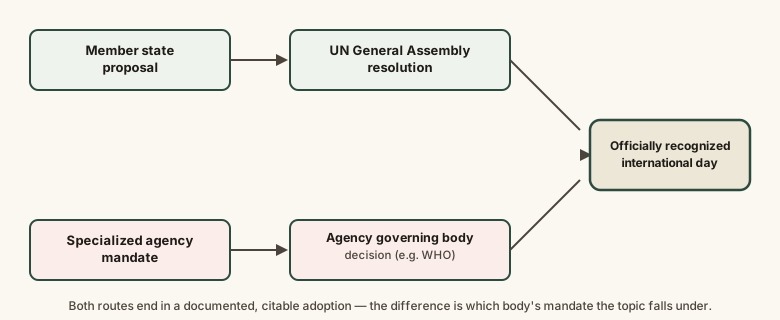
Two routes to becoming an official UN international day
Both paths end at the same outcome — an internationally recognized observance day with an annual theme and coordinated reporting — but they start from different institutional starting points, which is why some days trace to a General Assembly resolution number and others trace to a specific agency's own governing decision.
Common mistakes
Common Mistakes
✕
Assuming any widely-known 'international day' (including commercial or cultural ones) is officially UN-designated.
→ Check the UN's own official list of international days and weeks before citing a date as a UN observance.
✕
Assuming all international days go through the UN General Assembly.
→ Remember specialized agencies (WHO, UNESCO, FAO, etc.) can independently designate their own observance days within their specific mandate.
✕
Treating an international day as purely symbolic, with no real institutional follow-through.
→ Look for the flagship report, campaign theme, or coordinating body tied to the day — most genuine UN observances have one.
Common misconception
“International days are just symbolic calendar markers with no real institutional structure behind them.”
Most genuine UN international days are anchor points for an ongoing annual cycle — a coordinating body (like UN-Water or WHO), a yearly theme, and often a flagship report or policy benchmark timed to release alongside the day. The day itself is the visible tip of a year-round coordination process, not an isolated one-day event.
Quick check
Why does checking the UN's official list matter before calling something an 'international day'?
What to do next
What to do next
Next time you see an 'international day' referenced, check the UN's official list to confirm it's a genuine designation.
Look up the founding resolution or agency decision behind a day you care about, to understand what specific problem it was created to spotlight.
Notice whether a day has an annual theme or flagship report tied to it — that's a sign of ongoing institutional follow-through rather than a one-off symbolic date.
Distinguish in your own reading between UN-designated international days and separate national or cultural observance days.
FAQ
FAQ
Related terms
Related terms
UN General Assembly resolution
A formal decision adopted by vote of all UN member states in the General Assembly; most international days are created this way, though the resolutions are typically non-binding recommendations rather than enforceable law.
Specialized agency
A UN-affiliated organization (like WHO or UNESCO) with its own membership and mandate, which can independently designate observance days within its own area of focus.
This entry was researched from public sources and drafted with AI-assisted tools, then edited — errors are still possible. Spot one, or want a topic covered? Read our disclaimer.
 KnowThis