 KnowThis
Key Takeaways
Key Takeaways
- 1An embassy handles a country's official political relationship with the host country's national government and exists only once per host country, in the capital.
- 2A consulate handles citizen services (passports, visas, emergency assistance) and trade matters, and a country can maintain several consulates across a host country's other major cities.
- 3Embassies and consulates are governed by two separate treaties — the 1961 Vienna Convention on Diplomatic Relations for embassies, and the 1963 Vienna Convention on Consular Relations for consulates — with different (though related) protections for each.
The concept
Because embassies and consulates serve different functions under different treaties, a traveler needing a lost-passport replacement or a visa almost always deals with a consulate (or a consular section within an embassy), not the ambassador's political office.
A traveler needs to replace a lost passport while abroad. Should they go to their country's embassy or consulate?
Worked examples
Example 1: One embassy, multiple consulates (baseline case)
Example 2: Embassy inviolability in practice (edge case / variation)
Example 3: Consular assistance during a crisis (real-world / applied case)
Why can't host-country police simply enter a foreign embassy to make an arrest, even for a serious crime?
How it works (visual)
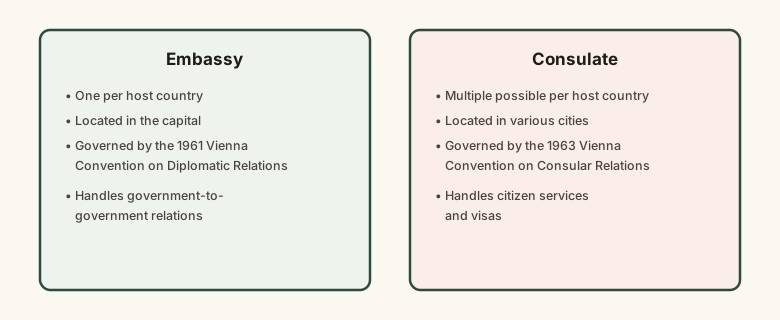
The two columns rarely operate in true isolation — many countries house a consular section inside the embassy building itself, so a single physical location can perform both the embassy's diplomatic function and a consulate's citizen-service function at once.
Common mistakes
Common Mistakes
Using 'embassy' and 'consulate' interchangeably as if they're just two names for the same office.
→ Check the function you actually need — political/government relations means the embassy, citizen services (passports, visas) usually means a consulate or consular section.
Assuming a country can only have one diplomatic presence total in a host country.
→ Remember a country typically has one embassy (in the capital) plus potentially several separate consulates in other major cities.
Believing embassy grounds are literally the sending country's sovereign territory.
→ Use the more precise legal framing: the premises are inviolable and protected from host-country enforcement under the Vienna Convention, which is a different legal concept than a transfer of territorial sovereignty.
Common misconception
“An embassy is legally foreign soil belonging to the sending country.”
Under the Vienna Convention on Diplomatic Relations, embassy premises are inviolable — host-country authorities cannot enter without permission — but sovereignty over the land itself does not transfer to the sending country. The host country retains sovereignty; what changes is that its own enforcement authorities are barred from acting on the premises without consent. This is a precise, different legal concept from "foreign soil," even though the practical effect (host police can't just walk in) can look similar from the outside.
What is the precise legal reason host-country police can't enter an embassy without permission, according to the Vienna Convention on Diplomatic Relations?
What to do next
What to do next
- If you ever need a visa or passport service abroad, look up your country's nearest consulate rather than assuming you must go to the capital's embassy.
- Notice the difference in news coverage between 'embassy' stories (usually political/diplomatic) and 'consulate' stories (usually citizen-service or trade related).
- Read the two Vienna Conventions' actual scope (linked in sources) to see how the treaty framework separates diplomatic and consular protections.
- Check how many consulates your own country's government operates abroad, and where they're located relative to the embassy.