Diplomatic immunity is a set of legal protections, codified in the 1961 Vienna Convention on Diplomatic Relations, that shields accredited diplomats from arrest and prosecution under a host country's laws, so that diplomatic communication can continue even when relations between two countries are strained.
Reading time
— 4 min
Updated
— Aug 21, 2026
Fact-reviewed
— Aug 21, 2026
Key Takeaways
Key Takeaways
1Diplomatic immunity comes from a specific 1961 treaty (the Vienna Convention on Diplomatic Relations), not from informal custom — nearly every country in the world has ratified it.
2Immunity protects the diplomatic function, not the person: a host country cannot arrest or prosecute an accredited diplomat, but the sending country can waive immunity or recall the diplomat, and the diplomat remains bound by their own country's laws.
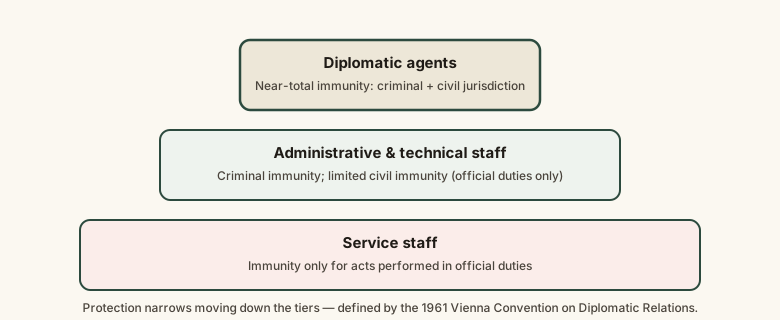
3Immunity comes in tiers — full diplomatic agents receive near-total protection from criminal jurisdiction, while administrative, technical, and service staff receive progressively narrower protection under the same treaty.
The concept
Diplomatic immunity is a legal protection that stops a host country from arresting or prosecuting a foreign diplomat under its own criminal laws. It exists so that diplomats can do their job — represent their government and communicate with a host country — without fear of being detained or intimidated by that host country, even during moments of serious political tension. It does not mean a diplomat can do whatever they want with no consequences: their home government can still discipline them, and the host country can declare them persona non grata and expel them.
Because immunity is a treaty obligation between states rather than a personal privilege, the practical remedy for diplomatic misconduct is almost always diplomatic, not judicial — expulsion, formal protest, or a request that the sending state waive immunity or prosecute the individual itself.
Quick check
A diplomat accredited to a host country commits a serious crime there. Under the Vienna Convention, can the host country's police simply arrest and prosecute the diplomat in a local court?
Worked examples
Example 1: A parking ticket vs. a criminal case (baseline case)
A diplomat's car accumulates unpaid parking tickets in a host city. The host country generally cannot compel payment through its courts, since civil enforcement against a diplomatic agent is also restricted under the Convention — cities often address this instead through informal channels, like withholding future parking permits or raising the pattern with the diplomat's foreign ministry, rather than legal prosecution.
Example 2: Waiver of immunity (edge case / variation)
In rare cases, a sending country chooses to waive a diplomat's immunity, allowing the host country to prosecute. This has happened in real cases involving serious crimes when the sending government determines that defending the individual is not worth the diplomatic cost of appearing to shield a serious offense — the waiver must be explicit and is entirely at the sending state's discretion, not something the host state or the diplomat can force.
Example 3: Expulsion as the real-world remedy (real-world / applied case)
When a host country believes a diplomat has committed a serious offense and immunity is not waived, the standard real-world remedy is declaring the diplomat persona non grata — formally notifying the sending country that the individual is no longer welcome. The sending country is then expected to recall the diplomat, typically within a set period. This tool is used regularly in international relations, including in disputes unrelated to criminal conduct, such as during periods of political tension between two countries.
Quick check
If a host country cannot prosecute a diplomat locally, what is the standard remedy available to it under the Vienna Convention?
How it works (visual)
Tiers of protection under the Vienna Convention on Diplomatic Relations
The tiered structure exists because the Convention balances two goals at once — protecting the diplomatic function fully at the top, while limiting how far that protection extends down through a mission's larger staff, so immunity doesn't become an unlimited shield for anyone employed by an embassy.
Common mistakes
Common Mistakes
✕
Assuming diplomatic immunity means a diplomat is above all law, everywhere, forever.
→ Remember immunity is jurisdiction-specific (it applies to the host country's courts) and can be waived by the sending state — the diplomat remains fully subject to their own country's laws.
✕
Assuming every embassy employee has the same level of immunity as the ambassador.
→ Check the Convention's tiered categories — administrative, technical, and service staff have progressively narrower protection than accredited diplomatic agents.
✕
Confusing 'declared persona non grata' with 'immunity revoked.'
→ A persona non grata declaration requires the sending country to recall the diplomat — it doesn't retroactively strip the immunity that applied while they were accredited.
Common misconception
“Diplomatic immunity is an unwritten courtesy between governments, applied inconsistently at each country's discretion.”
Diplomatic immunity is codified in a specific, near-universally ratified treaty — the 1961 Vienna Convention on Diplomatic Relations — with defined tiers of protection, defined remedies (persona non grata, waiver requests), and a long history of international legal interpretation, including cases before the International Court of Justice. It is a structured, treaty-based legal system, not an informal custom.
Quick check
Why do virtually all countries — including ones that are frequently in political conflict with each other — still honor the Vienna Convention's diplomatic immunity rules?
What to do next
What to do next
Next time a diplomatic immunity case appears in the news, check whether it involves a full diplomatic agent or another tier of mission staff — the protection level differs.
Read the actual text of the Vienna Convention on Diplomatic Relations (linked in sources) to see the tiered categories defined directly.
Notice the difference between 'immunity waived' and 'declared persona non grata' the next time either term appears in reporting — they are different remedies with different effects.
Look up how many countries have ratified the Vienna Convention to appreciate how close to universal this legal framework actually is.
FAQ
FAQ
Related terms
Related terms
Vienna Convention on Diplomatic Relations
The 1961 international treaty, ratified by nearly every UN member state, that codifies the rules of diplomatic immunity and the legal status of embassies.
Persona non grata
A formal declaration by a host country that a specific diplomat is no longer welcome, which does not strip immunity but obliges the sending country to recall them, usually within a set time.
Diplomatic agent
Under the Vienna Convention, a diplomat or member of the diplomatic staff of a mission who holds the highest level of immunity, as distinct from administrative, technical, or service staff who receive narrower protection.
This entry was researched from public sources and drafted with AI-assisted tools, then edited — errors are still possible. Spot one, or want a topic covered? Read our disclaimer.
 KnowThis