Ancient Greece was a collection of independent city-states across the Greek mainland, islands, and coastal settlements from around 800 to 146 BCE, which developed early democracy, foundational Western philosophy, and drama, before being absorbed into the Roman Republic.
Reading time
— 4 min
Updated
— Oct 7, 2026
Fact-reviewed
— Aug 16, 2026
Key Takeaways
Key Takeaways
1"Ancient Greece" was never a unified country — it was hundreds of independent city-states (poleis) that shared a language and religion but often fought each other, most famously Athens and Sparta.
2Athenian democracy (from around 508 BCE) let male citizens vote directly on laws, but excluded women, enslaved people, and non-citizen residents — a much narrower "democracy" than the word implies today.
3Alexander the Great's conquests (334–323 BCE) spread Greek culture from Egypt to the edge of India, creating the Hellenistic world that Rome later inherited and built on.
The concept
Ancient Greece wasn't a single country the way we'd picture one today — it was a patchwork of independent city-states (poleis) spread across the Greek mainland, the surrounding islands, and coastal settlements around the Mediterranean and Black Sea. Each city-state, like Athens, Sparta, Corinth, or Thebes, had its own government, laws, and army, even though they shared a language, religion, and Panhellenic festivals like the Olympic Games. This fragmentation is central to understanding Greek history — it's why Greek city-states fought each other as often as they cooperated against outside threats.
That gap between the ideal of Greek democracy and who it actually included matters for understanding how directly — and how imperfectly — it connects to democratic systems today.
Quick check
Who was allowed to vote in ancient Athenian democracy?
Case studies
Case 1: The Battle of Marathon and the Greco-Persian Wars (baseline case)
In 490 BCE, a heavily outnumbered Athenian army defeated an invading Persian force at Marathon, a victory that became foundational to Athenian identity and, centuries later, gave its name to the 26.2-mile running race (based on the legendary — and likely embellished — story of a runner carrying news of the victory back to Athens). The wider Greco-Persian Wars (499–449 BCE) saw Greek city-states, usually rivals, temporarily unite against the much larger Persian Empire, and their success is often cited by historians as a pivotal moment that let distinctly Greek political and cultural development continue rather than being absorbed into Persian rule.
Case 2: The Peloponnesian War — Greeks against Greeks (variation / turning point)
Just decades after uniting against Persia, Athens and Sparta led rival alliances into a grinding 27-year war (431–404 BCE) that ended with Sparta's victory and Athens's political and military decline. The historian Thucydides, who lived through it, wrote an account of the war that's still studied today as one of the founding texts of the study of history and international relations — not myth or legend, but a deliberately evidence-based, analytical account of real events, itself a genuinely new kind of writing at the time.
Case 3: How Greek philosophy still structures Western thought (real-world / applied case)
Socrates (c. 470–399 BCE), Plato, and Aristotle, working in and around Athens across roughly a century, established methods of questioning, logic, and systematic inquiry that still underpin Western philosophy, science, and education. The "Socratic method" — teaching through structured questioning rather than lecturing — is still used in law schools and classrooms today, and Aristotle's work on logic and biological classification shaped scientific method for nearly two thousand years afterward.
Quick check
How did the Greco-Persian Wars and the Peloponnesian War differ?
How it works (visual)
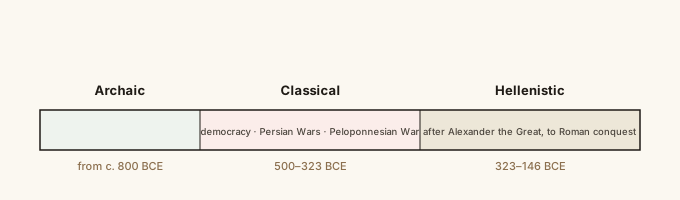
Ancient Greece: key periods, from early city-states to Roman conquest
Alexander the Great's conquests mark the hinge point: before 323 BCE, Greek culture was mostly confined to the Mediterranean and Aegean world; after it, Greek language, art, and ideas spread as far as modern-day Afghanistan and Pakistan, laying groundwork Rome would later absorb wholesale.
Common mistakes
Common Mistakes
✕
Treating "ancient Greece" as one unified nation with one government.
→ It was a collection of fiercely independent city-states that frequently fought each other — unity, when it happened, was usually temporary and driven by an outside threat like Persia.
✕
Assuming Athenian democracy resembled modern democracy in who could participate.
→ It excluded women, enslaved people, and foreign residents — roughly 80-90% of the population — a crucial caveat when calling it "the birthplace of democracy."
✕
Confusing the timeline of Socrates, Plato, and Aristotle as simultaneous rather than sequential.
→ They form a direct teacher-student chain across about a century: Socrates taught Plato, and Plato taught Aristotle, who later tutored Alexander the Great — not three contemporaries working independently.
Common misconception
“Ancient Greek statues and temples were plain white marble, reflecting a refined, minimalist aesthetic.”
Ancient Greek statues and buildings were originally painted in bright, often bold colors — the plain white appearance familiar today is the result of pigment fading and eroding away over more than two thousand years, not the original intended look. Archaeological analysis (including ultraviolet imaging that detects trace pigment) has confirmed vivid original color schemes on surviving sculptures.
What to do next
What to do next
Next time you see a "pure white" Greek statue in a museum, remember it was likely originally brightly painted.
When you hear "ancient Greek democracy" praised uncritically, mentally add the caveat about who was actually excluded from voting.
Trace the Socrates → Plato → Aristotle teaching chain next time one of them comes up — it makes their ideas easier to place in order.
FAQ
FAQ
Related terms
Related terms
City-state (polis)
An independent Greek city and its surrounding territory, governing itself rather than being part of a unified Greek nation.
Democracy
From Greek dēmokratia ("rule by the people") — a system where citizens vote directly or indirectly on laws and leaders, first practiced at scale in ancient Athens.
Philosophy
From Greek philosophia ("love of wisdom") — the systematic study of fundamental questions about knowledge, existence, ethics, and reasoning.
Hellenistic period
The era after Alexander the Great's conquests (from 323 BCE) when Greek culture spread across and blended with the Near East, Egypt, and Central Asia.
This entry was researched from public sources and drafted with AI-assisted tools, then edited — errors are still possible. Spot one, or want a topic covered? Read our disclaimer.
 KnowThis