Ancient China developed along the Yellow and Yangtze Rivers from around 2070 BCE, ruled through a sequence of dynasties legitimized by the "Mandate of Heaven," and produced writing, philosophy, and technology that shaped East Asia for millennia.
Reading time
— 4 min
Updated
— Oct 7, 2026
Fact-reviewed
— Aug 16, 2026
Key Takeaways
Key Takeaways
1Ancient China's political history runs through a sequence of dynasties, each one justified by the "Mandate of Heaven" — the belief that a just ruler has heaven's approval, which can be lost through misrule.
2The earliest confirmed Chinese writing appears on oracle bones from the Shang Dynasty (c. 1600–1046 BCE), used to ask questions of ancestors and gods through divination.
3Confucius (551–479 BCE) never held major political power in his lifetime, but his ideas about social duty and moral leadership shaped Chinese government and culture for over two thousand years after his death.
The concept
Ancient China developed along the Yellow River and later the Yangtze River, with its first confirmed dynasty, the Shang, ruling from around 1600 BCE. Chinese history is organized around dynasties — families that held power for a stretch of time before being replaced. What's distinctive is the idea used to justify this over and over: the Mandate of Heaven, the belief that a good ruler has heaven's backing, and a ruler who governs badly — through famine, defeat, or corruption — has lost it, which is used to explain why dynasties fall and new ones rise.
That political framework explains how power changed hands, but it doesn't explain what actually got built and thought during those dynasties — starting with a writing system whose earliest confirmed use was for asking questions of the dead.
Quick check
What was the political purpose of the "Mandate of Heaven" concept in ancient China?
Case studies
Case 1: Oracle bones and the birth of Chinese writing (baseline case)
Shang Dynasty diviners carved questions onto turtle shells or ox shoulder bones — about harvests, weather, military campaigns, even the king's toothaches — then applied heat until the bone cracked, reading the crack pattern as an answer from ancestors or gods, and often recording the question and outcome in early Chinese characters. Over 150,000 inscribed oracle bone fragments have been recovered, giving historians the earliest confirmed evidence of the Chinese writing system, an ancestor of the characters still used today.
Case 2: Qin Shi Huang unifies China (variation / turning point)
In 221 BCE, the ruler of the Qin state conquered the last of his rival states and declared himself Qin Shi Huang, "First Emperor" — the first person to rule a unified China. He standardized weights, measures, currency, and even the width of cart axles across the newly unified territory, and began connecting existing defensive walls into what would eventually become the Great Wall. His rule was also famously harsh — he's associated with book burnings targeting rival philosophies and forced labor on massive projects, including his own tomb complex, guarded by the now-famous Terracotta Army of over 8,000 life-sized soldiers, discovered only in 1974.
Case 3: Confucius's ideas still shape East Asia today (real-world / applied case)
Confucius (551–479 BCE) taught ideas about social duty, respect for elders and ancestors, and the moral responsibility of rulers to govern justly — ideas that were later adopted as the official state philosophy of the Han Dynasty and shaped imperial civil service exams for nearly two thousand years afterward. Confucian values around education, family duty, and social hierarchy remain culturally influential today across China, Korea, Japan, and Vietnam, making him one of the very few individual thinkers whose ideas have shaped the daily culture of over a billion people, more than two millennia after his death.
Quick check
What did Qin Shi Huang do after unifying China in 221 BCE?
How it works (visual)
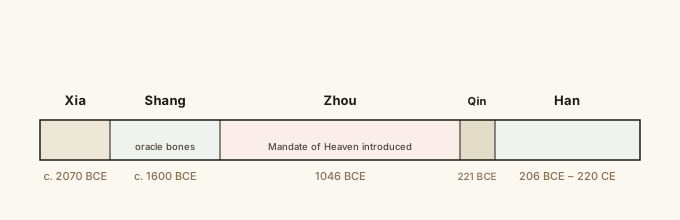
Major dynasties of ancient and imperial China, c. 2070 BCE – 220 CE
Notice how short the Qin Dynasty was — just 15 years (221–206 BCE) — compared to the roughly 400-year Han Dynasty that followed it. Qin Shi Huang's rapid, forceful unification set the template, but it was the longer, more stable Han Dynasty that actually cemented Chinese imperial culture for the centuries after.
Common mistakes
Common Mistakes
✕
Assuming the Great Wall of China was built as one continuous project by a single dynasty.
→ It was built, rebuilt, and connected in stages across multiple dynasties over roughly 2,000 years — most of the wall tourists visit today near Beijing actually dates from the much later Ming Dynasty (1368–1644 CE), not Qin Shi Huang's original walls.
✕
Treating Confucius as a religious founder comparable to a prophet.
→ Confucianism is a philosophical and ethical system focused on social duty and moral governance, not a religion with gods or an afterlife doctrine — Confucius himself is generally described by historians as a teacher and philosopher, not a religious figure.
✕
Assuming Chinese history is one unbroken, unchanging empire.
→ It cycled through distinct dynasties, periods of division and civil war (like the Warring States period before Qin unification), and real political rupture — treat it with the same nuance as any other multi-thousand-year political history.
Common misconception
“Ancient China was isolated from the rest of the world until European contact.”
Ancient China was connected to Central Asia, the Middle East, and eventually Europe through the Silk Road trade network from at least the Han Dynasty onward (2nd century BCE), exchanging silk, paper, and technology for goods, ideas, and religions like Buddhism, which arrived in China via these very trade routes from India and Central Asia. "Isolation" describes some later periods of restricted foreign trade policy, not ancient China as a whole.
What to do next
What to do next
Next time you see the Great Wall in a photo, remember most of the visible structure dates from the Ming Dynasty, over 1,500 years after the wall's earliest sections.
If you come across Confucian values in media from China, Korea, Japan, or Vietnam today, connect it back to a philosopher who died in 479 BCE without ever holding major political power himself.
Look up a photo of the Terracotta Army, discovered by farmers digging a well in 1974 — over 8,000 unique soldiers, still being excavated today.
FAQ
FAQ
Related terms
Related terms
Mandate of Heaven
The Chinese political and religious belief that heaven grants a just ruler the right to rule, and can withdraw that right if a ruler becomes unjust or incompetent.
Dynasty
A sequence of rulers from the same family line, each dynasty typically named after the family or state that founded it.
Oracle bones
Turtle shells or ox bones inscribed with early Chinese writing, used in the Shang Dynasty for divination and containing the earliest confirmed Chinese script.
Silk Road
The network of trade routes connecting China to Central Asia, the Middle East, and Europe, named for the Chinese silk that traveled along it.
This entry was researched from public sources and drafted with AI-assisted tools, then edited — errors are still possible. Spot one, or want a topic covered? Read our disclaimer.
 KnowThis