Ancient Mesopotamia was a region in modern-day Iraq between the Tigris and Euphrates rivers where, starting around 3500 BCE, humans built the first cities, invented writing, and wrote the first law codes.
Reading time
— 4 min
Updated
— Oct 7, 2026
Fact-reviewed
— Aug 16, 2026
Key Takeaways
Key Takeaways
1Mesopotamia — "land between the rivers" — sat between the Tigris and Euphrates in what is now Iraq, and is where the first cities in human history appeared.
2Sumerians invented cuneiform writing around 3200 BCE, originally to track grain and trade, not to record literature or history.
3Mesopotamia was never one unified nation for most of its history — it was a shifting patchwork of competing city-states, then empires (Akkadian, Babylonian, Assyrian) that rose and fell over roughly 3,000 years.
The concept
Mesopotamia was a region in the Middle East, roughly modern-day Iraq, sitting between two rivers — the Tigris and the Euphrates. Because the rivers flooded and left behind rich soil, farming could support far more people than hunting and gathering could, and starting around 3500 BCE, people settled into the first real cities, like Uruk and Ur. To manage all the grain, trade, and property that came with city life, they invented writing — wedge-shaped marks pressed into wet clay called cuneiform, the earliest writing system we know of.
Understanding why Mesopotamia gets called "the cradle of civilization" means looking at what specifically started there first — and separating the genuine firsts from things that were independently invented elsewhere around the same time.
Quick check
Sumerians invented cuneiform writing. What was it originally used for?
Case studies
Case 1: Uruk — the first true city (baseline case)
By around 3100 BCE, Uruk had grown to an estimated 40,000–80,000 people inside its walls — larger than any human settlement before it. It had a monumental temple complex dedicated to the goddess Inanna, planned residential districts, and a economy complex enough that its administrators needed a way to track it — which is why the earliest cuneiform tablets come from Uruk. The legendary king Gilgamesh, hero of the Epic of Gilgamesh (the oldest surviving epic poem in world literature), is traditionally associated with Uruk, though how much of the epic reflects a real historical ruler is debated by historians.
Case 2: Hammurabi's Code — law in writing (variation / turning point)
Around 1754 BCE, the Babylonian king Hammurabi had 282 laws carved onto a nearly 7-foot stone stele and set up in public, covering everything from trade disputes to criminal punishment to family law. It wasn't the first law code in Mesopotamia — earlier ones from Ur and Eshnunna survive in fragments — but it's the most complete, and its famous "eye for an eye" principle (lex talionis) shows a legal system built on codified, publicly known rules rather than a ruler's word alone. Punishments varied sharply by the social class of both offender and victim, which is a reminder that "ancient law" doesn't mean "equal law."
Case 3: What Mesopotamia still hands us today (real-world / applied case)
The 60-minute hour and 360-degree circle both come from the Sumerian base-60 (sexagesimal) number system, still in use every time you check a clock. The seven-day week has roots in Babylonian astronomy, which tracked seven visible celestial bodies (the sun, moon, and five planets). And the basic idea that laws should be written down, public, and apply predictably rather than depend entirely on a ruler's mood — however imperfectly Hammurabi's Code lived up to it — is a direct ancestor of the idea that a legal system should be knowable in advance.
Quick check
Why do clocks have 60 minutes in an hour, and circles have 360 degrees?
How it works (visual)
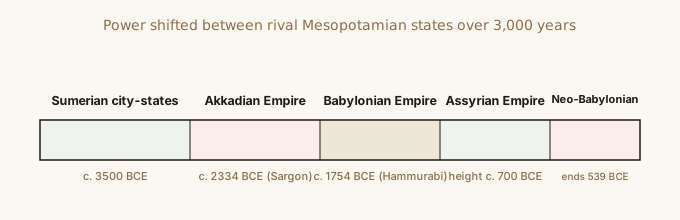
Mesopotamia timeline: major powers, c. 3500 BCE – 539 BCE
The key thing the timeline shows: Mesopotamian "civilization" wasn't one continuous empire — it was a 3,000-year relay race between different powers occupying the same river valley, each inheriting the writing system, religion, and city-building know-how of the ones before it.
Common mistakes
Common Mistakes
✕
Treating "Mesopotamia" and "Babylon" as the same thing.
→ Babylon was one city-state that became dominant at certain points (notably under Hammurabi, and centuries later under Nebuchadnezzar II) — Mesopotamian history spans many powers, of which Babylon is only one, not the whole story.
✕
Assuming Egypt and Mesopotamia had the same civilization or copied each other.
→ They developed largely independently and around the same era, with different writing systems (hieroglyphics vs. cuneiform), different religions, and different political structures — parallel invention, not shared origin.
✕
Thinking Hammurabi's Code applied equally to everyone.
→ Punishments explicitly differed by the social class of the people involved — it was a written legal system, not an equal one by modern standards.
Common misconception
“Mesopotamia was a single ancient kingdom, like a Mesopotamian version of Egypt under the pharaohs.”
Mesopotamia was a region, not a kingdom — for most of its history it was divided among competing, independent city-states, and even when unified under an empire (Akkadian, Babylonian, or Assyrian), that unification usually didn't last more than a few centuries before fragmenting again. The geographic label "Mesopotamia" is doing the work that a single dynasty's name does for Egypt.
What to do next
What to do next
Next time you read an analog clock or measure an angle in degrees, notice you're using Sumerian math that's over 4,000 years old.
If you come across the phrase "eye for an eye," you now know its most famous written source: Hammurabi's Code, carved in stone around 1754 BCE.
Look up a photo of the Uruk stele or the Hammurabi stele online — seeing the actual cuneiform makes the abstract idea of "the first writing" concrete.
FAQ
FAQ
Related terms
Related terms
Cuneiform
The wedge-shaped writing system pressed into clay tablets, invented in Sumer around 3200 BCE — the earliest known writing system.
City-state
An independent city that governs itself and the farmland around it, rather than being part of a larger unified nation.
Ziggurat
A massive stepped temple tower built in Mesopotamian cities, dedicated to a city's patron god.
Code of Hammurabi
A Babylonian law code from around 1754 BCE, one of the earliest and most complete written legal codes to survive.
This entry was researched from public sources and drafted with AI-assisted tools, then edited — errors are still possible. Spot one, or want a topic covered? Read our disclaimer.
 KnowThis