Ancient Egypt was a civilization along the Nile River in northeastern Africa that lasted from around 3100 BCE to 30 BCE, ruled by pharaohs believed to be divine, and famous for its pyramids, hieroglyphic writing, and mummification.
Reading time
— 4 min
Updated
— Oct 7, 2026
Fact-reviewed
— Aug 16, 2026
Key Takeaways
Key Takeaways
1Ancient Egypt lasted roughly 3,000 years (c. 3100 BCE–30 BCE) along the Nile River, held together by a shared belief that the pharaoh was a divine ruler responsible for the country's stability.
2The Nile's predictable annual flood, not luck, is what let Egypt farm reliably enough to support pyramid-building, a professional priesthood, and a standing bureaucracy — geography did a lot of the work.
3Egyptian history is divided by historians into Kingdoms (Old, Middle, New) separated by unstable "Intermediate Periods" — it wasn't one smooth continuous empire, it went through real collapses and recoveries.
The concept
Ancient Egypt grew up along the Nile River in northeastern Africa. Every year the Nile flooded and left behind fertile silt, which meant Egyptian farmers could reliably grow enough food to feed people who weren't farming — priests, scribes, soldiers, and the workers who built monuments like the pyramids. Egyptians were ruled by a pharaoh, who wasn't just a king but was believed to be a god living among people, responsible for keeping order (maat) in the universe itself.
The pyramids get the attention, but they're really the visible tip of a much bigger system — one built on religious belief, engineering skill, and a level of political organization that took centuries to develop, not appear overnight.
Quick check
Cleopatra VII, Egypt's most famous pharaoh, ruled around 30 BCE. The Great Pyramid of Giza was built around 2560 BCE. What does that tell you?
Case studies
Case 1: The Great Pyramid of Giza (baseline case)
Built around 2560 BCE as a tomb for the pharaoh Khufu, the Great Pyramid stood as the tallest human-made structure on Earth for roughly 3,800 years — a record unbroken until Lincoln Cathedral was completed in England around 1311 CE. It was built from an estimated 2.3 million limestone blocks, using a workforce of skilled laborers (not, contrary to the popular myth, enslaved people — archaeological evidence from workers' villages near Giza shows organized housing, medical care, and bread and beer rations for paid crews).
Case 2: Hatshepsut, a female pharaoh (variation / exception)
Around 1479 BCE, Hatshepsut became one of the few women to rule Egypt as pharaoh in her own right rather than as a queen consort, and she had herself depicted in official art with the traditional pharaoh's false beard — a sign that the role's authority was tied to the office, not literally to being male. Her reign was marked by extensive trade expeditions (notably to the land of Punt) and major building projects, including her mortuary temple at Deir el-Bahari, one of ancient Egypt's architectural masterpieces. After her death, later pharaohs attempted to erase her name and images from monuments, likely to preserve a clean male succession line rather than out of contempt for her specific reign.
Case 3: Decoding hieroglyphics — how Egypt still speaks to us (real-world / applied case)
For over a thousand years after the last hieroglyphic inscriptions were carved, nobody could read them — the knowledge was lost. That changed in 1799, when French soldiers found the Rosetta Stone near the town of Rosetta, inscribed with the same decree in hieroglyphics, Egyptian demotic script, and ancient Greek. Because scholars could already read Greek, the French linguist Jean-François Champollion used the stone to finally crack hieroglyphics in 1822 — which is why virtually everything we know today about Egyptian religion, history, and daily life, straight from Egyptian sources rather than later Greek or Roman accounts, dates only from the last 200 years of scholarship.
Quick check
How were hieroglyphics finally deciphered after being unreadable for over a thousand years?
How it works (visual)
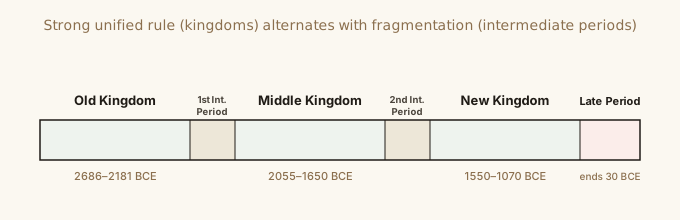
Ancient Egypt's three Kingdoms and the Intermediate Periods between them
The pattern to notice: each Intermediate Period was a real breakdown of central authority, sometimes with rival dynasties ruling different parts of Egypt at once — and each time, a new Kingdom rebuilt unified rule rather than the country staying permanently fragmented.
Common mistakes
Common Mistakes
✕
Picturing all of ancient Egyptian history as one unchanging era.
→ It spans roughly 3,000 years across three Kingdoms and multiple Intermediate Periods of real political collapse — treat "ancient Egypt" the way you'd treat "the last 3,000 years of European history," not a single snapshot.
✕
Believing the pyramids were built by enslaved people.
→ Archaeological evidence from workers' settlements near Giza shows organized, paid, fed labor crews — the enslaved-labor story comes largely from later Greek writers like Herodotus, not from Egyptian sources.
✕
Assuming hieroglyphics were always readable by later scholars.
→ The knowledge of how to read them was completely lost for over a thousand years and only recovered in 1822 via the Rosetta Stone — most of what we now know about Egypt is comparatively recent scholarship.
Common misconception
“The pyramids were built by enslaved Israelites or other enslaved populations.”
This idea comes mainly from later traditions and popular culture, not Egyptian or archaeological evidence. Excavated workers' villages near the Giza pyramids show paid laborers with organized housing, bread and beer rations, and access to medical treatment for injuries — consistent with skilled and unskilled labor crews working in rotating shifts, likely drawn partly from farmers during the Nile flood season when fieldwork was impossible, not enslaved populations.
What to do next
What to do next
Next time you see a pyramid in a documentary or photo, remember it was built by paid, organized labor crews, not enslaved people.
If you visit a museum with Egyptian artifacts, look for hieroglyphic inscriptions and remember they were unreadable to everyone for over a thousand years before 1822.
Notice how often "ancient Egypt" gets flattened into one image in pop culture — try placing whatever you're looking at (a pharaoh, a temple, a myth) into Old, Middle, or New Kingdom to sharpen the picture.
FAQ
FAQ
Related terms
Related terms
Pharaoh
The title of an ancient Egyptian ruler, believed by Egyptians to be a living link between the gods and the people.
Hieroglyphics
Egypt's formal picture-based writing system, used mainly for religious and monumental inscriptions.
Mummification
The process of preserving a body after death by removing organs and drying the tissue, based on the belief that the body was needed in the afterlife.
Rosetta Stone
A stone slab inscribed with the same text in hieroglyphics, Egyptian demotic script, and Greek, which let scholars finally decode hieroglyphics in 1822.
This entry was researched from public sources and drafted with AI-assisted tools, then edited — errors are still possible. Spot one, or want a topic covered? Read our disclaimer.
 KnowThis