 KnowThis
Key Takeaways
Key Takeaways
- 1A global summit like COP runs one to two weeks, not one day — most of the real work happens in smaller working-group sessions and bloc negotiations that never appear on camera.
- 2Most UN climate summit decisions are adopted by consensus (no formal objection from any delegation present), not a majority vote — meaning a single determined delegation can hold up an outcome.
- 3The UN General Assembly's regular resolutions are non-binding recommendations by default, distinct from UN Security Council resolutions, which can carry binding legal force.
The concept
Understanding the difference between a working-group session, a plenary, and the final vote explains why summit coverage often looks chaotic in the final 48 hours — that's genuinely when the compressed real negotiating happens, after weeks of lower-visibility groundwork.
News coverage shows a COP summit running well past its scheduled closing date, with all-night negotiating sessions. What does this usually indicate about the process?
Worked examples
Example 1: The basic COP timeline (baseline case)
Example 2: A negotiating bloc holding a unified position (edge case / variation)
Example 3: UN General Assembly resolution vs UN Security Council resolution (real-world / applied case)
A UN General Assembly resolution passes 140-to-5. What does this tell you about whether it's legally binding on member states?
How it works (visual)
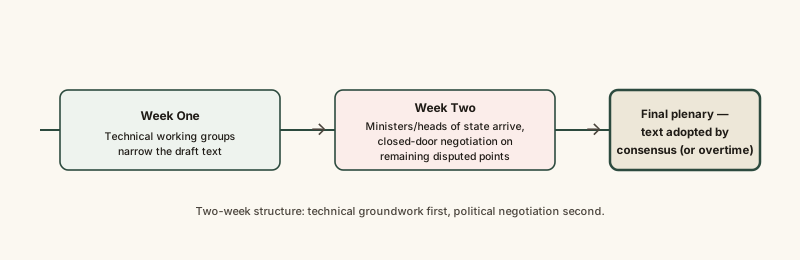
The visible, camera-covered moments — opening speeches and the final plenary vote — bookend a much longer, quieter negotiating process that determines what's actually inside the final text.
Common mistakes
Common Mistakes
Assuming a summit's outcome is decided in a single dramatic final vote.
→ Recognize that weeks of working-group and bloc-level negotiation shape the actual content of the final text — the closing plenary mostly ratifies what's already been negotiated.
Treating a General Assembly resolution as legally binding because it passed by a large margin.
→ Check whether the body that passed it (General Assembly vs. Security Council under Chapter VII) has binding authority — vote size doesn't determine legal status.
Assuming every country negotiates entirely on its own at a summit.
→ Look for the negotiating bloc a country belongs to — many positions are coordinated at the bloc level, not stated individually by each country.
Common misconception
“A summit 'failing' to reach a headline-grabbing new agreement means nothing productive happened.”
Summits regularly produce incremental progress — refined implementation rules, updated national commitments, or narrower unresolved issues carried into the next summit — even when they don't produce one dramatic new treaty. Judging a summit purely by whether it produced a single sweeping new agreement misses most of the actual negotiated progress, which tends to be incremental rather than a single breakthrough moment.
What to do next
What to do next
- When following summit coverage, look past the opening-day speeches for reporting on which negotiating blocs are involved in the remaining disputes.
- Check whether a reported outcome came from a plenary consensus, a formal vote, or is still an unadopted draft — these carry very different weight.
- For UN-related news specifically, check whether the resolution came from the General Assembly (non-binding) or the Security Council (potentially binding) before assuming it has legal force.
- Don't judge a summit as a total failure just because it didn't produce one sweeping new agreement — check for incremental progress on implementation details instead.