 KnowThis
Key Takeaways
Key Takeaways
- 1A refugee has a specific legal definition under the 1951 Refugee Convention: someone outside their home country unable to return due to a well-founded fear of persecution.
- 2An asylum seeker has made that same claim but hasn't yet received a legal decision — every refugee was once an asylum seeker, but not every asylum seeker is ultimately recognized as a refugee.
- 3An internally displaced person (IDP) has fled for refugee-like reasons but never crossed an international border, which puts them outside the 1951 Convention's specific protections even though their situation can be just as dangerous.
The concept
Because these categories carry real legal consequences — which protections apply, which government is responsible, which agency has a mandate to help — getting the terminology right isn't pedantry; it changes who is legally entitled to what.
A news report describes a group of people who fled armed conflict but remained within their own country's borders, unable to return home. What is the correct term for their status?
Worked examples
Example 1: Tracing one person's status through the process (baseline case)
Example 2: Two people fleeing the same conflict, different legal categories (edge case / variation)
Example 3: A person who doesn't fit the refugee definition at all (real-world / applied case)
Why does UNHCR specifically avoid calling someone an 'illegal migrant' if they may have a valid asylum claim pending?
How it works (visual)
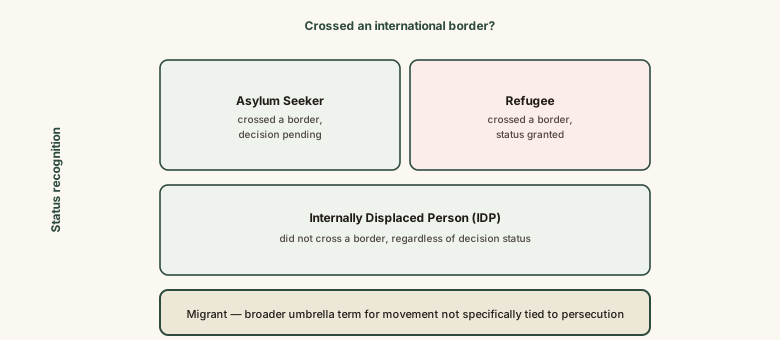
Two simple questions — did the person cross an international border, and has their protection claim been formally decided — sort almost every case into the right one of these four categories.
Common mistakes
Common Mistakes
Using 'refugee' and 'migrant' interchangeably in general conversation or writing.
→ Check whether persecution and a formal legal claim are actually involved — if not, 'migrant' is the more accurate general term, and if so, check whether status has been granted (refugee) or is pending (asylum seeker).
Calling someone displaced within their own country a 'refugee.'
→ Use 'internally displaced person' (IDP) specifically when no international border was crossed, even if the underlying danger is identical to a refugee situation.
Assuming everyone fleeing a war automatically qualifies as a refugee under the 1951 Convention.
→ Remember the Convention's specific criteria (persecution based on race, religion, nationality, political opinion, or social group) — broader war-related displacement is sometimes handled under separate regional or temporary protection frameworks instead.
Common misconception
“Someone who enters a country without prior authorization to claim asylum has automatically committed an immigration crime.”
Under the 1951 Refugee Convention framework (Article 31), states are generally not supposed to penalize refugees for irregular entry or presence, provided they present themselves to authorities without delay and show good cause for the unauthorized entry — since fleeing persecution rarely allows time to secure a visa first. The legal reality is more protective of the asylum process than the common "illegal entry" framing suggests.
What to do next
What to do next
- Before using 'refugee' in writing or conversation, check whether the person actually crossed an international border and has a persecution-based claim.
- Use 'asylum seeker' specifically for someone whose protection claim is still pending, not yet decided.
- Reserve 'internally displaced person' for anyone who fled danger without leaving their own country.
- Treat 'migrant' as the broad umbrella term it is — accurate as a general label, but not a substitute for the more specific legal categories when precision matters.