A COP (Conference of the Parties) is the annual formal meeting of every country that ratified the 1992 UN Framework Convention on Climate Change, held in a different host country each year, where negotiators review progress and adopt new climate agreements by consensus.
Reading time
— 4 min
Updated
— Aug 21, 2026
Fact-reviewed
— Aug 21, 2026
Key Takeaways
Key Takeaways
1COP stands for Conference of the Parties — the annual meeting of every country that ratified the 1992 UN Framework Convention on Climate Change (UNFCCC), not a standalone organization of its own.
2COP sessions are numbered sequentially from the first meeting in 1995 — COP21 in Paris (2021 numbering would be wrong; it was 2015) produced the Paris Agreement, for example — and each is hosted by a different country on a rotating basis.
3Decisions at COP are made by consensus, not majority vote, which means negotiations can run long and any single dissenting party can hold up or water down a text the rest of the room supports.
The concept
A COP is simply the yearly get-together of every country that signed onto the UN's climate treaty back in 1992. Delegations from nearly 200 countries send negotiators to review how climate action is going and hash out new agreements. The most famous COPs are the ones that produced a major new agreement — COP3 (Kyoto Protocol, 1997) and COP21 (Paris Agreement, 2015) — but most COPs in between are working sessions that build toward those bigger moments rather than headline-grabbing events themselves.
Knowing that COP is a recurring meeting format — not a single organization with its own independent authority — clears up most of the confusion in casual news coverage, which often talks about "COP" making a decision as if it were a single body acting on its own rather than shorthand for whatever the assembled parties collectively agreed to that year.
Quick check
Why do COP negotiations sometimes run a day or more past their officially scheduled end date?
Worked examples
Example 1: Reading a COP number correctly (baseline case)
COP1 was held in Berlin in 1995, the first year after the UNFCCC entered into force. Each subsequent year adds one, so COP21 (2015, Paris) is the 21st annual session, and a COP held roughly a decade later would be in the low-to-mid 30s — the number is simply a running count of annual sessions, not tied to any calendar-year arithmetic on its own.
Example 2: Distinguishing a "framework COP" from a "landmark-agreement COP" (edge case / variation)
Most COP sessions produce incremental decisions — refining reporting rules, adjusting funding mechanisms, setting agendas for future work — without a single headline treaty attached. COP3 (Kyoto, 1997) and COP21 (Paris, 2015) stand out precisely because they produced new binding or quasi-binding instruments, which is why they're the ones most people have actually heard of. The absence of a major new treaty from a given COP doesn't mean nothing happened — procedural and technical decisions from "quieter" COPs are often what makes the landmark agreements from other years actually implementable.
Example 3: A single country blocking consensus on part of a text (real-world / applied case)
Because decisions require no formal objection from any party present, COP outcome documents have historically had specific wording changed at the last minute — the most cited example is a late change to the coal-related language in the final Glasgow (COP26, 2021) text, shifted from "phase out" to "phase down" after an objection from a party in the room, illustrating in a very concrete way how the consensus rule can alter a final agreement's exact language even after most delegations had already indicated support for the original wording.
Quick check
What does it mean, structurally, that a single country's objection changed the final wording of the Glasgow COP26 text on coal?
How it works (visual)
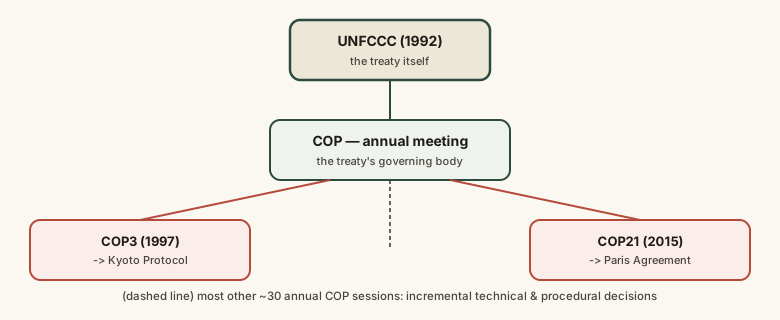
Where COP sits in the UNFCCC treaty structure
The diagram makes the key structural point visible: COP isn't a separate organization sitting alongside the UNFCCC — it's the treaty's own built-in annual decision-making mechanism, and the landmark agreements are simply the highest-profile outputs it has produced over three decades of sessions.
Common mistakes
Common Mistakes
✕
Treating 'COP' as an independent organization separate from the UNFCCC.
→ Remember COP is the UNFCCC's own annual governing meeting — it has no independent legal existence outside the treaty it serves.
✕
Assuming every COP session produces a major new treaty.
→ Most COPs handle incremental technical and procedural decisions; only a handful in three decades produced landmark instruments like Kyoto or Paris.
✕
Expecting COP decisions to pass by majority vote like a typical legislature.
→ COP operates by consensus — no formal objection from any party present — which is a fundamentally different (and often slower) decision process than voting.
Common misconception
“COP is a permanent UN agency headquartered somewhere, staffed year-round to run global climate policy.”
COP is a recurring annual meeting, not a standing agency. The UNFCCC does have a permanent secretariat (based in Bonn, Germany) that supports the process between sessions, but the Conference of the Parties itself is the meeting event — the actual decision-making body only convenes once a year.
What to do next
What to do next
Next time you see a COP number in the news (like 'COP29'), count backward from COP1 in 1995 to sanity-check what year it refers to.
Look up which of the five UN regional groups is hosting the next COP to understand why the location is where it is.
When reading coverage of a COP outcome, check whether the text describes a new binding agreement or an incremental procedural decision — most sessions are the latter.
Read the UNFCCC's own one-page summary of what COP is before forming an opinion on any specific year's outcome.
FAQ
FAQ
Related terms
Related terms
Conference of the Parties (COP)
The annual formal meeting of every country that ratified the UN Framework Convention on Climate Change (UNFCCC), the treaty body's supreme decision-making authority.
UNFCCC
The UN Framework Convention on Climate Change, a 1992 treaty establishing the basic framework for international climate cooperation, out of which both the Kyoto Protocol and the Paris Agreement were later negotiated at COP sessions.
Consensus decision-making
The UNFCCC's standard practice of adopting decisions only when no party formally objects, rather than by majority vote — meaning a single dissenting country can block or delay a text everyone else supports.
This entry was researched from public sources and drafted with AI-assisted tools, then edited — errors are still possible. Spot one, or want a topic covered? Read our disclaimer.
 KnowThis