 KnowThis
Key Takeaways
Key Takeaways
- 1Environmental NGOs aren't one thing — major operating models include advocacy/campaigning, direct land conservation (land trusts), scientific research, and legal action, and most large organizations blend more than one.
- 2Funding comes mainly from individual donations, membership dues, foundation grants, and corporate partnerships — the mix an organization relies on strongly shapes which activities it can sustain.
- 3Independent charity rating agencies like Charity Navigator let donors compare how efficiently different organizations convert donations into actual program work versus administrative overhead.
The concept
Understanding these different operating models matters for anyone deciding where to direct time, attention, or donations — an organization built around policy advocacy will do fundamentally different work with a donation than one built around directly purchasing habitat.
A land trust NGO and an advocacy NGO both say they want to protect a specific forest from development. What's the key structural difference in how each would actually try to accomplish that?
Worked examples
Example 1: A land trust protecting a wetland through direct purchase (baseline case)
Example 2: A conservation easement that keeps a working farm in private hands (edge case / variation)
Example 3: An advocacy campaign changing policy at national scale (real-world / applied case)
Compared to a land trust directly purchasing a property, what is a key tradeoff of the advocacy-campaign approach to protecting land, even when it succeeds?
How it works (visual)
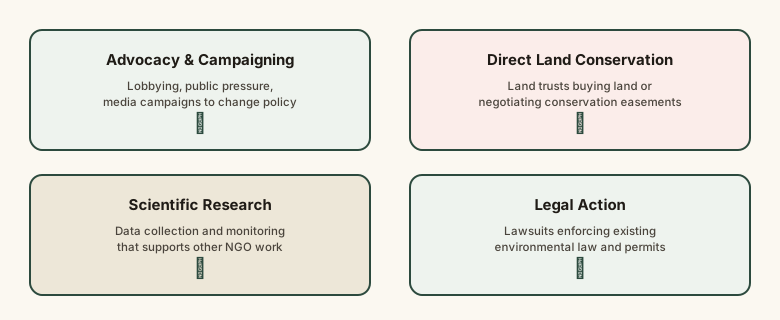
Large, well-known environmental organizations often blend two or more of these models rather than sticking to just one — a group might run public advocacy campaigns while also funding scientific research that supports its policy arguments.
Common mistakes
Common Mistakes
Assuming all environmental NGOs work the same way — lobbying governments.
→ Recognize that land trusts, research organizations, and legal-action groups often achieve conservation outcomes without any lobbying or legislative process at all.
Assuming a conservation easement means the land becomes publicly owned.
→ An easement typically leaves the land in private ownership — it restricts what can legally be done with it, permanently, without transferring ownership to the NGO or the public.
Donating to an NGO without checking its financial transparency.
→ Use an independent rating agency like Charity Navigator to see what share of an organization's budget actually reaches program work versus overhead, before assuming a donation will go where you expect.
Common misconception
“A conservation easement is basically the same as the government or an NGO owning the land outright.”
A conservation easement leaves the underlying land in private ownership — the landowner can typically still live on it, farm it, or sell it — but permanently attaches a legal restriction (usually against development or subdivision) to the property's deed, so the restriction binds all future owners too. It's a targeted legal tool for permanently limiting land use without requiring an NGO or government to buy and manage the property itself.
Why might a land trust prefer negotiating a conservation easement over outright purchasing a piece of land, in cases where the landowner wants to keep living there?
What to do next
What to do next
- Before donating to an environmental NGO, check its rating on an independent site like Charity Navigator to see its program-spending transparency.
- Identify which operating model (advocacy, land trust, research, legal action) an organization actually uses before assuming what your support will accomplish.
- If you want a permanent, guaranteed local outcome, land-trust-style direct conservation may be more predictable than supporting a policy campaign with an uncertain outcome.
- If you care about large-scale outcomes and are comfortable with longer timelines and political uncertainty, advocacy-focused organizations may be a better fit.