ESG (Environmental, Social, Governance) reporting is the practice of a company formally disclosing data on its environmental impact, social practices, and governance structure, following standardized frameworks so investors and regulators can compare performance across companies rather than trusting each company's own self-description.
Reading time
— 5 min
Updated
— Oct 7, 2026
Fact-reviewed
— Oct 7, 2026
Key Takeaways
Key Takeaways
1ESG stands for Environmental, Social, and Governance — three non-financial categories companies are increasingly asked to report on, alongside their traditional financial statements.
2Standardized frameworks like the Global Reporting Initiative (GRI) and TCFD exist specifically so ESG disclosures can be compared across companies, rather than each company describing its own performance however it likes.
3In 2023 the International Sustainability Standards Board (ISSB) issued its first global baseline standards, aiming to consolidate what had been a fragmented landscape of competing voluntary frameworks.
ESG reporting at a glance (2026)
Short answer: ESG reporting is a company publishing audited-style numbers on emissions, workforce and governance under a named standard, instead of describing itself in marketing language. Three standard-setters matter: GRI (broad impact), TCFD (climate-risk structure, now folded into ISSB work) and the ISSB's IFRS S1 and S2 (the global investor baseline). Whether a given company must report depends on where it operates, and that picture changed in 2026.
Framework or rule
Who it is for
Status
GRI Standards
Anyone reporting broad sustainability impact
Voluntary standard, widely used
TCFD recommendations
Investors wanting climate-risk disclosure
Structure absorbed into IFRS S2
IFRS S1 and S2 (ISSB)
Investor-focused global baseline
Used or being introduced in about 40 jurisdictions as of February 2026
EU CSRD
Large companies operating in the EU
Scope cut by the 2026 Omnibus I directive to companies with over 1,000 employees and over €450 million turnover, for financial years starting 1 January 2028 or later
U.S. SEC climate rule
U.S. public companies
Stayed since 2024; SEC stopped defending it in 2025 and proposed rescinding it in 2026
The concept
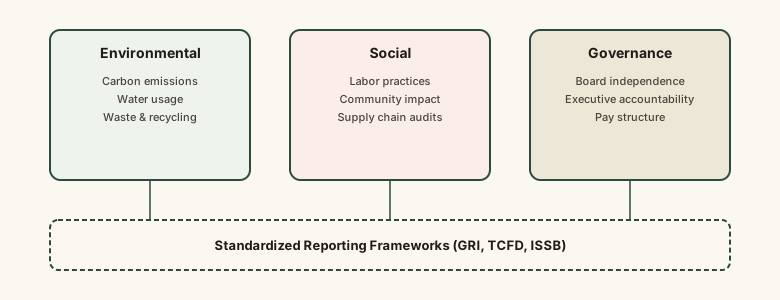
ESG is short for Environmental, Social, and Governance — three categories companies report on beyond their normal financial numbers. Environmental covers things like carbon emissions and waste; Social covers labor practices and community impact; Governance covers how the company is actually run, including board structure and executive accountability. The whole point of standardized ESG reporting is comparability: if every company just wrote its own sustainability story in its own words, investors couldn't compare Company A to Company B in any reliable way.
Understanding that ESG reporting moved from scattered voluntary frameworks toward standardized, sometimes legally mandated disclosure explains why the topic has become significant for investors and regulators, not just for corporate public relations departments.
Quick check
Why did having multiple different ESG reporting frameworks (GRI, TCFD, and others) create a real problem for investors trying to compare companies?
Worked examples
Example 1: A company's basic ESG report structure (baseline case)
A manufacturing company's annual ESG report includes an Environmental section reporting total greenhouse gas emissions and water usage, a Social section reporting employee safety incident rates and supply-chain labor audits, and a Governance section describing its board's independence and executive compensation structure tied to sustainability targets. Each section reports specific, numeric metrics rather than general statements, which is what lets outside analysts actually compare it to a competitor's report.
Example 2: The difference between a marketing claim and a standardized disclosure (edge case / variation)
A company's advertisement says it is "committed to sustainability" with no specific numbers attached — that's a marketing claim, not an ESG disclosure. The same company's formal ESG report, following GRI or ISSB standards, must instead report a specific, auditable figure like "42,000 metric tons of CO2-equivalent emissions in the reporting year, verified by a third party." The distinction matters because only the second kind of statement can actually be checked, compared year to year, or compared against another company's disclosed figure.
Example 3: Mandatory ESG disclosure under EU regulation (real-world / applied case)
Under the EU's Corporate Sustainability Reporting Directive, a large company operating in the EU must publish detailed, externally audited sustainability disclosures covering environmental, social, and governance topics — not as an optional extra, but as a legal filing requirement similar in seriousness to its financial statements. This represents a real shift from ESG as voluntary corporate communication toward ESG as a compliance obligation with legal consequences for inaccurate or missing disclosure.
Quick check
What is the key difference between a company's general marketing statement about being 'environmentally responsible' and a formal ESG disclosure under a standard like GRI or ISSB?
How it works (visual)
The three components of ESG reporting
The three pillars rest on a shared foundation of standardized frameworks — without that common foundation, each company's Environmental, Social, and Governance disclosures would use different definitions and metrics, making cross-company comparison effectively meaningless.
Common mistakes
Common Mistakes
✕
Treating a company's sustainability marketing language as equivalent to a formal ESG disclosure.
→ Look for specific, quantified, ideally third-party-audited metrics reported under a named framework (GRI, TCFD, ISSB) rather than general claims in an ad or press release.
✕
Assuming ESG reporting is purely voluntary everywhere.
→ Check the relevant jurisdiction — regulations like the EU's Corporate Sustainability Reporting Directive have made detailed ESG disclosure a legal requirement for many large companies, not just a voluntary best practice.
✕
Assuming all ESG frameworks measure the same things in the same way.
→ Recognize that GRI, TCFD, and other frameworks historically had different scopes and methodologies — this fragmentation is exactly what the ISSB's 2023 global baseline standards were created to reduce.
Common misconception
“A company's ESG report is essentially the same thing as its sustainability marketing materials, just longer.”
A formal ESG report, prepared under a recognized standard like GRI or the newer ISSB baseline, discloses specific, often externally audited quantitative metrics intended to be comparable across companies and over time. Marketing materials are typically general claims not tied to any standardized, checkable metric. Confusing the two — sometimes called greenwashing when done deliberately — is exactly the gap that standardized, sometimes legally mandated ESG disclosure frameworks were built to close.
Quick check
A company claims in an advertisement to be 'a leader in sustainability' but its formal ESG filing shows rising, not falling, greenhouse gas emissions over the past three years. What does this scenario illustrate?
What to do next
What to do next
When evaluating a company's sustainability claims, look for its formal ESG report under a named framework (GRI, TCFD, ISSB), not just its marketing materials.
Check whether the company's ESG disclosures are third-party audited — audited figures carry more weight than self-reported, unverified numbers.
Be aware that ESG reporting requirements vary by jurisdiction — some countries and regions (like the EU) now legally mandate detailed disclosure for large companies.
Watch for year-over-year trend data, not just a single year's snapshot — a single good number can mask a worsening multi-year trend, or vice versa.
FAQ
FAQ
Related terms
Related terms
ESG (Environmental, Social, Governance)
A framework for evaluating a company's performance on three non-financial dimensions: environmental impact, treatment of people (employees, communities, supply chain), and internal governance structure.
Global Reporting Initiative (GRI)
An independent international organization that publishes widely used standards for how companies should structure their sustainability disclosures.
TCFD (Task Force on Climate-related Financial Disclosures)
A framework, originally created by the Financial Stability Board, specifically for how companies should disclose climate-related financial risks to investors.
Greenwashing
The practice of a company presenting itself as more environmentally responsible than its actual practices justify, often through vague or unverifiable marketing claims rather than standardized disclosure.
This entry was researched from public sources and drafted with AI-assisted tools, then edited — errors are still possible. Spot one, or want a topic covered? Read our disclaimer.
 KnowThis