 KnowThis
Key Takeaways
Key Takeaways
- 1An environmental impact assessment (EIA) is a legally required, structured prediction of a project's environmental effects — not a public opinion survey or a simple checklist.
- 2The process was pioneered by the US National Environmental Policy Act (NEPA) of 1970 and has since been adopted, in similar form, by well over 100 countries.
- 3An EIA doesn't just identify problems — it requires the project sponsor to propose specific mitigation measures, and it puts the whole analysis in front of the public before a final approval decision.
The concept
Understanding EIA as a procedural safeguard — not an automatic veto — explains both why it's such a widely copied policy tool and why it's sometimes criticized by people on opposite sides for opposite reasons: some think it slows down projects that should be approved quickly, others think it doesn't stop enough projects that should be blocked.
A community group is upset that a proposed highway project completed an environmental impact assessment showing serious wetland damage, and the government approved the project anyway. What does this reveal about how EIA actually works?
Worked examples
Example 1: A straightforward EIA for a wastewater treatment plant (baseline case)
Example 2: A contested EIA where the scoping decision itself becomes the fight (edge case / variation)
Example 3: An EIA required by an international lender, not just domestic law (real-world / applied case)
Why might the scoping stage of an EIA matter as much as the final environmental impact statement itself?
How it works (visual)
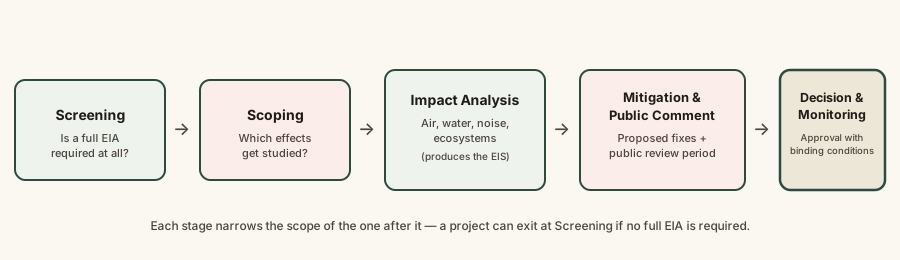
Each stage narrows and sharpens the one before it — screening decides whether a full study is needed at all, scoping decides what that study will actually cover, and only projects that clear both steps reach the detailed impact-analysis stage that produces the public-facing Environmental Impact Statement.
Common mistakes
Common Mistakes
Assuming an EIA is a yes/no approval vote rather than a disclosure-and-mitigation process.
→ Remember that a completed EIA, even one showing significant harm, does not automatically block a project — it's a procedural requirement to study, disclose, and propose mitigation for effects, not a guaranteed veto.
Treating the environmental impact statement as the entire EIA process.
→ The statement is the output document — the actual process includes screening, scoping, public comment, and post-approval monitoring, all of which shape what ends up in that document.
Assuming EIA requirements only exist in the country where a project is built.
→ International lenders like the World Bank often impose their own EIA-style requirements as a financing condition, independent of (and sometimes stricter than) domestic law.
Common misconception
“An environmental impact assessment that finds serious environmental harm means the project will legally be blocked.”
NEPA-style EIA laws are procedural, not substantive — they require an agency to study, disclose, and consider alternatives and mitigation for a project's environmental effects, and to explain its reasoning, but they generally do not require the agency to choose the least-harmful option or block a harmful project outright. A project can be approved despite significant predicted environmental effects as long as the assessment process itself was followed.
A company wants to build a factory and completes a full EIA that identifies major air-quality impacts on a nearby neighborhood, proposing no meaningful mitigation. What is the most accurate description of what happens next under a typical NEPA-style law?
What to do next
What to do next
- If a project near you is going through an EIA, look specifically at the scoping documents first — they reveal what will and won't actually be studied.
- Read the proposed mitigation measures section of any Environmental Impact Statement, not just the predicted-effects section — this is where the real substance of a project's environmental commitments lives.
- Remember that public comment periods are a real, legally required part of the process — a comment on the record can become part of what a court reviews if the decision is later challenged.
- When comparing projects across countries, check whether the EIA requirement comes from domestic law, an international lender's policy, or both — the strictness and enforceability can differ meaningfully.