 KnowThis
Key Takeaways
Key Takeaways
- 1Carbon pricing has two main designs: a carbon tax fixes the price per ton and lets total emissions float, while cap-and-trade fixes the total emissions cap and lets the price float based on trading.
- 2The EU Emissions Trading System, launched in 2005, is the world's largest cap-and-trade carbon market, covering thousands of power plants and industrial facilities across the EU.
- 3The core economic idea behind both approaches is the same: make emitting carbon cost real money, so businesses have a financial incentive to cut emissions wherever it's cheapest to do so.
The concept
Both approaches share the same underlying goal — put a genuine cost on emissions so the market, not just regulation, pushes toward lower-carbon choices — but the choice between them shapes who bears the cost, how predictable the price is, and how directly the total emissions outcome is controlled.
A government wants absolute certainty about how much total carbon dioxide an industry will emit next year, even if the price businesses pay per ton is unpredictable. Which carbon pricing design better fits that goal?
Worked examples
Example 1: Calculating a simple carbon tax bill (baseline case)
Example 2: How permit trading creates a market price under cap-and-trade (edge case / variation)
Example 3: The EU ETS's shrinking cap pushing up the real market price over time (real-world / applied case)
Why does the market price of carbon allowances in a cap-and-trade system like the EU ETS tend to rise as the cap shrinks over time, assuming demand for permits stays roughly the same?
How it works (visual)
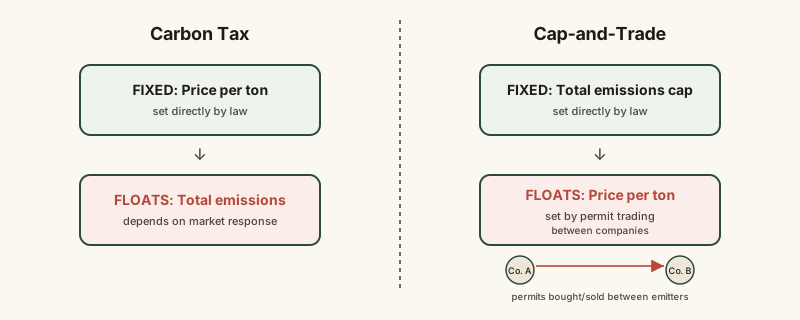
The diagram highlights the core tradeoff: a carbon tax locks in the price and leaves the quantity of emissions to market response, while cap-and-trade locks in the quantity and leaves the price to be discovered through trading between emitters.
Common mistakes
Common Mistakes
Assuming carbon tax and cap-and-trade are the same thing with different names.
→ Remember the price-versus-quantity distinction: a tax fixes price and floats quantity, cap-and-trade fixes quantity (the cap) and floats price through permit trading.
Thinking a company can simply buy its way out of ever reducing emissions under cap-and-trade.
→ As the cap shrinks over time (as it does under systems like the EU ETS), buying permits gets progressively more expensive, which is specifically designed to eventually make cutting emissions cheaper than continuing to buy allowances.
Assuming carbon pricing only exists as a national policy.
→ Carbon pricing operates at multiple levels — national carbon taxes, multinational systems like the EU ETS, and regional or subnational cap-and-trade programs all exist simultaneously in different jurisdictions.
Common misconception
“A carbon tax and a cap-and-trade system are basically interchangeable policy tools that always produce identical results.”
While both put a real cost on carbon emissions, they behave differently under uncertainty. A carbon tax gives businesses price certainty (they always know their per-ton cost) but the government can't be certain how much total emissions will actually fall in response. Cap-and-trade gives environmental certainty (the total emissions cap is fixed by law) but leaves businesses facing an uncertain, market-determined price that can swing with economic conditions and permit supply.
A country cares more about hitting a precise, legally guaranteed emissions reduction target by a specific year than about giving businesses cost certainty. Which carbon pricing tool more directly serves that specific goal?
Try it yourself
What to do next
What to do next
- When you read about a country's carbon policy, check whether it's a fixed-price tax or a cap-and-trade system — the two behave very differently under economic pressure.
- Look up the World Bank's Carbon Pricing Dashboard if you want to compare real carbon tax and cap-and-trade prices across countries.
- Remember that a shrinking cap over time (as in the EU ETS) is a deliberate design feature meant to make emissions progressively more expensive, not a market accident.
- Use the calculator above with a real reported price-per-ton figure to get a feel for how carbon costs scale with emissions volume.