 KnowThis
Key Takeaways
Key Takeaways
- 1A carbon offset represents one metric ton of CO2-equivalent emissions reduced, avoided, or removed somewhere else — it doesn't remove or reduce the emissions from your own activity directly.
- 2An offset is only environmentally meaningful if it meets 'additionality' — the funded reduction must genuinely not have happened without that specific purchase; a project that was already planned or profitable on its own provides no real added benefit.
- 3Offset prices vary enormously by project type and quality verification, which is exactly why the same dollar amount can fund very different real-world climate outcomes depending on which offset is purchased.
The concept
None of this means offsetting is inherently meaningless — well-verified offset projects do fund real emissions reductions. The key practical skill is distinguishing a credible, additionality-verified offset from one that simply sounds good on a receipt.
A company buys carbon offsets tied to a solar farm that was already fully funded and under construction before the offset purchase happened. Does this purchase represent a genuine additional climate benefit?
Worked examples
Example 1: Calculating the cost of offsetting a flight (baseline case)
Example 2: Same emissions, wildly different offset prices (edge case / variation)
If two carbon offset providers both sell a credit for '1 ton of CO2 reduced' at very different prices, does the cheaper option necessarily provide the same real-world climate benefit as the more expensive one?
Example 3: A corporate net-zero pledge relying heavily on offsets (real-world / applied case)
How it works (visual)
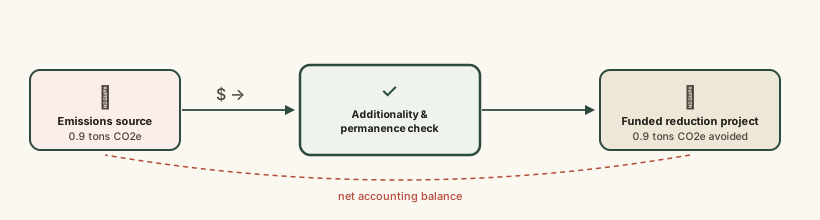
The verification checkpoint in the middle of the diagram is the step that determines whether the whole arrangement means anything environmentally — without a credible additionality and permanence check, the right-hand side of the diagram could represent a reduction that would have happened regardless of the payment, making the "balance" on the left purely an accounting fiction.
Common mistakes
Common Mistakes
Assuming any carbon offset purchase is automatically a meaningful climate action.
→ Check whether the offset is certified against a recognized standard (Verra VCS, Gold Standard, or similar) that specifically evaluates additionality and permanence, not just the advertised price per ton.
Treating offsetting as a substitute for reducing your own emissions in the first place.
→ Prioritize direct reduction (flying less, driving less, using less energy) first, and treat offsetting as a supplement for emissions that are genuinely hard to eliminate, not a replacement for the reduction itself.
Assuming a lower price per ton always means a worse-quality offset, or a higher price always means a better one.
→ Research the specific project type and verification standard behind an offset rather than using price alone as a quality proxy — price reflects many factors, not verification rigor alone.
Common misconception
“Buying a carbon offset for a flight or purchase directly cancels out that specific activity's emissions, as if the CO2 were physically removed from where it was released.”
An offset doesn't physically remove or prevent the emissions from the original activity — the flight still releases its CO2 into the atmosphere. What the offset does is fund an equivalent reduction, avoidance, or removal of emissions somewhere else, which only provides a genuine net climate benefit if that funded project meets additionality (it wouldn't have happened without the offset money) and permanence (the reduction is durable, not later reversed).
Does purchasing a carbon offset for a flight mean the flight itself released less CO2 into the atmosphere?
Try it yourself
What to do next
What to do next
- Reduce your own emissions first — offsetting works best as a supplement for what's genuinely hard to eliminate, not a substitute for reduction.
- Before buying an offset, check whether the provider is certified against a recognized standard (Verra VCS, Gold Standard) that evaluates additionality and permanence.
- Use the calculator above with your own activity's estimated CO2e and a real market offset price to understand the actual cost of offsetting it.
- Be skeptical of a 'net-zero' claim that relies heavily on offsets rather than direct emissions reduction within the organization's own operations.