 KnowThis
Key Takeaways
Key Takeaways
- 1Wasted food has a double environmental cost: the resources used to grow and transport it are wasted, and once landfilled, it decomposes anaerobically and produces methane, a far more potent greenhouse gas than the CO2 released by normal, oxygen-present decomposition.
- 2The EPA's Wasted Food Scale ranks prevention (not generating the surplus at all) and feeding people above composting, and composting above landfill disposal — mirroring the same logic as the general waste management hierarchy.
- 3Most household food waste is genuinely edible food discarded due to over-purchasing, poor storage, or confusion over date labels, not inedible scraps like peels and bones.
The concept
Most conversations about food waste focus on composting as the fix, but the EPA's own hierarchy ranks prevention and feeding people well above composting — composting is a genuine improvement over landfilling, but it's still lower on the priority list than simply not generating the surplus food in the first place.
A household starts composting all its food scraps but doesn't change its shopping or storage habits, so it still buys and later discards roughly the same amount of food as before. Has this household fully addressed food waste according to the EPA's Wasted Food Scale?
Worked examples
Example 1: Comparing three end-of-life paths for the same leftover food (baseline case)
Example 2: Date-label confusion causing avoidable waste (edge case / variation)
Does a 'best by' date on a food package always mean the food becomes unsafe to eat after that date?
Example 3: A grocery store's food-recovery donation program (real-world / applied case)
How it works (visual)
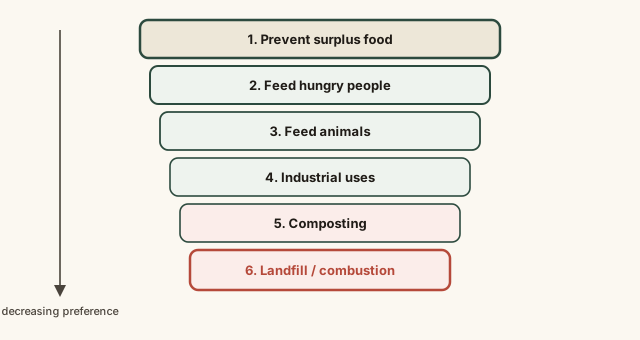
Composting sits near the bottom of the scale, not the top — it's a real improvement over landfill because it avoids methane-producing anaerobic decomposition, but the scale still ranks it below every option that actually gets the food used for its original purpose, feeding someone or something.
Common mistakes
Common Mistakes
Discarding food based on a 'best by' or 'sell by' date without checking whether it shows any actual signs of spoilage.
→ Treat most date labels as freshness estimates, not safety cutoffs, and use your senses (smell, appearance, texture) alongside proper storage as the real safety check for most foods.
Assuming composting alone 'solves' a household's food waste problem.
→ Track how much food is being thrown out in the first place — composting reduces the landfill/methane impact of waste that already exists, but doesn't reduce how much food is being wasted overall.
Over-purchasing perishable food without a plan for using it before it spoils.
→ Plan meals against what's already in the fridge and pantry before buying more, and freeze portions of perishable food you won't use in time.
Common misconception
“Since food is biodegradable, tossing it in the regular trash isn't really an environmental problem the way plastic waste is.”
Being biodegradable doesn't make landfill disposal harmless. In a landfill's oxygen-poor, compacted environment, food waste decomposes anaerobically and produces methane — a greenhouse gas far more potent than the CO2 released by normal aerobic decomposition (like composting) or by simply eating the food. Landfills are among the largest human-related sources of methane emissions precisely because of this dynamic.
Why does food waste in a landfill produce methane, while the same food waste in a home compost pile mostly produces carbon dioxide instead?
What to do next
What to do next
- Plan meals and shopping lists against what's already in your fridge and pantry, to reduce over-purchasing that leads to spoilage.
- Learn the real meaning of 'best by' vs 'use by' labels for common foods you buy, rather than discarding automatically at the printed date.
- Freeze portions of perishable food you won't use in time, rather than letting it spoil unused.
- If composting isn't already part of your routine, add it as a fallback for genuine scraps — but treat prevention, not composting, as the primary goal.