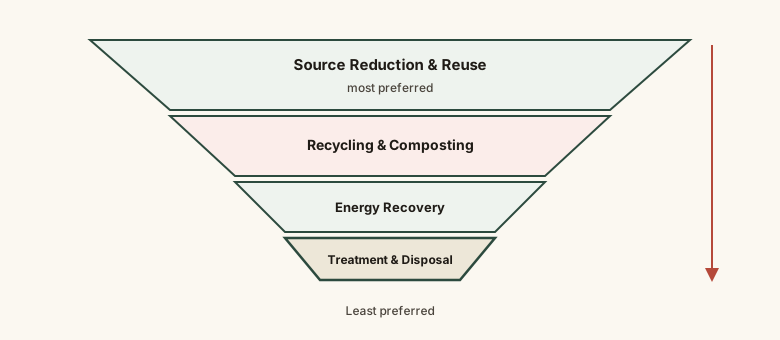
The waste management hierarchy ranks source reduction and reuse above recycling and composting, which in turn rank above energy recovery and landfill disposal — the phrase 'reduce, reuse, recycle' is already listed in the correct order of environmental preference, not three interchangeable options.
Reading time
— 4 min
Updated
— Aug 21, 2026
Fact-reviewed
— Aug 21, 2026
Key Takeaways
Key Takeaways
1"Reduce, reuse, recycle" is already ranked in order of environmental preference — the EPA's waste management hierarchy places source reduction and reuse above recycling and composting, which in turn rank above energy recovery and landfill disposal.
2Recycling only processes material that already became waste; reduction and reuse prevent that material from becoming waste in the first place, which is why they sit higher on the hierarchy — a can never made uses less energy than a can made and then recycled.
3A high recycling rate alone doesn't mean a household or city is managing waste well — the hierarchy explicitly ranks recycling below simply generating less waste to begin with.
The concept
The EPA's waste management hierarchy ranks strategies from best to worst: first, reduce how much you use or throw away; second, reuse what you already have; third, recycle or compost what's left; fourth, recover energy by burning waste; and last, send what remains to a landfill. Each step down the list means more material has already become waste before anything useful happens to it.
The practical value of the hierarchy is that it gives a ranking, not just a checklist — when two options are both "good for the environment," the hierarchy tells you which one actually does more.
Quick check
A household recycles diligently but buys a large amount of single-use packaged goods each week. According to the waste hierarchy, is this household managing waste as well as it could?
Worked examples
Example 1: Ranking three real options for a single situation (baseline case)
A household needs to store leftovers. Option A: buy single-use plastic wrap each time (no reduction, no reuse). Option B: buy a box of reusable silicone food covers once and reuse them for years (reuse tier). Option C: buy plastic wrap but recycle the packaging it came in (recycling tier, and only for the packaging, not the wrap itself, which typically isn't recyclable). Ranked by the hierarchy: Option B (reuse) is the best choice, Option C is a distant third, and Option A does the least.
Example 2: Calculating a household's diversion rate (edge case / variation)
A household generates 20 kg of total waste in a month and diverts 14 kg of it through recycling and composting combined (not counting anything reduced or reused, since those never became "waste" to measure in the first place). Diversion rate: 14 ÷ 20 × 100 = 70%. This number only measures the bottom two tiers (recycling and composting) — it says nothing about how much waste this household avoided generating through reduction and reuse, which is the hierarchy's real point: a high diversion rate can still describe a household that is generating far more waste than necessary.
Quick check
Why can a household with a 70% diversion rate still be managing waste worse than a household with a 40% diversion rate?
Example 3: A city government applying the hierarchy to policy (real-world / applied case)
A city aiming to cut landfill waste has two policy options with the same budget: (1) fund a new curbside recycling truck route, or (2) fund a program that lends out reusable dishware and equipment for public events, reducing single-use disposables at the source. Per the hierarchy, option 2 targets a higher tier (reduction) and prevents waste from being generated at all, while option 1 only improves how efficiently already-generated waste gets processed. This is exactly the reasoning many real municipal waste-reduction plans (which explicitly reference the EPA hierarchy) use to prioritize source-reduction programs, like event dishware lending or plastic bag policies, ahead of expanding recycling infrastructure alone.
How it works (visual)
The EPA waste management hierarchy, as an inverted pyramid
The pyramid narrows from top to bottom because each lower tier can absorb less of the total problem — not every material can be reduced or reused, but everything used still needs somewhere to go once it's genuinely unavoidable waste, which is why disposal remains the bottom "catch-all" tier rather than disappearing.
Common mistakes
Common Mistakes
✕
Treating a high recycling or diversion rate as the main measure of good waste management.
→ Track total waste generated per person or household over time, not just the percentage of it that gets recycled — a shrinking total is the higher-tier goal the hierarchy actually prioritizes.
✕
Assuming reduce, reuse, and recycle are three equally good, interchangeable options to pick from.
→ Default to reduction or reuse whenever a real option exists, and treat recycling as the fallback for what genuinely can't be avoided or reused.
✕
Believing recycling has no environmental cost since the material is 'saved' from landfill.
→ Remember recycling still requires collection, transportation, sorting, and reprocessing energy — real, but smaller than the cost of manufacturing something new from raw material, and larger than simply not generating the waste at all.
Common misconception
“Recycling is the most important part of 'reduce, reuse, recycle' since it's the one most people actively participate in.”
The EPA's own hierarchy ranks recycling below both reduction and reuse in environmental benefit. Recycling only comes into play after something has already become waste; reduction and reuse prevent that waste from being generated in the first place, which is why they occupy the top, most-preferred tier of the hierarchy — the order in the phrase itself reflects this ranking, not habit or convenience.
Quick check
If someone wants to make the single biggest improvement to their household's environmental footprint from waste, which hierarchy tier should they focus on first?
Try it yourself
Calculate a diversion rate (recycling + composting share of total waste)
Diversion rate70
What to do next
What to do next
Before buying a single-use item, ask whether a reusable option exists — that's the top tier of the hierarchy and the highest-leverage choice available.
Track your household's total waste output for a month, not just what fraction gets recycled — that total is the number the hierarchy actually wants you to shrink.
Use the calculator above to see your own diversion rate, but remember it only measures the recycling/composting tier, not reduction.
When evaluating a sustainability claim or program, ask which hierarchy tier it actually targets before assuming it's the most impactful option.
FAQ
FAQ
Related terms
Related terms
Waste management hierarchy
EPA's ranked framework for waste strategies, from most to least environmentally preferred: source reduction and reuse, recycling and composting, energy recovery, and treatment/disposal.
Source reduction
Preventing waste from being created in the first place, by designing, purchasing, or using products so that less material needs to be discarded at all — the top tier of the hierarchy.
Diversion rate
The percentage of total waste generated that is diverted away from landfill or incineration, through reuse, recycling, or composting.
This entry was researched from public sources and drafted with AI-assisted tools, then edited — errors are still possible. Spot one, or want a topic covered? Read our disclaimer.
 KnowThis