The circular economy is a framework, formalized by the Ellen MacArthur Foundation, for designing products and systems around three principles: eliminating waste and pollution by design, keeping materials in use at their highest value, and regenerating natural systems — replacing the traditional linear take-make-dispose model.
Reading time
— 4 min
Updated
— Aug 22, 2026
Fact-reviewed
— Aug 22, 2026
Key Takeaways
Key Takeaways
1The circular economy is a design framework built on three principles: eliminate waste and pollution by design, keep materials in use at their highest value, and regenerate natural systems.
2It's fundamentally different from recycling alone — recycling happens after a product is designed, while circular design changes how a product is built in the first place so it can be repaired, reused, or fully recovered.
3The traditional linear economy (take raw materials, make a product, dispose of it) treats waste as an unavoidable end point; the circular model treats waste as a design failure that better upfront choices can prevent.
The concept
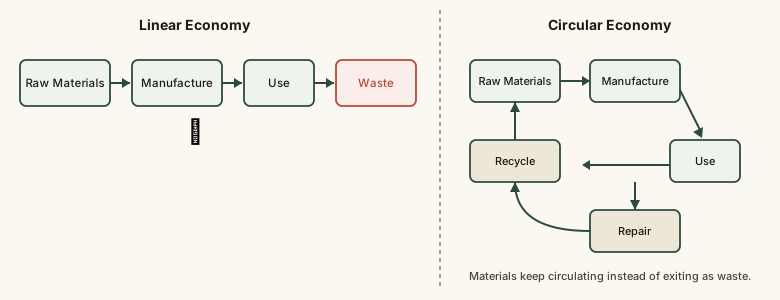
A circular economy designs products and systems so materials keep circulating instead of becoming waste. Instead of a phone designed to be replaced when the battery degrades, a circular-design phone has a battery that can be swapped, and the rest of the device is built to be repaired, refurbished, or its materials recovered at end of life. It's the opposite of the traditional linear economy — take materials, make a product, throw it away — which was never designed with an end-of-life plan for the materials at all.
The practical difference this makes is visible at the design stage, well before a product ever reaches a customer or a landfill.
Quick check
A company switches to using 100% recycled plastic in a product that's still glued together and impossible to disassemble or repair. Is this a genuinely circular-economy product?
Worked examples
Example 1: A modular, repairable phone design (baseline case)
Some smartphone manufacturers now design phones with modular components — a battery, screen, and camera that can each be individually swapped with basic tools rather than requiring the whole device to be discarded when one part fails. This directly implements the "circulate products and materials at highest value" principle: repair (replacing one component) preserves far more of the product's original value and embedded manufacturing energy than recycling the whole device for raw materials would.
Example 2: Furniture-as-a-service business models (edge case / variation)
Some office furniture companies now lease furniture rather than selling it outright, retaining ownership and taking responsibility for refurbishing and redistributing items at the end of a lease rather than the customer discarding them. This is a circular economy strategy operating at the business-model level, not just the product level — because the manufacturer keeps ownership of the material value, it has a direct financial incentive to design furniture that's durable and easy to refurbish, aligning profit motive with circular design in a way a one-time sale doesn't.
A compostable coffee cup is designed for the biological cycle — intended to break down safely and return nutrients to soil. But if a city's waste system has no industrial composting infrastructure, that same cup gets landfilled alongside ordinary trash, where it may not break down meaningfully differently from conventional packaging, since many compostable materials require the higher, sustained heat of industrial composting facilities rather than a backyard compost bin or an anaerobic landfill environment. The product's design intent and the actual waste infrastructure it ends up in both have to align for the circular loop to actually close.
Quick check
Why might a compostable product fail to deliver its intended environmental benefit in a real city?
How it works (visual)
Linear economy vs. circular economy
The structural difference is the closed loop on the right — value keeps circulating back into the system through repair and recycling, instead of exiting the system permanently as waste the way the linear model does.
Common mistakes
Common Mistakes
✕
Treating "circular economy" and "recycling" as synonyms.
→ Remember recycling is one tool within a circular system, applied after a product's useful life — genuine circularity starts with how the product is designed in the first place, prioritizing reuse and repair before recycling.
✕
Assuming any product made from recycled material is automatically "circular."
→ Check whether the product is also designed for disassembly, repair, or further recovery at end of life — recycled input content alone doesn't guarantee the loop closes again after this use.
✕
Assuming compostable or biodegradable materials work the same way in any waste system.
→ Check whether your local waste infrastructure actually supports the material's intended end-of-life path (industrial composting, specific recycling streams) before assuming the environmental claim applies where you live.
Common misconception
“The circular economy is just a rebranded, more fashionable term for recycling.”
Recycling is a single stage within a much broader circular framework that starts at the product design phase — eliminating waste before it's created, prioritizing repair and reuse over recycling, and only recycling as a later-priority option once reuse isn't possible. A product can be highly recyclable and still not be circularly designed if it can't be repaired, disassembled, or kept in use at high value first.
What to do next
What to do next
When buying durable goods, look for repairability features (modular parts, available spare parts, published repair guides) as a circular-design signal, not just recycled content claims.
Before assuming a compostable or biodegradable product is automatically better, check whether your local waste system actually has the infrastructure to process it as intended.
Support right-to-repair policies, which directly enable the "keep materials in use at highest value" principle at the consumer level.
Look into product-as-a-service or leasing models for items you don't need to permanently own, which can align circular incentives at the business level.
FAQ
FAQ
Related terms
Related terms
Circular economy
An economic model, formalized by the Ellen MacArthur Foundation, designed around eliminating waste by design, keeping materials in use at their highest value for as long as possible, and regenerating natural systems — replacing the traditional linear take-make-dispose model.
Linear economy
The traditional economic model of extracting raw materials, manufacturing products, and discarding them as waste at the end of use, with no built-in mechanism for materials to return to productive use.
A company switches to using 100% recycled plastic in a product that's still glued together and impossible to disassemble or repair. Is this a genuinely circular-economy product?
This entry was researched from public sources and drafted with AI-assisted tools, then edited — errors are still possible. Spot one, or want a topic covered? Read our disclaimer.
 KnowThis