Environmental misconceptions persist because they sound plausible and are rarely fact-checked against the underlying data — this entry corrects five of the most common ones with sourced numbers.
Reading time
— 4 min
Updated
— Aug 21, 2026
Fact-reviewed
— Aug 21, 2026
Key Takeaways
Key Takeaways
1Most plastic that gets put in a recycling bin is not actually recycled back into new plastic — the US plastic recycling rate has hovered around 5-9% for years, and most plastic is downcycled at best, landfilled or incinerated at worst.
2Electric vehicles produce more emissions during manufacturing (mainly from battery production) than gasoline cars, but they make up for it within roughly 1-2 years of typical driving and produce dramatically less lifecycle emissions overall — the 'EVs are worse for the planet' claim only looks at one slice of the lifecycle.
3"Climate" and "weather" are different timescales — a single cold winter doesn't disprove a decades-long warming trend, any more than one hot day proves it.
The concept
Environmental myths spread the same way most myths do — they sound intuitively true, they get repeated without anyone checking the original data, and by the time they're common knowledge, correcting them feels like arguing against common sense. The plastic recycling myth is a good example: putting a bottle in a blue bin feels like it closes the loop, but most plastic never becomes new plastic again. The electric vehicle myth works differently — it takes a real fact (battery manufacturing has a bigger carbon footprint than building a gas engine) and stops the analysis right there, before the vehicle has driven a single mile.
Below are three of the most persistent environmental myths, each checked against the actual published data.
Quick check
Someone says 'recycling plastic doesn't matter since so little of it actually gets recycled anyway.' What's the more accurate framing?
Worked examples
Example 1: The plastic recycling rate myth (baseline case)
Myth: "Plastic you put in the recycling bin gets turned back into plastic products." Reality, per EPA material-specific data: US plastic recycling has run in roughly the 5-9% range in recent reporting years. The rest is landfilled, incinerated, or in earlier decades exported abroad. Most plastic that IS recycled is downcycled — a clear PET bottle typically becomes carpet fiber or polyester textile, not a new clear bottle — because repeated melting degrades plastic polymers in a way that doesn't happen the same way with glass or aluminum, which recycle back into their original form far more times.
Example 2: The electric vehicle emissions myth (edge case / variation)
Myth: "Building an EV's battery creates so much pollution that EVs are actually worse for the environment than gas cars." The battery-manufacturing emissions claim is real — it's the "therefore worse overall" conclusion that's wrong. US Department of Energy lifecycle analyses show that EVs typically offset their higher manufacturing emissions within roughly the first one to two years of average driving, after which their lower per-mile emissions (no tailpipe emissions, and grid electricity is on average cleaner than gasoline combustion even accounting for power-plant emissions) put them well ahead of a comparable gas vehicle over a typical 10-15 year vehicle lifespan.
Example 3: One cold winter vs decades of climate data (real-world / applied case)
A viral claim after a severe winter storm: "how can global warming be real if it's this cold?" This conflates weather (conditions over days) with climate (averaged trends over decades). A warming planet still has cold snaps — in fact, a warmer Arctic can weaken the polar vortex and push extreme cold further south more often, which is the opposite of what the myth assumes. The actual climate signal is measured in decades-long global average temperature trends, not any single storm, and that long-run trend is unambiguously warming according to every major national and international climate agency's data.
Quick check
Why doesn't one unusually cold week disprove a long-term warming trend?
How it works (visual)
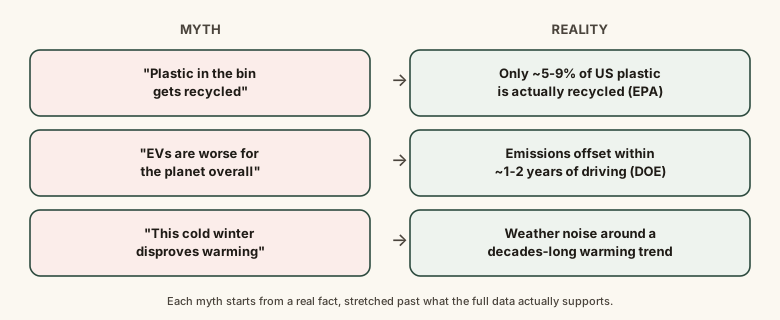
Myth vs. reality: three environmental claims checked against the data
Each row follows the same pattern: a real, verifiable fact on the myth side (plastic bottles ARE technically recyclable; EV batteries DO have higher manufacturing emissions; it WAS a genuinely cold week) gets stretched into a conclusion the fact doesn't actually support once the full data and timeframe are considered.
Common mistakes
Common Mistakes
✕
Accepting a claim because it cites a real, specific-sounding statistic without checking the source or the full context around it.
→ Look for the primary source (EPA, IUCN, DOE, a named agency) rather than a share graphic, and check whether the statistic is being applied over the right scope and timeframe.
✕
Assuming a partial truth (batteries have high manufacturing emissions) automatically implies the popularly-repeated conclusion (EVs are worse overall).
→ Ask whether the full picture — the entire lifecycle, not just one stage — has actually been accounted for before accepting the conclusion.
✕
Treating a single weather event as evidence for or against a long-term climate trend.
→ Remember that climate trends are calculated from decades of averaged global data — a single storm, heat wave, or cold snap is one data point inside normal variability, not a trend by itself.
Common misconception
“If an environmental claim turns out to be wrong or overstated in one direction, the safe assumption is that the opposite extreme must be true instead.”
Debunking an exaggerated myth doesn't mean the underlying issue doesn't exist — a low plastic recycling rate doesn't mean plastic waste is fine, and EVs offsetting their manufacturing emissions doesn't mean they have zero environmental footprint. The corrective is usually a more accurate, nuanced middle position backed by real data, not a swing to the opposite overstatement.
Quick check
After learning EVs offset their higher manufacturing emissions within 1-2 years of driving, what's the most accurate conclusion?
What to do next
What to do next
Before sharing an environmental statistic, check whether it comes from a named primary source (EPA, IUCN, DOE, UNEP) rather than an unsourced graphic or headline.
When you see a claim that stretches a real fact into a sweeping conclusion, ask what timeframe and scope the original data actually covers.
Read the other topic-10 entries linked below (climate change causes, the recycling hierarchy, protected areas, and the Paris Agreement) for the full sourced picture behind each myth covered here.
Resist the urge to overcorrect — debunking an exaggerated claim doesn't mean the opposite extreme is automatically true.
FAQ
FAQ
Related terms
Related terms
Downcycling
Recycling a material into a lower-quality product than the original, rather than back into the same type of item — most plastic recycling is downcycling, which is why plastic can typically only be recycled once or twice, not indefinitely.
Lifecycle emissions
The total greenhouse gas emissions produced by a product across its entire existence — manufacturing, use, and disposal — not just the emissions produced while it's being used.
This entry was researched from public sources and drafted with AI-assisted tools, then edited — errors are still possible. Spot one, or want a topic covered? Read our disclaimer.
 KnowThis