 KnowThis
Key Takeaways
Key Takeaways
- 1The Paris Agreement (adopted 2015, in force since November 2016) does not legally bind any country to hit a specific emissions number — it legally binds each country only to submit, report on, and periodically strengthen its own self-determined climate plan.
- 2That plan is called a Nationally Determined Contribution (NDC). Every signatory sets its own NDC; there is no international body that assigns targets to individual countries.
- 3The Agreement's temperature goals — holding warming well below 2°C above pre-industrial levels, pursuing efforts to limit it to 1.5°C — are collective aspirational goals, not a legally binding cap enforced against any single country.
The concept
Understanding this design — binding process, non-binding numbers — is the single most useful thing to know before reading any news coverage of the Agreement, since most public confusion about whether a country is "breaking" the Paris Agreement stems from treating the temperature goal or a country's own NDC target as if it were an enforceable legal ceiling.
A country submits an NDC pledging a 40% emissions cut by 2030, but only achieves a 25% cut. Has that country legally violated the Paris Agreement?
Worked examples
Example 1: Tracing the five-year NDC cycle (baseline case)
Example 2: Why the 1.5°C goal is described as "increasingly out of reach" without anyone violating the treaty (edge case / variation)
Example 3: A country formally withdrawing from the Agreement (real-world / applied case)
Why does it typically take close to four years for a country to fully exit the Paris Agreement, even after deciding to withdraw?
How it works (visual)
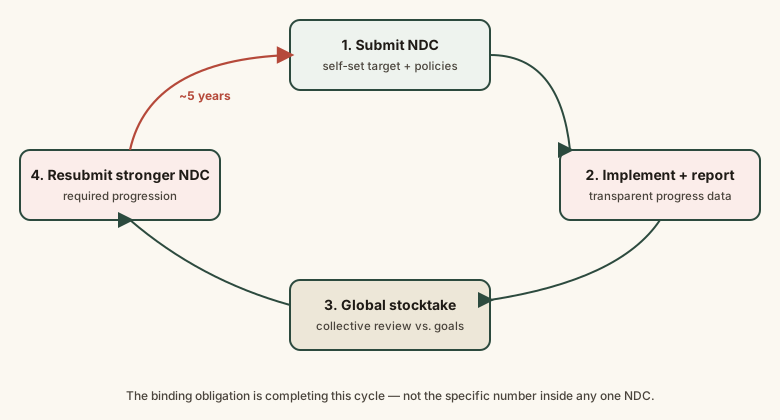
The loop has no exit point built into its normal operation — each cycle feeds directly into the next, which is precisely the mechanism the treaty relies on instead of a single fixed, binding number.
Common mistakes
Common Mistakes
Treating the 1.5°C or 2°C figures as a hard legal ceiling assigned to any individual country.
→ Remember these are collective, aspirational goals for the sum of all countries' efforts — no single country is legally bound to a specific temperature outcome.
Assuming a country misses its own NDC target and has therefore 'broken' the treaty.
→ The binding obligations are procedural — submitting NDCs, reporting transparently, and updating them every five years — not achieving the specific percentage inside any one NDC.
Confusing the Paris Agreement's structure with the Kyoto Protocol's binding-target model.
→ Kyoto assigned specific binding targets to a defined list of developed countries; Paris deliberately replaced that with a bottom-up, self-determined-target model to secure near-universal participation.
Common misconception
“The Paris Agreement legally requires every country to cut its emissions by a specific, internationally assigned percentage.”
No such assignment exists. Each country writes its own Nationally Determined Contribution with its own self-chosen target. What the treaty legally requires is the process around that target — submitting it, reporting progress transparently, and returning every five years with a more ambitious one — not achieving any particular number.
If NDC targets aren't individually binding, what mechanism does the Paris Agreement rely on to actually drive emissions down over time?
What to do next
What to do next
- When you read a headline about a country 'violating' the Paris Agreement, check whether it's describing a missed procedural step (like failing to submit an NDC) versus simply falling short of its own stated emissions target — only the former is a real treaty issue.
- Look up your own country's current NDC on the UNFCCC's public NDC Registry to see its actual submitted target and policies, rather than relying on secondhand summaries.
- Track the outcome of the next global stocktake cycle to see how the gap between combined NDCs and the 1.5°C/2°C goals is officially assessed.
- Read the Paris Agreement's own text (it's short, under 30 pages) at least once — most misconceptions about it dissolve on a direct read of Articles 3, 4, and 28.