 KnowThis
Key Takeaways
Key Takeaways
- 1Environmental justice holds that environmental burdens like pollution and toxic waste sites shouldn't fall disproportionately on any particular community, regardless of race or income.
- 2The modern environmental justice movement traces to a specific, well-documented 1982 protest in Warren County, North Carolina, against a PCB-contaminated soil landfill sited in a majority-Black community.
- 3The US EPA maintains a dedicated Office of Environmental Justice specifically to build these considerations into its regulatory and enforcement decisions, not just leave them as an academic concept.
The concept
Understanding the Warren County origin story matters because it grounds "environmental justice" in a specific, well-documented historical event and research finding, rather than treating it as an abstract or purely theoretical framework.
Why is the concept of 'cumulative impact' important in environmental justice analysis, compared to evaluating a single new facility's environmental effects in isolation?
Worked examples
Example 1: The Warren County protest as the movement's founding event (baseline case)
Example 2: Distinguishing intentional siting from cumulative, unintentional effect (edge case / variation)
Example 3: The EPA's Office of Environmental Justice reviewing a permit application (real-world / applied case)
A city's five separate industrial permit approvals over 20 years were each individually compliant with environmental regulations at the time they were approved, yet the surrounding community now has one of the highest cumulative pollution burdens in the city. What does environmental justice analysis specifically draw attention to in this scenario?
How it works (visual)
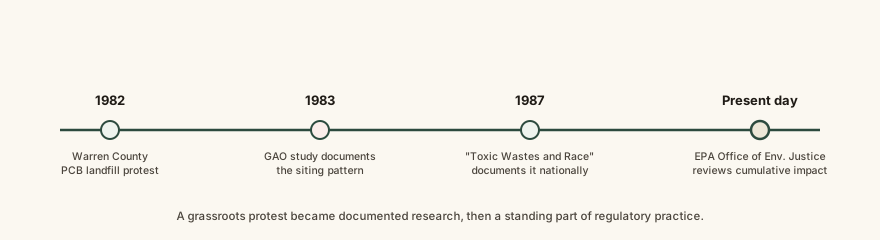
The timeline traces a direct line from a single, specific community protest to a documented research pattern to an institutionalized government review process — illustrating how a grassroots event became a standing part of environmental regulatory practice.
Common mistakes
Common Mistakes
Treating environmental justice as a purely academic or abstract concept with no operational application.
→ Recognize that the US EPA has a dedicated Office of Environmental Justice that factors these considerations into real permitting and enforcement decisions.
Assuming environmental injustice always requires proving deliberate discriminatory intent.
→ Understand that cumulative impact analysis specifically looks at the pattern and combined effect of decisions over time, which can produce an unjust outcome even without any single decision being made with discriminatory intent.
Assuming the environmental justice movement began as a purely theoretical academic framework.
→ Trace it to its specific, well-documented origin: the 1982 Warren County, North Carolina protest against a PCB landfill, which directly triggered the federal research that established the field.
Common misconception
“A pattern of hazardous facilities clustering in a particular community can only be called an environmental justice concern if it can be proven someone deliberately intended to discriminate.”
Environmental justice research, going back to the 1983 federal study and the 1987 "Toxic Wastes and Race" report, documents disparities as a pattern across many decisions, which can emerge from the cumulative effect of individually "neutral" siting choices over time — not only from provable deliberate intent in any single decision. This is exactly why tools like cumulative impact assessment exist: to identify and address a real, harmful pattern regardless of whether any one decision-maker intended it.
What historical event is most directly credited with launching the modern environmental justice movement in the United States?
What to do next
What to do next
- If you're researching a proposed facility near a community, look for cumulative impact assessments, not just that single facility's standalone environmental review.
- Check whether your country or region has a dedicated environmental justice office or framework, similar to the US EPA's Office of Environmental Justice.
- Read the original 1987 'Toxic Wastes and Race' report if you want the primary historical research document behind the modern environmental justice field.
- When evaluating environmental policy debates, distinguish between disparate outcome (a documented pattern) and disparate intent (a claim about motive) — they require different kinds of evidence.