 KnowThis
Key Takeaways
Key Takeaways
- 1Plastic bans range enormously in scope — from a narrow fee on shopping bags to the EU's Single-Use Plastics Directive banning entire categories of disposable items.
- 2Rwanda has banned plastic bags since 2008 and enforces the ban strictly, including bag checks at its border, making it one of the strictest plastic policies in the world.
- 3Bans on the item itself are only one policy tool — extended producer responsibility laws instead make manufacturers financially responsible for what happens to their products after use.
The concept
Recognizing that plastic policy comes in different forms — outright item bans, fees, and producer-responsibility laws — explains why comparing "which country has the strongest plastic policy" isn't a simple yes/no question; strictness, scope, and enforcement all vary independently.
A country wants to reduce plastic waste without banning any specific product outright. Which policy tool described above would fit that goal?
Worked examples
Example 1: A narrow bag-fee policy (baseline case)
Example 2: Rwanda's strict plastic bag ban with border enforcement (edge case / variation)
Example 3: The EU's multi-item directive covering an entire product category (real-world / applied case)
Why does the EU's Single-Use Plastics Directive ban plastic cutlery and straws outright, but instead require design and collection standards (not an outright ban) for plastic drink bottles?
How it works (visual)
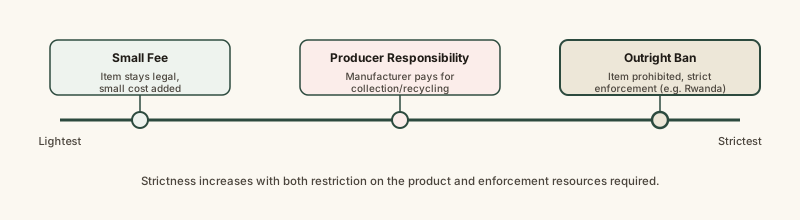
Moving along the scale from a small fee to an outright, strictly enforced ban represents an increase in both the direct restriction on the product and the government resources needed to enforce it.
Common mistakes
Common Mistakes
Assuming any country with a plastic bag law has an equally strict policy.
→ Check both the scope (which items are covered) and the enforcement mechanism — a law on the books with light enforcement is very different from Rwanda's border-check-level enforcement.
Assuming 'biodegradable' plastic breaks down quickly in any environment.
→ Recognize that many biodegradable plastics require specific industrial composting conditions to break down as intended — in an ordinary landfill or as ocean litter, they can persist almost as long as conventional plastic.
Treating a plastic ban and extended producer responsibility as the same policy tool.
→ A ban prohibits the product outright; extended producer responsibility instead makes manufacturers responsible for end-of-life handling without prohibiting the product itself — genuinely different mechanisms.
Common misconception
“A product labeled 'biodegradable plastic' will break down safely and quickly no matter where it ends up.”
Most biodegradable plastics are engineered to break down under specific industrial composting conditions — particular temperature and humidity levels rarely present in an ordinary landfill, and certainly not in ocean water. Litter made of biodegradable plastic that ends up outside those specific conditions can persist for a very long time, in some cases comparably to conventional plastic, which is why policy experts generally treat "biodegradable" labeling as a real but limited claim, not a guarantee of harmless disposal anywhere.
A shopper sees a bag labeled 'biodegradable' and assumes it's environmentally safe to litter since it will break down naturally wherever it ends up. What's the flaw in that assumption?
What to do next
What to do next
- When comparing plastic policies across countries, check both scope (which items) and enforcement strength, not just whether a ban technically exists.
- Don't assume a 'biodegradable' label means an item is safe to litter — check whether it requires specific industrial composting conditions to actually break down.
- If you're evaluating a country's or company's plastic policy, look for whether it uses outright bans, fees, or extended producer responsibility — each represents a different level of restriction.
- Look up the EU Single-Use Plastics Directive's actual item list if you want a concrete, real-world example of how a multi-item ban is structured.