 KnowThis
Key Takeaways
Key Takeaways
- 1A home's building envelope — insulation, air sealing, and windows — determines how much heating and cooling energy is needed in the first place, which is usually the highest-leverage efficiency investment in a home.
- 2Air sealing (closing unintentional gaps and leaks) and insulation are different but complementary strategies — a well-insulated but poorly sealed home can still lose significant conditioned air through leaks.
- 3Appliance efficiency (like ENERGY STAR ratings) is a genuine, additional lever, but it acts on energy that's already being used inside a home whose envelope determines the baseline heating and cooling demand to begin with.
The concept
This doesn't mean appliance efficiency doesn't matter — an ENERGY STAR-rated furnace or air conditioner genuinely uses less energy to do the same job. The point is sequencing: envelope improvements reduce how much heating/cooling work needs to happen at all, while appliance efficiency improves how efficiently that (now-smaller) remaining job gets done.
A homeowner installs a brand-new, highly efficient furnace in a home with poor insulation and multiple air leaks, expecting a dramatic reduction in heating costs. Is this the highest-leverage single investment available?
Worked examples
Example 1: Insulation without air sealing still leaks energy (baseline case)
Example 2: Comparing envelope investment against appliance investment (edge case / variation)
Why might sealing and insulating a leaky home sometimes save more energy than upgrading to a more efficient air conditioner, even though the more efficient unit has a better performance rating on paper?
Example 3: LEED certification evaluating more than just energy use (real-world / applied case)
How it works (visual)
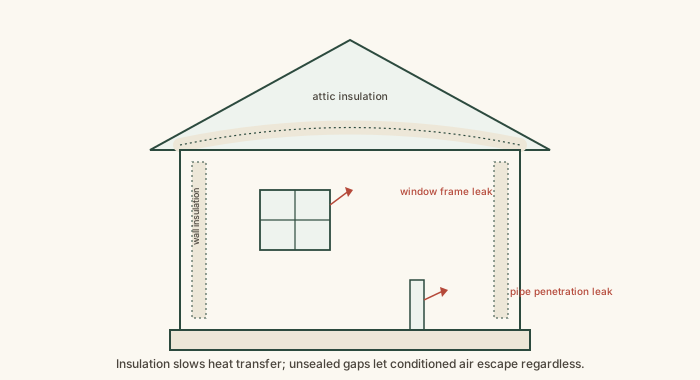
The diagram deliberately separates two different problems occupying the same physical space — the insulation layer (shown as a continuous wavy band) slows heat transfer through solid surfaces, while the small arrows at specific gaps show that air leakage is a distinct failure mode that insulation alone doesn't fix.
Common mistakes
Common Mistakes
Assuming adding insulation automatically fixes air leakage problems too.
→ Treat air sealing (closing gaps and cracks) as a separate, necessary step alongside insulation — ENERGY STAR guidance recommends addressing both together.
Prioritizing a new efficient appliance purchase over addressing a home's insulation and sealing first.
→ If your home has known envelope deficiencies, address insulation and air sealing first or alongside equipment upgrades — it reduces the underlying load any equipment has to meet.
Assuming 'green building' certification (like LEED) is purely a measure of energy efficiency.
→ Understand that formal green building frameworks evaluate multiple categories — water, materials, site, and indoor quality — not energy performance alone.
Common misconception
“The most effective way to reduce a home's energy bill is buying more efficient appliances, since that's the visible, purchasable upgrade.”
Appliance efficiency is a real, additional lever, but ENERGY STAR and Department of Energy guidance consistently identify the building envelope — insulation and air sealing — as typically the higher-leverage investment, especially in older or poorly sealed homes, because it reduces the underlying heating and cooling demand that any appliance, efficient or not, has to meet in the first place.
A home has excellent attic insulation but several unsealed gaps around wiring and plumbing penetrations. According to ENERGY STAR guidance, is the insulation alone sufficient to maximize the home's energy efficiency?
What to do next
What to do next
- If your home has known drafts or an older insulation setup, prioritize air sealing and insulation upgrades before or alongside appliance replacement.
- Look for visible gaps around attic hatches, recessed lighting, and pipe or wiring penetrations — these are common, fixable air-leak sources.
- When buying new heating, cooling, or major appliances, check for ENERGY STAR ratings as a genuine additional efficiency lever, not a substitute for envelope work.
- If pursuing a formal green building certification like LEED, remember it evaluates more than energy alone — water, materials, and site factors matter too.