 KnowThis
Key Takeaways
Key Takeaways
- 1Heat is a real, measurable form of energy that physics defines precisely — "cold" has no equivalent definition, because it's just the absence or reduction of heat, not a substance of its own.
- 2Heat always flows from a warmer object or region to a cooler one, never the reverse, without energy being added from outside — that one-directional rule is the second law of thermodynamics.
- 3A drafty window doesn't let cold air 'in' so much as it lets your body's own heat escape faster than it otherwise would, which is exactly why sealing and insulation work by slowing heat loss, not blocking incoming cold.
The concept
Once heat is understood as the only thing physically flowing, insulation, sealing, and even the concept of "keeping the cold out" all make more sense as heat-management problems rather than cold-blocking problems.
Standing near a drafty window in winter, a person feels a chill on the side of their body facing the window. What is actually happening?
Worked examples
Example 1: Holding an ice cube (baseline case)
Holding an ice cube, your hand feels progressively colder. What's physically happening is that heat is continuously flowing out of your warmer hand into the colder ice, following the second law of thermodynamics exactly — heat always moves from warmer to cooler, never the other way. The ice doesn't inject any "cold" into your skin; your hand's own thermal energy is being drawn away, some of it even consumed by melting the ice (its latent heat of fusion), which is why ice feels colder for longer than an equally cold piece of metal of the same temperature.
When holding an ice cube, what is physically moving between your hand and the ice?
Example 2: A well-sealed room next to a drafty one (edge case / variation)
Why does a drafty room require far more heating energy to stay warm than an identical, well-sealed room at the same target temperature?
Example 3: Why insulation is rated by R-value, not "cold resistance" (real-world / applied case)
Home insulation is rated using R-value, a measure of how strongly a material resists heat flow through it — never a rating for blocking incoming cold, because that would describe a physical process that doesn't exist. A higher R-value material, like thick fiberglass batting, slows the rate at which a home's interior heat escapes to colder outside air in winter, and equally slows the rate at which outside heat enters in summer — the same underlying mechanism working in both directions, which is exactly why good insulation helps with both heating and cooling costs rather than being a winter-only feature.
Why does good home insulation help reduce both heating costs in winter and cooling costs in summer, using the exact same material?
How it works (visual)
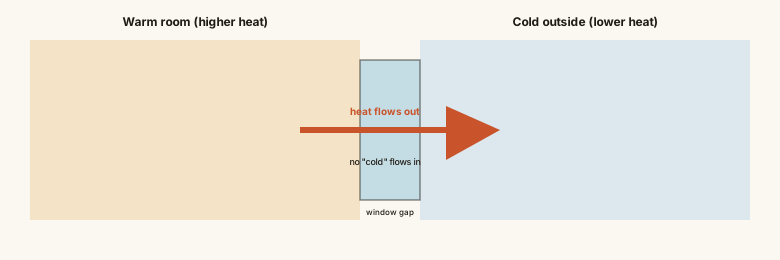
Only one arrow exists in this diagram, because only one thing is physically moving — heat leaving the warm side for the cool side.
Common mistakes
Common Mistakes
Describing insulation or weatherstripping as 'keeping the cold out,' which frames the problem backward.
→ Think of it as 'keeping your own heat in' — the material slows heat loss, it doesn't block an incoming substance.
Assuming a drafty spot in a room has literally colder air molecules pouring in from outside.
→ Recognize that circulating air near the gap is simply losing heat faster, which lowers its temperature locally — no special 'cold' substance is involved.
Buying insulation only for winter heating, assuming it won't help with summer cooling.
→ Remember R-value resists heat flow in either direction — the same insulation reduces both winter heat loss and summer heat gain.
Common misconception
“Cold is a real substance or force that flows into a warm space, the same way heat flows.”
Physics recognizes only heat — a real, measurable transfer of thermal energy — as something that actually flows, always moving from a warmer region to a cooler one, per the second law of thermodynamics. "Cold" has no equivalent physical existence; it's simply the perception of reduced heat, a lower temperature. A drafty window doesn't let cold pour into a room — it lets the room's own heat escape to the colder outside air faster than it otherwise would, and the resulting drop in local temperature is what gets felt and described as "the cold coming in." This is exactly why insulation and sealing work by slowing heat loss, not by blocking some incoming cold substance that was never physically there.
Try it yourself
Fourier's law estimates the rate of heat flow through a material, given its thermal conductivity, area, thickness, and the temperature difference across it.
What to do next
What to do next
- Next time you feel a draft, describe it to yourself as heat leaving faster, not cold coming in — the physics is the same, but the mental model gets the direction right.
- Check for gaps around windows and doors and seal them, understanding that you're slowing your own heat's escape, not blocking an incoming substance.
- Look up your insulation's R-value and remember that a higher number means slower heat transfer in both directions — helpful for winter heating and summer cooling alike.
- Notice wind chill on a cold day and connect it to this same mechanism: moving air pulls heat from your skin faster than still air, without the air itself being any colder.