 KnowThis
Key Takeaways
Key Takeaways
- 1Lightning and thunder are created at the exact same instant, by the exact same event — the delay you perceive comes entirely from how much faster light travels than sound, not from any timing difference at the source.
- 2Light covers about 300,000 km every second, while sound crawls along at roughly 343 m/s in air — a difference of nearly a million times, which is why a nearby flash looks instant while its thunder arrives seconds later.
- 3That delay is directly proportional to distance, which is exactly why counting seconds between flash and thunder (then dividing by five) gives a genuinely useful estimate of how many miles away a storm is.
The concept
Because the delay is purely a distance measurement, it can be used the other way around too — knowing the delay lets you calculate distance, which is exactly the safety-relevant skill this concept supports.
A person sees a lightning flash and hears the thunder 6 seconds later. What does that delay actually represent?
Worked examples
Example 1: A storm 1 mile away (baseline case)
Sound travels roughly 343 meters per second, or about 1,125 feet per second — close enough to 1,100 feet per second that the "5 seconds per mile" rule of thumb holds up well. A strike 1 mile (5,280 feet) away produces thunder that takes about 5 seconds to arrive, while the flash itself reaches the observer in a small fraction of a millisecond — for practical purposes, instantly. Counting "one-one-thousand, two-one-thousand..." up to five between flash and boom is therefore a genuinely accurate estimate of a 1-mile distance, not just a rough guess.
Why does the thunder from a strike 1 mile away take about 5 seconds to arrive, while the flash arrives effectively instantly?
Example 2: A strike close enough that flash and thunder feel simultaneous (edge case / variation)
Why does a very close lightning strike produce a flash and thunder that feel simultaneous, when a distant one clearly doesn't?
Example 3: Using the flash-to-bang method for storm safety (real-world / applied case)
A hiker sees a distant flash and counts 20 seconds before hearing thunder, indicating the strike was roughly 4 miles away (20 divided by 5). NOAA's safety guidance recommends seeking shelter once that count drops to 30 seconds or less, since storms can move several miles in the time it takes to reach safety, and lightning can strike well outside the area of heaviest rain. Watching the count shrink over successive flashes — 20 seconds, then 15, then 10 — gives a real-time, physics-based read on how quickly the storm is actually approaching, not just a guess based on how the sky looks.
A hiker's flash-to-bang count drops from 25 seconds to 12 seconds over several successive lightning strikes. What does that trend indicate?
How it works (visual)
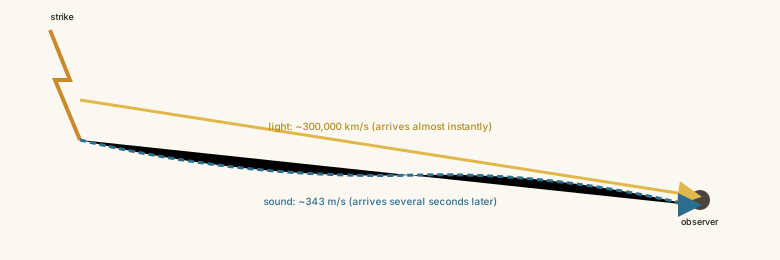
Both signals leave the strike together — the gap that opens up across the diagram is purely the result of sound's far slower travel speed, not a difference in when each was produced.
Common mistakes
Common Mistakes
Assuming the flash-to-bang delay means the thunder happened after the lightning, as a separate later event.
→ Remember both are produced at the same instant — the delay is entirely due to sound traveling far slower than light over the same distance.
Ignoring the flash-to-bang count once it drops below 30 seconds, waiting for the storm to 'look' dangerous.
→ Follow NOAA's guidance and treat a 30-second-or-shorter count as a real signal to seek shelter immediately, regardless of how the sky appears.
Assuming the divide-by-five rule is an exact law rather than an approximation.
→ Treat it as a close, genuinely useful estimate — sound's actual speed varies slightly with air temperature, so treat the result as approximate, not precise to the foot.
Common misconception
“Lightning happens, and then a moment later, thunder happens as a separate, later event.”
The flash and the thunder are produced at the exact same instant, by the exact same physical event — the superheating and explosive expansion of air in the lightning channel. What creates the perceived gap is purely a difference in travel speed: light covers the distance to an observer at roughly 300,000 km/s, arriving effectively instantly, while sound crawls along at only about 343 m/s in air, taking several real seconds to cover the same distance. Because that delay scales directly with distance, it's not just an interesting illusion — it's the basis for a genuinely reliable way to estimate how far away a storm is, and how quickly it's approaching.
Try it yourself
Enter the number of seconds counted between seeing the flash and hearing the thunder to estimate the strike's distance.
What to do next
What to do next
- During a storm, count the seconds between a flash and its thunder, then divide by five for an approximate distance in miles.
- Follow NOAA's guidance: seek shelter once that count reaches 30 seconds or less, and stay sheltered until 30 minutes after the last thunder.
- Watch how the count changes across successive strikes to judge whether the storm is approaching or moving away in real time.
- Remember that a near-simultaneous flash and boom means the strike is very close — treat it as an immediate signal to get inside, not just a curiosity.