 KnowThis
Key Takeaways
Key Takeaways
- 1Lightning strikes wherever it finds the shortest, most conductive path from cloud to ground — not randomly, and not by any rule against repeating a spot.
- 2The Empire State Building is struck roughly 20-25 times a year, and any tall, isolated, or highly conductive structure gets hit again and again for the same reason.
- 3A lightning rod doesn't reduce how often a building gets struck — it gives each strike a safe, planned path to ground instead of letting current pass through the building's structure.
The concept
Once you see a strike as "whichever path wins the race to connect," the specific traits that make a location win — height, isolation, and conductivity — start to explain a lot of real-world lightning behavior.
A radio tower on a hilltop gets struck by lightning during a storm. Two months later, another storm passes directly over the same hill. What is most likely to happen?
Worked examples
Example 1: The Empire State Building (baseline case)
At 1,454 feet including its antenna, and standing well above most of the surrounding Manhattan skyline for decades, the Empire State Building is exactly the profile that wins the race to meet a descending stepped leader: tall, prominent, and a strong electrical conductor thanks to its steel frame. NOAA-cited monitoring data puts its strike frequency at roughly 20-25 times a year — not as a fluke, but as the predictable outcome of the same physical advantage repeating every storm season. If the old saying were literally true, a building struck this often would be a paradox. Under the real mechanism, it's simply the least surprising building in the city to get hit.
Why does a very tall building get struck by lightning far more often than the low buildings around it, storm after storm?
Example 2: A lone tree in an open field (edge case / variation)
A lone tree in an open field gets struck by lightning far more often than a similarly tall tree deep inside a forest. What best explains the difference?
Example 3: Designing a lightning rod system for a house (real-world / applied case)
A lightning protection system installed on a house, following standards like NFPA 780, doesn't try to stop lightning from striking the property — it accepts that a strike may happen and controls exactly where it goes. A pointed metal air terminal (the classic Franklin rod) is mounted at the building's highest points specifically because a sharp, elevated, well-grounded point produces a strong upward streamer more reliably than the surrounding roofline, giving it a real advantage in winning the connection over the rest of the house. Multiple rods and connecting cables are positioned so that every part of the roof falls within each rod's cone of protection, and a heavy grounding conductor then carries the current safely down and out into the earth, well away from the building's wiring, plumbing, and occupants. The system doesn't lower the odds that the property gets struck at all — it makes sure that when it does, the strike has a controlled, low-resistance route that bypasses everything the current could otherwise damage.
What is the actual purpose of a lightning rod (air terminal) mounted on a building, per standards like NFPA 780?
How it works (visual)
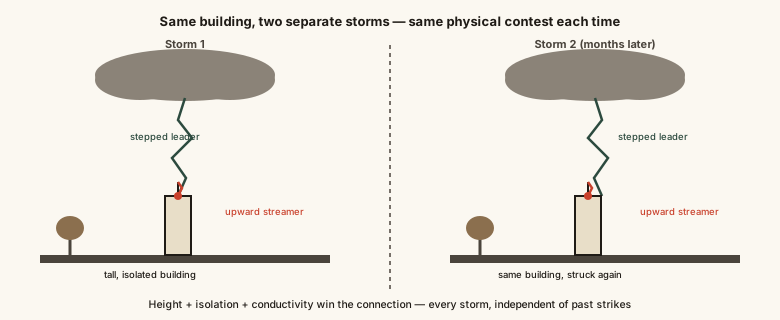
Notice that nothing in the diagram carries information forward from one storm to the next — the leader and the streamer run through the identical physical contest every time, and the tall building keeps winning it for the same structural reasons.
Common mistakes
Common Mistakes
Assuming a spot that's already been struck by lightning is now "safe" for the rest of the storm season.
→ Treat height, isolation, and conductivity as the ongoing risk factors they are — a location doesn't become safer just because it was struck before.
Sheltering under an isolated tall tree during a storm, thinking a tree provides cover from the rain and reduces risk.
→ Move toward a substantial building or a hard-topped vehicle instead — an isolated tree is a lightning target, not shelter from it.
Believing a lightning rod on a building attracts strikes that otherwise wouldn't have happened at all.
→ Recognize that the building's height and exposure already determine its strike risk; the rod redirects an already-likely strike safely to ground, rather than creating new risk.
Common misconception
“Lightning never strikes the same place twice.”
It strikes the same place constantly, if that place keeps offering the easiest path to ground. The Empire State Building takes roughly 20-25 strikes a year, and tall radio towers, isolated trees, and mountain summits are struck repeatedly within a single storm season. Lightning has no memory and follows no rule against repetition — each strike is a fresh contest decided purely by which nearby point is tallest, most isolated, and most electrically conductive at that instant. The saying likely persists because most everyday objects (a person, a parked car, a backyard) are struck so rarely that a second strike in the same spot feels impossibly unlucky — but for the tall, exposed, conductive minority of objects that regularly win that contest, repeat strikes aren't just possible, they're the expected pattern every single storm.
What to do next
What to do next
- Follow NOAA's "when thunder roars, go indoors" guidance — get inside a substantial building or hard-topped vehicle at the first sound of thunder, regardless of past strike history at your location.
- Avoid becoming the tallest or most isolated object in an open area during a storm — that's the exact profile that wins the race to complete a strike.
- If you own a tall or isolated structure, look into a lightning protection system designed to NFPA 780, which manages where a strike goes rather than trying to prevent one.
- Retire the phrase "lightning never strikes the same place twice" as an idiom about bad luck, not a claim about how electricity actually behaves.