 KnowThis
Key Takeaways
Key Takeaways
- 1Bear hibernation is a 5-7 month fast with zero food, water, urination, or defecation — the bear survives entirely on fat reserves built up beforehand.
- 2To store enough fuel for that, bears enter hyperphagia in late summer and fall, eating up to 20,000+ calories a day and gaining as much as 3-6 pounds daily.
- 3Fat Bear Week isn't just a cute contest — visibly fatter bears at Katmai National Park have measurably better odds of surviving the winter and, for females, successfully nursing cubs through it.
The concept
Surviving that fast isn't possible without first building the fuel tank big enough — which is exactly what the fall feeding frenzy, and Fat Bear Week itself, are actually measuring.
Why does a hibernating bear's body convert waste urea back into protein instead of excreting it as urine?
Worked examples
Example 1: A typical hyperphagia season (baseline case)
Example 2: A pregnant female's extra burden (edge case / variation)
Example 3: Why Fat Bear Week is a real survival signal (real-world / applied case)
Why might a pregnant female bear's body reabsorb a fertilized embryo instead of carrying the pregnancy to term?
How it works (visual)
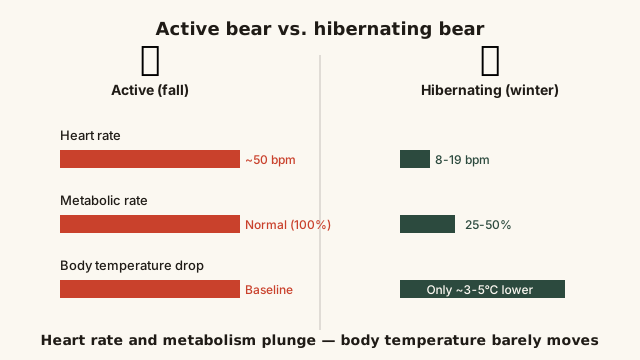
Notice how much heart rate and metabolism drop compared to how little body temperature falls — that gap is exactly why bear hibernation is considered a milder form of torpor than a true deep hibernator like a ground squirrel, letting a bear stay capable of waking up faster if a threat appears.
Common mistakes
Common Mistakes
Assuming bear hibernation is the same as a squirrel's or a bat's.
→ True deep hibernators drop body temperature close to freezing; bears only drop a few degrees and can wake relatively quickly, making bear hibernation a milder form of torpor.
Thinking a hibernating bear is completely unresponsive the whole winter.
→ Bears can and do rouse if disturbed, shift position in the den, and females give birth and nurse cubs during hibernation — it's a deep rest state, not unconsciousness.
Assuming any bear gaining weight before winter is unhealthy or overeating unnaturally.
→ Rapid, large fat gain in fall (hyperphagia) is a normal, essential survival adaptation, not a health problem — it's the fuel for the entire winter fast ahead.
Common misconception
“Hibernating bears are basically just sleeping for the winter.”
Hibernation is a controlled physiological shutdown, not ordinary sleep. A bear's heart rate can fall from around 50 beats per minute to single digits, its metabolism drops sharply, and it survives 5 to 7 months without eating, drinking, urinating, or defecating — running entirely on fat reserves and recycling its own waste products internally. None of that happens during normal sleep, which is why building enough fat beforehand, through weeks of near-constant eating, is a matter of survival rather than simply getting ready for a long nap.
Try it yourself
What to do next
What to do next
- Watch Katmai National Park's live "bear cam" footage in late summer to see hyperphagia in action before Fat Bear Week's October vote.
- Try the calculator above with a lower daily gain rate to see how much longer a bear would need to feed to reach the same fat target — a real illustration of why salmon abundance matters so much to bear survival.
- If you encounter bears in the wild during fall, give them extra space — hyperphagia makes bears more food-focused and less cautious than usual.