 KnowThis
Key Takeaways
Key Takeaways
- 1The "zombie-ant fungus" (Ophiocordyceps unilateralis) really does compel infected ants to leave their colony, climb to a specific height, and clamp onto a leaf before it kills them and grows spores from their body.
- 2Toxoplasma gondii, a parasite that can only reproduce inside a cat, appears to reduce infected rodents' instinctive fear of cat scent — making them easier for cats to catch and completing the parasite's life cycle.
- 3Neither parasite is "choosing" to control its host — these are evolved side effects of infection that happen to boost the parasite's odds of reproducing, so natural selection keeps favoring them generation after generation.
The concept
That specificity is exactly where the pop-culture version of these parasites (think a fungus jumping from insects to humans) and the real biology sharply diverge — worth walking through concretely.
What does it mean that the zombie-ant fungus grows through the ant's muscle fibers rather than directly controlling its brain?
Worked examples
Example 1: The zombie-ant fungus's full cycle (baseline case)
Example 2: Toxoplasma's weaker, more debated human evidence (edge case / variation)
Example 3: Why the real fungus can't cause a human outbreak (real-world / applied case)
Why can't a fungus like Ophiocordyceps unilateralis realistically infect and control humans the way it does ants?
How it works (visual)
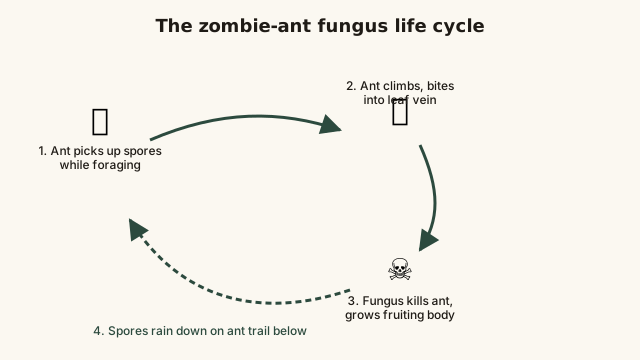
Follow the loop all the way around — the ant's climbing-and-biting behavior isn't a random side effect, it's the one step in the whole cycle that positions the fungus's spores exactly where the next ant will walk underneath.
Common mistakes
Common Mistakes
Assuming these parasites "intend" to control their hosts, the way a fictional villain would.
→ These behaviors are evolved side effects of infection — traits that happened to help the parasite spread get favored by natural selection over many generations, with no intent involved.
Treating the rodent-Toxoplasma fear-reduction finding as proof of strong, similar effects in humans.
→ The rodent evidence is well-established, but human behavioral evidence is much weaker and more debated — don't equate the two levels of evidence.
Assuming a real fungus like the one in The Last of Us could realistically infect humans the same way.
→ Ophiocordyceps species are host-specific to certain insects and can't tolerate mammalian body temperature, which is a genuine biological barrier to any human jump.
Common misconception
“Mind-controlling 'zombie' parasites only exist in science fiction.”
Several real parasites genuinely manipulate host behavior to complete their life cycle. The zombie-ant fungus compels infected ants to climb vegetation and bite into a leaf vein before killing them and releasing spores from their body — a well-documented, repeatable phenomenon in tropical forests. Toxoplasma gondii appears to reduce infected rodents' fear of cat scent, making them easier prey and helping the parasite reach its only host capable of sexual reproduction. Neither involves conscious intent — both are evolved traits favored by natural selection because they happen to help the parasite spread.
What to do next
What to do next
- If you're pregnant or immunocompromised, follow standard Toxoplasma precautions — avoid handling cat litter without gloves and cook meat to safe temperatures, per CDC guidance.
- Look up Ophiocordyceps unilateralis photos and field videos from tropical forest researchers to see this phenomenon documented in the wild, not just described.
- When encountering a viral claim about a "real-life zombie fungus" threat to humans, check the specific species and its documented host range and temperature tolerance before assuming it applies to humans.