 KnowThis
Key Takeaways
Key Takeaways
- 1Gravity accelerates every object at the same rate — about 9.8 m/s² near Earth's surface — completely independent of its mass.
- 2A heavier object needs more force to accelerate it, but gravity also pulls harder on it by the exact same proportion, so the two effects cancel out perfectly.
- 3What actually slows a feather down in everyday life is air resistance, a separate force that has nothing to do with gravity and acts far more strongly on light, high-surface-area objects.
The concept
Once air resistance is identified as the real culprit, it becomes possible to predict exactly when the "heavier falls faster" intuition will hold (dense objects in air) and when it won't (a vacuum, or objects with similar air resistance).
A bowling ball and a marble, both very dense and roughly similar in shape, are dropped from the same height in ordinary air. What is most likely to happen?
Worked examples
Example 1: A hammer and a feather on the Moon (baseline case)
During the 1971 Apollo 15 mission, astronaut David Scott dropped a geological hammer and a falcon feather from the same height at the same time, on the Moon's airless surface. With no atmosphere to produce air resistance, both objects were in true free fall, and both hit the lunar surface at the exact same instant, exactly as Galileo's reasoning predicted roughly 380 years earlier. This is the cleanest real-world demonstration available: identical starting height, identical release time, and one variable (air) completely removed.
Why did the Apollo 15 hammer-and-feather drop land both objects at the same instant, when the same experiment on Earth would show the feather landing dramatically later?
Example 2: The same drop, back on Earth (edge case / variation)
On Earth, a feather falls far more slowly than a hammer, but on the Moon they fall together. What does this comparison actually demonstrate?
Example 3: A skydiver's terminal velocity (real-world / applied case)
A skydiver in freefall accelerates at nearly 9.8 m/s² only for the first few seconds after jumping. As speed builds, air resistance — which grows with speed — increases until it exactly balances the downward pull of gravity, at which point the skydiver stops accelerating and falls at a constant terminal velocity, typically around 195 km/h (120 mph) in a standard belly-to-earth position. Changing body position to increase surface area — spreading arms and legs wide — increases air resistance and lowers terminal velocity, which is exactly why skydivers can control their fall rate without changing their mass at all.
A skydiver changes from a head-first dive position to a spread-eagle, belly-to-earth position mid-fall. What happens to their falling speed, and why?
How it works (visual)
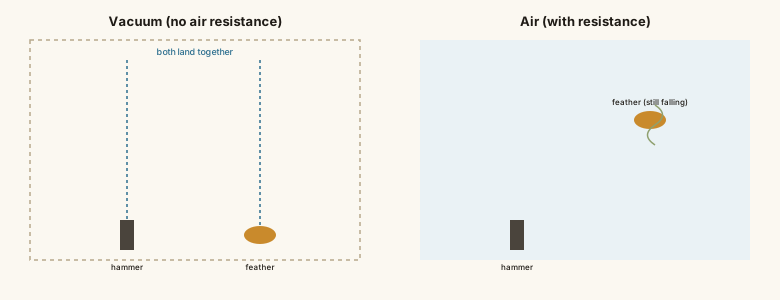
The only variable between the two panels is the presence of air — gravity's pull on both objects is identical in each case.
Common mistakes
Common Mistakes
Concluding that mass affects how fast gravity accelerates an object.
→ Remember that mass cancels out of the free-fall equation entirely — a heavier object needs more force to accelerate, but gravity supplies proportionally more force, too.
Assuming any observed 'heavier falls faster' result proves something about gravity itself.
→ Check whether air resistance differs meaningfully between the two objects — that's almost always the actual explanation, not a property of gravity.
Thinking a vacuum only matters for exotic physics experiments, not everyday intuition.
→ Use the vacuum case as the clean baseline: it isolates gravity alone, showing what's 'really' happening underneath the air resistance most people actually observe day to day.
Common misconception
“Heavier objects fall faster than lighter ones because gravity pulls harder on more mass.”
Gravity does pull harder on more massive objects, but that extra pull is exactly canceled out by the extra force needed to accelerate that extra mass — the two effects cancel perfectly, leaving free-fall acceleration identical for every mass, roughly 9.8 m/s² near Earth's surface. The everyday experience of heavy objects beating light ones to the ground comes entirely from air resistance, an unrelated force that depends on an object's surface area and speed, not its mass, and which acts far more strongly on light, high-surface-area objects like feathers or paper. Apollo 15's 1971 hammer-and-feather drop on the airless Moon demonstrated this directly — identical landing time, because the confounding force (air) had been removed entirely.
Try it yourself
This gives the true free-fall time under gravity alone — real-world results for light or high-surface-area objects will differ due to air resistance.
What to do next
What to do next
- Watch footage of the 1971 Apollo 15 hammer-and-feather drop to see the effect demonstrated directly, with no air present.
- Next time you see two objects fall at different speeds, ask whether air resistance — not mass — is the actual explanation.
- Try dropping two sheets of paper — one crumpled into a ball, one flat — from the same height; same mass, very different air resistance, very different fall times.
- Connect this to skydiving or parachute design: changing surface area, not weight, is what controls fall speed once terminal velocity is involved.