Mass measures the amount of matter in an object and stays constant everywhere in the universe; weight is the force of gravity acting on that mass, calculated as weight = mass × local gravitational acceleration, so the same mass produces a different weight on Earth, the Moon, or Mars.
Reading time
— 4 min
Updated
— Aug 21, 2026
Fact-reviewed
— Aug 21, 2026
Key Takeaways
Key Takeaways
1Mass is the amount of matter in an object, measured in kilograms, and it is identical everywhere in the universe — on Earth, on the Moon, or floating in deep space.
2Weight is the force gravity exerts on that mass, measured in newtons, and it changes depending on the local gravitational acceleration — the same mass weighs about six times less on the Moon than on Earth.
3A bathroom scale doesn't measure mass directly — it measures the force your body exerts on it, then a fixed conversion (assuming Earth-surface gravity) prints that force as a familiar 'weight' number.
The concept
Everyday speech treats "mass" and "weight" as interchangeable, but physics keeps them strictly separate. Mass is how much matter an object is made of — measured in kilograms — and it never changes, whether the object is sitting on your kitchen counter or drifting through the vacuum of space. Weight is the force gravity exerts on that mass, measured in newtons, and it depends entirely on how strong gravity is wherever the object happens to be.
Quick check
An astronaut orbiting Earth appears to float freely inside the space station. Does this mean gravity has stopped acting on them?
Worked examples
Example 1: A person's weight on Earth (baseline case)
A person with a mass of 70 kg stands on a scale at sea level, where g ≈ 9.8 m/s². Their weight is 70 × 9.8 = 686 newtons. Converted to the more familiar pounds-force (1 N ≈ 0.2248 lbf), that's about 154 pounds — the number a US bathroom scale would actually display, since US consumer scales report weight-force in pounds rather than mass in kilograms.
Example 2: The same mass on the Moon (edge case / variation)
That identical 70 kg astronaut steps onto a scale on the lunar surface, where g ≈ 1.62 m/s². Their mass hasn't changed — it's still 70 kg — but their weight is now 70 × 1.62 ≈ 113 newtons, about one-sixth of their Earth weight. This is exactly why Apollo astronauts could bound across the lunar surface in bulky spacesuits: the suits' mass didn't change, but the gravitational force resisting their jumps dropped to a fraction of what they felt training on Earth.
Quick check
A 70 kg astronaut's weight drops from 686 N on Earth to about 113 N on the Moon. What explains the difference?
Example 3: Why a bathroom scale is really a force sensor (real-world / applied case)
A bathroom scale doesn't have any way to directly measure how much matter is inside your body — it measures the compressive force your feet exert on its internal spring or load cell, exactly the newtons-style force described above. The scale's internal electronics then divide that force reading by Earth's standard gravity (9.80665 m/s², the internationally defined standard value) to back-calculate a mass figure, which is what actually gets displayed in kilograms. That backward calculation is only accurate because the scale assumes you're using it at Earth's surface — take the same scale to the Moon and it would under-report your mass dramatically, because it would keep dividing by Earth's 9.8 m/s² even though the true local g is only 1.62 m/s².
How it works (visual)
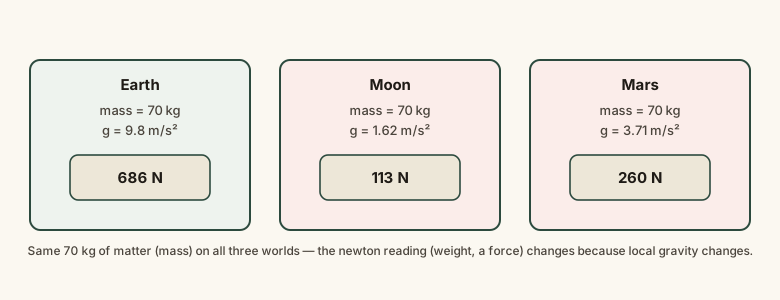
The same 70 kg mass produces different weight-force readings on three worlds
Reading left to right, the mass figure (70 kg) never changes — only the weight figure changes, because each world's gravitational acceleration is different. Mars, with g ≈ 3.71 m/s², sits between Earth and the Moon, which is exactly why mission planners cite it as roughly 38% of Earth gravity when discussing future crewed missions.
Common mistakes
Common Mistakes
✕
Using 'kilograms' and 'weight' as if they mean the same physical quantity in a scientific context.
→ Kilograms measure mass; newtons (or pounds-force) measure weight. In everyday conversation this distinction rarely matters, but in physics problems, mixing them up produces answers off by a factor of gravitational acceleration.
✕
Assuming an object becomes 'lighter' (less massive) simply by leaving Earth's surface.
→ Mass is unaffected by location. What changes when you leave Earth is the local gravitational force acting on that unchanged mass — that's weight, not mass.
✕
Thinking astronauts in orbit are weightless because they're 'too far' from Earth's gravity.
→ At ISS altitude, Earth's gravity is still about 90% of its surface strength. Weightlessness in orbit comes from continuous freefall, not from escaping gravity's reach.
Common misconception
“Mass and weight are just two different units for the same physical property, so 'converting' between kilograms and pounds is the same kind of operation whether you mean mass-kilograms or force-pounds.”
Mass and weight are genuinely different physical quantities — one measures matter, the other measures a gravitational force acting on that matter. Kilograms-to-pounds conversions used in everyday life (cooking, body weight) are actually a mass-to-mass conversion (kilograms to pounds-mass), which works consistently because both people involved are standing on Earth. True weight-force conversions (newtons to pounds-force) are a separate, less commonly needed conversion that only becomes necessary in physics and engineering contexts, or when gravity itself is different, as on another planet.
Quick check
Why would a standard bathroom scale give a wildly wrong mass reading if used on the Moon?
Try it yourself
Calculate weight (a force) from mass and local gravity
Weight (newtons)686
What to do next
What to do next
Next time you read a body-weight figure in kilograms, remember it's technically a mass figure, backed into from a force reading assuming Earth-surface gravity.
Use the calculator above to see how dramatically the same mass's weight changes across Earth, the Moon, and Mars.
When working a physics problem, check whether the quantity given is mass (kg) or weight (N/lbf) before plugging it into a formula — mixing them up is one of the most common intro-physics errors.
If you're curious about everyday kilogram-to-pound conversions specifically, see the dedicated conversion guide linked below — that conversion is mass-to-mass, not the force conversion covered here.
FAQ
FAQ
Related terms
Related terms
Mass
The amount of matter an object contains, measured in kilograms (SI) or pounds-mass; it does not change no matter where the object is located.
Weight
The force gravity exerts on an object's mass, measured in newtons (SI) or pounds-force; it changes depending on the local gravitational acceleration.
Gravitational acceleration (g)
The rate at which gravity accelerates a falling object at a given location, roughly 9.8 m/s² at Earth's surface, 1.62 m/s² on the Moon, and 3.71 m/s² on Mars.
Newton (N)
The SI unit of force, defined as the force needed to accelerate a 1-kilogram mass at 1 meter per second squared — the correct scientific unit for weight.
Two bakers each measure '1 cup of flour' using a measuring cup, but one scoops the cup directly into the flour bag while the other spoons flour in gently and levels it. Will their measurements weigh the same?
This entry was researched from public sources and drafted with AI-assisted tools, then edited — errors are still possible. Spot one, or want a topic covered? Read our disclaimer.
 KnowThis