 KnowThis
Key Takeaways
Key Takeaways
- 1The foot, cubit, and yard all began as body-based units — a foot's length, a forearm's length (cubit), and a stride or arm's reach (yard) — which varied naturally from person to person.
- 2The royal Egyptian cubit was standardized around 2700 BCE using a master granite rod, one of the earliest known examples of a length unit fixed to a reproducible physical standard rather than left to vary by individual.
- 3Every one of these units was eventually redefined against an exact, internationally agreed value — the modern foot and yard trace to the 1959 agreement that fixed the inch at precisely 2.54 cm.
The concept
This pattern — a body-based origin, followed eventually by a fixed physical standard, followed eventually by an exact metric definition — repeats across almost every traditional length unit, not just these three, and reflects a broader historical arc from local convenience toward global reproducibility.
Why was it a real practical problem for ancient builders to use body-based units like the cubit without standardization?
Worked examples
Example 1: Converting a royal cubit to modern centimeters (baseline case)
Example 2: Comparing the royal cubit to the shorter 'common' cubit (edge case / variation)
Example 3: Tracing the modern foot back through its historical redefinitions (real-world / applied case)
Why does the tiny difference between the historical US survey foot and the modern international foot still matter today?
How it works (visual)
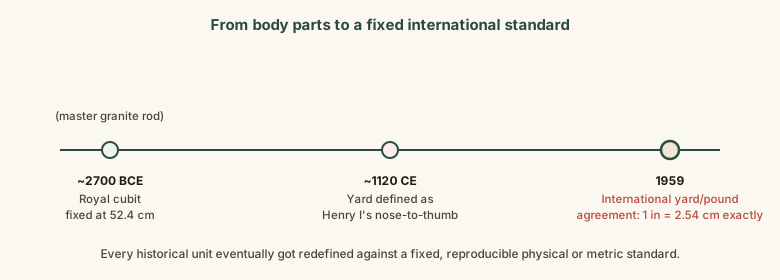
Nearly 4,700 years separate the first standardized cubit rod from the final international fixing of the inch — a slow but steady march from body-based approximation toward an exact, globally reproducible number.
Common mistakes
Common Mistakes
Assuming 'the cubit' refers to one single fixed length across all of history and every civilization.
→ Different eras and regions used different cubit lengths — the Egyptian royal cubit (~52.4 cm) differs from the shorter common cubit (~45 cm) and from cubits used in Mesopotamia or the Hebrew Bible (which vary further still).
Treating the Henry I nose-to-thumb yard origin story as confirmed historical fact.
→ This is a popular, widely repeated legend, but historians treat it as unverified folklore rather than a documented historical record — the yard's actual standardization happened through later, better-documented physical reference standards.
Assuming ancient body-based units were purely approximate with no standardization at all.
→ Some ancient civilizations, especially Egypt, standardized their units against fixed physical rods remarkably early — body-based origin doesn't mean the unit stayed unstandardized forever.
Common misconception
“Body-based measurement units are a primitive relic that modern science has fully replaced with 'objective' standards.”
Even today's most rigorously defined units started somewhere practical and human-scaled — the meter itself was originally defined (1793) as one ten-millionth of the distance from the North Pole to the equator, a choice motivated by wanting a "natural," non-arbitrary reference. Modern units (the meter is now defined via the speed of light) simply moved standardization from a single physical object or body part to something more precisely reproducible — the underlying human impulse to fix a length against something concrete hasn't changed.
Try it yourself
What to do next
What to do next
- Remember that 'the cubit' isn't one fixed length — check which specific cubit (royal, common, biblical) a historical source is using.
- Treat the Henry I yard origin story as folklore, not documented fact, when citing it.
- Note that the modern foot and yard both trace back to the single 1959 international agreement fixing the inch at 2.54 cm.
- Use the calculator above to explore how ancient measurements convert to modern units, and see how close historical builders got to precise standardization.