 KnowThis
Key Takeaways
Key Takeaways
- 1Metric length units (millimeter, centimeter, meter, kilometer) relate to each other by clean powers of ten, so converting within the metric system is just shifting a decimal point.
- 2Imperial length units (inch, foot, yard, mile) use irregular ratios inherited from history — 12 inches per foot, 3 feet per yard, 1,760 yards per mile — that have to be memorized or looked up individually.
- 3The two systems are bridged by a single internationally fixed conversion factor: 1 inch equals exactly 2.54 centimeters, defined by agreement in 1959, not measured.
The concept
Both systems handle length the same underlying way — a base unit scaled up or down — but the scaling logic is what makes one easy to compute with mentally and the other easy to use for everyday human-scale measurement (a foot is genuinely close to a human foot; a meter is not close to any obvious body part).
Why is converting 3.4 meters to centimeters (340 cm) so much simpler than converting 3.4 yards to inches?
Worked examples
Example 1: Converting a length within the metric system (baseline case)
Example 2: Converting a length within the imperial system (edge case / variation)
Example 3: Bridging the two systems (real-world / applied case)
A US manufacturer specifies a part as 12 inches long. A UK engineering firm needs this in millimeters for their CAD software. What's the correct conversion?
How it works (visual)
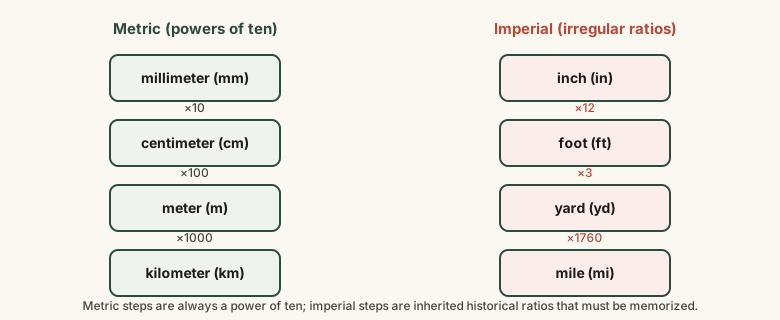
The metric ladder climbs by a consistent ×10 at every rung, which is why metric conversions never require memorization beyond knowing the prefix meanings. The imperial ladder climbs by a different multiplier at every rung — ×12, then ×3, then ×1,760 — each one a separate historical fact that has to be recalled individually.
Common mistakes
Common Mistakes
Assuming the US inch and historical British inch were always identical.
→ They were extremely close but not perfectly identical until the 1959 International Yard and Pound Agreement standardized the inch at exactly 2.54 cm across English-speaking countries.
Forgetting that a metric decimal shift only works within the metric system, and reaching for the same shortcut across systems.
→ Crossing from metric to imperial (or back) always requires the fixed bridge factor (2.54 cm/inch or its reciprocal) — there's no decimal shortcut across systems.
Rounding 2.54 to 2.5 for a 'close enough' quick estimate on a precision task.
→ 2.5 vs. 2.54 is a 1.6% error — fine for a rough mental estimate, but enough to matter on manufactured parts, shipping dimensions, or anything with a tight tolerance.
Common misconception
“The metric system is simply 'more accurate' than the imperial system.”
Accuracy isn't a property of the unit system itself — both systems can measure to arbitrary precision (a ruler marked in inches can have 64ths marked on it, just as a ruler in centimeters can have millimeters marked). The real difference is arithmetic convenience: metric's power-of-ten relationships make conversion and scaling trivial, while imperial's irregular ratios require memorized multipliers. Neither system is more "true" to the actual physical length being measured.
Try it yourself
What to do next
What to do next
- Memorize the one bridge number that matters most: 1 inch = 2.54 cm exactly — every other length conversion between the two systems can be derived from it.
- For metric-to-metric conversions, practice moving the decimal point directly rather than multiplying, since that's the actual mechanism.
- When precision matters (manufacturing, shipping, engineering), use the full 2.54 rather than a rounded 2.5.
- Use the calculator above with your own measurements to build intuition for how the two systems compare at real-world scale.